


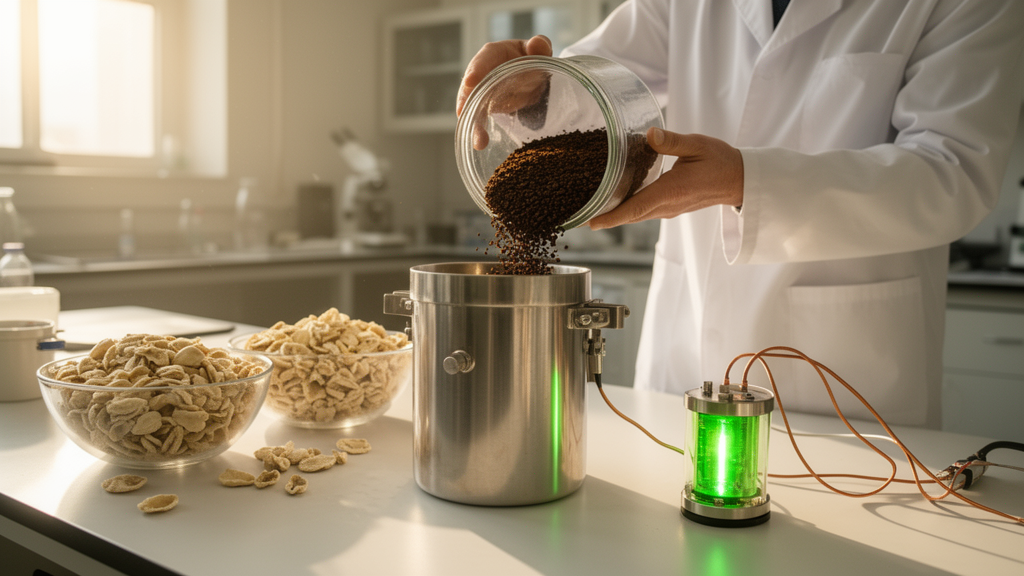
Every cup of coffee leaves behind more than just a caffeine kick. From the pulp stripped away during wet processing to the spent grounds discarded after brewing, the global coffee industry generates staggering volumes of organic waste that are frequently dumped untreated, acidifying soils, fouling waterways, and releasing greenhouse gases into the atmosphere. Now, a comprehensive systematic review published in Frontiers in Sustainability suggests that this overlooked mountain of residue could become one of the most promising feedstocks for the emerging circular bioeconomy, capable of yielding biogas, biochar, liquid biofuels, and organic fertilizers while cutting carbon emissions by nearly 38 percent in optimized scenarios.
The study, led by researchers at Universidad Tecnológica del Perú, represents one of the most rigorous attempts to map the full landscape of coffee-waste valorization technologies. Following the PRISMA 2020 guidelines and the PICO framework, the team screened 472 records from Scopus and Web of Science, ultimately including 116 primary studies published between 2020 and 2025. Each study was scored across six methodological quality criteria, from feedstock characterization to techno-economic scalability, ensuring that only high-quality investigations informed the quantitative comparisons that anchor the review’s conclusions.
The findings reveal a striking pattern in how scientists and engineers are approaching coffee waste. Thermochemical routes, dominated by slow pyrolysis, accounted for 27.6 percent of reported technology occurrences, while biochemical pathways led by anaerobic digestion followed closely at 24.1 percent. Other pyrolysis and activation processes, microbial fermentation, composting and vermicomposting, anaerobic co-digestion, and gasification rounded out the portfolio. These technologies are not competing alternatives but complementary tools, each suited to different fractions of the coffee value chain depending on moisture content, carbon-to-nitrogen ratio, and lignin concentration.
The chemistry behind this division of labor is elegant. Coffee pulp and mucilage, which together make up roughly 94 percent of the solid waste generated during wet processing, are rich in soluble carbohydrates and water, making them ideal substrates for microbial digestion and fermentation. In contrast, coffee husks, parchment, and spent grounds contain higher concentrations of carbon and lignin with lower moisture, properties that favor thermochemical conversion. When these dry, recalcitrant fractions are heated to temperatures between 400 and 700 degrees Celsius under inert atmospheres, they yield biochar with thermal stability, low ash content, and remarkable adsorption capacity, recovering between 25 and 40 percent of the initial dry weight as a stable carbon-rich solid.
The environmental payoff from these conversions is quantifiable and substantial. In one life cycle assessment of instant coffee production, integrating a combined cooling, heating, and power system fueled by spent coffee grounds reduced global warming potential from 27.08 to 16.90 kilograms of carbon dioxide equivalent per kilogram of product, a 37.6 percent reduction compared to the baseline scenario. Meanwhile, decentralized pyrolysis units deployed on farms in Ecuador and Brazil demonstrated reductions in thermal drying energy costs ranging from 20 to 35 percent by replacing subsidized fossil fuels with locally produced biochar. Across multiple studies, anaerobic digestion and composting of organic coffee waste were found to mitigate approximately 435 kilograms of carbon dioxide equivalent emissions per ton of treated material.
Beyond energy and climate benefits, coffee-derived biochar is emerging as a versatile environmental workhorse. Studies documented in the review show that biochar produced from coffee husks can reduce the mobility of textile dyes in contaminated alluvial soils by more than 90 percent, while modified biochar adsorbents have removed herbicides and sulfonamide antibiotics from contaminated water with efficiencies exceeding 85 percent. Some researchers have even pushed the technology into unexpected territory, using hydrothermal carbonization to convert spent grounds into hard carbons for battery anodes, achieving specific capacities of 210 to 280 milliampere-hours per gram and offering a sustainable alternative to mined graphite.
The biological pathways are equally impressive in their diversity. Controlled fermentation of coffee pulp and mucilage under anaerobic conditions has yielded ethanol concentrations of up to 8.8 percent by volume, with conversion efficiencies exceeding 80 percent. Dark fermentation of raw coffee silverskin, the thin tegument that separates from the bean during roasting, has produced biohydrogen and acetate without the need for exogenous inoculum. Even kombucha brewed from coffee husk cascara has been reported as a functional beverage enriched with antioxidant phenolic compounds, opening unexpected opportunities in the nutraceutical market.
However, the review is candid about the barriers that stand between laboratory promise and industrial reality. A quantitative capacity analysis revealed that 58.6 percent of the 116 studies operate at laboratory scale below 5 kilograms per hour, while only 13.8 percent reach demonstration or industrial capacity above 50 kilograms per hour. This concentration at small scales limits the assessment of real-world performance and constrains robust techno-economic evaluation. High implementation costs, feedstock heterogeneity, insufficient rural technical training, and a lack of standardized biofertilizer regulations further compound the challenge, particularly in Latin American and African producing countries where the waste streams are most abundant.
The regulatory landscape adds another layer of complexity. In Colombia, agricultural use of organic and digested products is supported by existing standards such as NTC 5167 and Decree 1287 of 2014, but in Ecuador, the literature identifies a more specific gap regarding small-scale thermochemical recovery, with existing energy conversion provisions geared toward larger facilities and insufficient coverage of pyrolysis systems that rural cooperatives could realistically deploy. The authors emphasize that these regulatory barriers are heterogeneous and jurisdiction-specific rather than a generalized absence of rules, meaning that solutions must be tailored to local contexts rather than imposed uniformly.
Despite these hurdles, the researchers identify integrated biorefineries as the most promising pathway forward. By combining pyrolysis, anaerobic digestion, fermentation, and composting within a single facility, these systems can simultaneously produce biochar, biogas, compost, and adsorbents while maximizing resource recovery and minimizing waste. Exergoeconomic analyses cited in the review reported increases of up to 91 percent in overall process energy efficiency alongside reduced operating costs, pointing toward the economic feasibility of such integrated configurations. As the authors conclude, translating laboratory and pilot-scale achievements into sustainable production-scale applications will require strengthening local technical capacities, fostering institutional coordination, and establishing enabling policy frameworks that recognize coffee waste not as a liability but as a strategic resource for the circular bioeconomy.
Subject of Research: Thermochemical and biochemical conversion technologies for valorizing coffee-industry waste residues
Article Title: Thermochemical and biochemical conversion technologies for the valorization of coffee-industry residues: a systematic review
Article References: Yzquierdo-Alejandría, M., Chomlón-Perales, C. A., & Vásquez–Coronel, J. A. (2026). Thermochemical and biochemical conversion technologies for the valorization of coffee-industry residues: a systematic review. Frontiers in Sustainability, 7, Article 1947220. https://doi.org/10.3389/frsus.2026.1947220
Image Credits: AI Generated
DOI: 10.3389/frsus.2026.1947220
Keywords: coffee waste, pyrolysis, anaerobic digestion, biochar, circular economy, biorefinery, biogas, bioethanol, life cycle assessment, sustainability, agro-industrial residues, waste valorization
Cite Scienmag News
Faith Mcneil. (October 16, 2026). From Coffee Waste to Clean Energy: How Spent Grounds and Husks Could Slash Emissions by Nearly 38 Percent. Scienmag. https://scienmag.com/from-coffee-waste-to-clean-energy-how-spent-grounds-and-husks-could-slash-emissions-by-nearly-38-percent/
Faith Mcneil. "From Coffee Waste to Clean Energy: How Spent Grounds and Husks Could Slash Emissions by Nearly 38 Percent." Scienmag, 16 October 2026, https://scienmag.com/from-coffee-waste-to-clean-energy-how-spent-grounds-and-husks-could-slash-emissions-by-nearly-38-percent/. Accessed 16 October 2026.
Faith Mcneil. "From Coffee Waste to Clean Energy: How Spent Grounds and Husks Could Slash Emissions by Nearly 38 Percent." Scienmag. October 16, 2026. https://scienmag.com/from-coffee-waste-to-clean-energy-how-spent-grounds-and-husks-could-slash-emissions-by-nearly-38-percent/


