


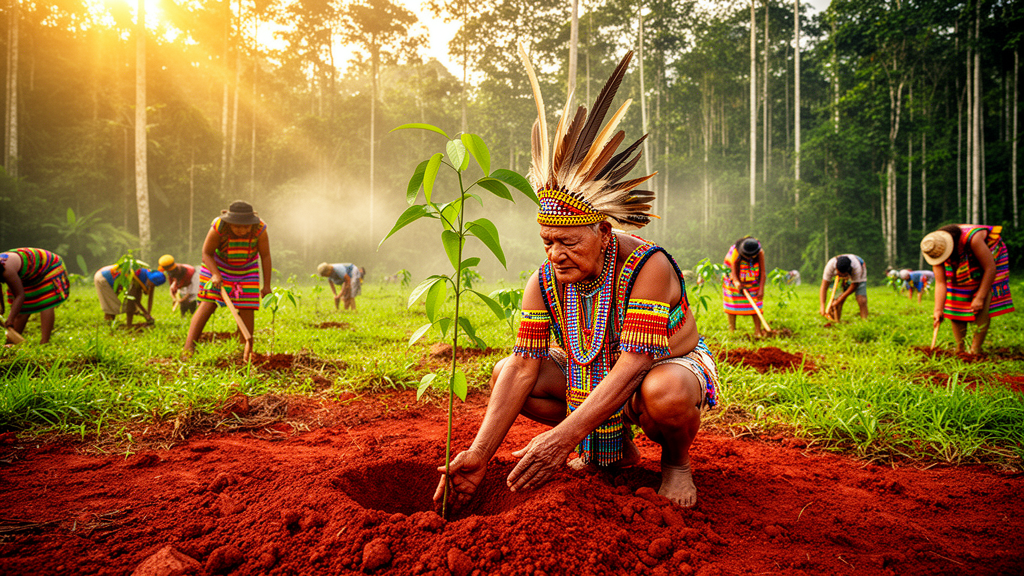
Brazil has quietly written one of the most ambitious experiments in global cultural policy into a draft law now before its National Congress. The proposed National Culture Plan, or Plano Nacional de Cultura, covering 2025 to 2035, does something no major nation has attempted at this scale: it elevates Bem Viver, an Indigenous and traditional worldview centred on harmonious coexistence between humans and nature, from academic debate into the machinery of national cultural management. The move is analysed in a commentary published in the European Journal of Cultural Management and Policy by Jianwei Gong of City University of Macau, who examines the plan’s most unconventional component, Axis 7, titled Culture, Bem Viver and Climate Action.
The legislative vehicle is Projeto de Lei n° 5.894, submitted in 2025 by President Luiz Inácio Lula da Silva. It replaces a previous national plan for 2010 to 2020 that lingered on through successive extensions and suffered severe institutional disruption after the 2016 impeachment of President Dilma Rousseff. The intervening years were bruising for both culture and climate policy: during the Bolsonaro administration from 2019 to 2022, the Ministry of Culture was downgraded to a secretariat, its budget shrank, and federal climate action was largely absent. The new plan was drafted under Culture Minister Margareth Menezes, an artist and cultural manager from Bahia and the first Black woman to hold the post, and shaped through multiple rounds of public consultation, including the 4th National Culture Conference.
Constitutionally anchored in Article 215, Paragraph 3, and Article 216-A of the Federal Constitution, the bill declares culture a core element of democracy, inclusion, justice, and sustainable development. The plan is organised into eight strategic axes spanning social participation, heritage, training, infrastructure, the creative and solidary economy, digital rights, and climate. Axis 7 is the outlier. According to Article 5, Item VII, of the bill, it commits the state to protecting, valuing and fostering the cultures and knowledge of traditional peoples and communities, Indigenous peoples, and communities of the African cultural matrix, including Quilombola communities, explicitly framing that protection as a strategy for resilience, the promotion of Bem Viver, and climate action. A second clause calls for the adaptation, mitigation and recovery of the cultural sector itself when disasters and environmental or health emergencies strike, in coordination with cultural agents, groups, communities and spaces.
The conceptual lineage of Bem Viver, known in Spanish-speaking contexts as Buen Vivir, traces back to the Quechua notion of Sumak Kawsay, or Plentiful Living, and has already been written into the national constitutions of Bolivia and Ecuador. Scholars such as Alcantara and Sampaio have argued that it offers a viable alternative to conventional development paradigms, a reflective counterpoint to consumerism and environmental degradation. What makes the Brazilian provision technically novel is its translation of that cosmology into operational cultural management. Clause (a) treats the documentation and reinforcement of traditional knowledge not as heritage preservation in the museum sense but as an active instrument for helping communities confront climate-related challenges. Clause (b) extends cultural policy inward, treating cultural institutions and practices as assets that must themselves be made disaster-resilient.
The plan’s supporting architecture reinforces this cross-sectoral ambition. Article 3 lists guiding principles that include the valorisation of traditional knowledge, techniques and practices, the promotion of cross-sectoral integration, and an emphasis on territorialisation. Article 4 requires policy to account for territoriality and intersectionality within the Sistema Nacional de Cultura, the institutional mechanism coordinating federal, state and municipal levels. In practical terms, cultural programmes may need to be designed with greater flexibility across regions and social groups, and cultural managers may find their remit expanding well beyond entertainment and heritage display into environmental adaptation. Gong argues this represents an attempt to dismantle the boundaries separating cultural policy from other domains of public policy, reorienting the field toward broader questions of human–nature relations.
The practical difficulties, however, are formidable. Brazil is a federation, and implementation depends on coordination across three tiers of government. Budget allocation under resource constraints, the development of unified indicators, and the meaningful participation of traditional communities all pose challenges. There is also an inherent tension in tempo: documenting and promoting traditional knowledge demands sustained fieldwork and community trust, while climate disasters arrive suddenly and demand rapid response from the cultural sector. Balancing those two rhythms is not straightforward. Measurement compounds the problem, because culture’s contribution to resilience is indirect and difficult to quantify compared with environmental or economic indicators, raising the risk of a gap between the ambition of the policy text and its on-the-ground realisation.
Independent research tempers expectations further. Studies of Bem Viver as a framework for reconfiguring Brazilian cities note that existing urban models, shaped by capitalist and colonial legacies, struggle to accommodate the needs of diverse communities. An empirical study of family farmers in the northern Amazon region of Mato Grosso found that sustainable development and Bem Viver are understood locally as a dialectical, continuously constructed process, underscoring the importance of collective participation and traditional knowledge, while also documenting practical obstacles such as large-scale agricultural expansion in isolated rural areas. Work on bioeconomy and socio-biodiversity argues that combining traditional practices with sustainable use may offer pathways toward Bem Viver, but that socio-environmental crises in a changing climate must still be addressed directly. The collective lesson is that culture can foster community identity and adaptive capacity, yet if reliance falls primarily on the cultural dimension while infrastructure, technical support and economic incentives are neglected, the actual impact may prove limited.
Comparative context sharpens the picture. European cultural management, exemplified by Germany, tends toward institutionalisation and legislative safeguards, advancing climate goals through structured funding schemes and established evaluation processes. Germany’s nationwide Culture4Climate initiative engages the entire cultural sector in climate protection through frameworks supported by federal bodies and the German Cultural Council, while at the European Union level the New European Bauhaus integrates culture, design and heritage with the European Green Deal through coordinated policy instruments. These approaches are stable and predictable, but they rarely articulate climate concerns through Indigenous cosmologies or community-based traditional knowledge as foundational policy principles. Brazil’s model, by contrast, places greater weight on community participation and the living utilisation of traditional knowledge, gaining territorial adaptability at the cost of federal coordination and dispersed resources. A systematic review of Bem Viver applications indicates the concept’s local uptake is expanding but remains dominated by confirmatory studies and critical dialogue, a tension between policy practice and theory that is less pronounced in institutionalised European settings.
Asian comparisons are harder to draw given the region’s diversity, but two cases illustrate the range. In South Korea, climate initiatives affecting the cultural sector have been embedded within broader national development agendas: the Korean Green New Deal supported energy-efficiency upgrades in museums, libraries and other public cultural facilities, situating them within wider technological and environmental transformation programmes. In Japan, the Satoyama Initiative combines technological and infrastructural means with traditional ecological knowledge, integrating cultural landscapes and community-based practices into sustainability frameworks. Both models can mobilise resources swiftly, yet they rely more heavily on technological or infrastructural means and less frequently elevate traditional knowledge to the status of a strategic axis in national cultural policy. Whether Indigenous or traditional worldviews in other Asian contexts could offer comparable resources for Brazil-style integration remains an open question.
Taken together, the three models reflect distinct paths: Europe leans toward institutional stability, Asia toward developmental integration, and Brazil is experimenting with a cross-sectoral approach centred on communities and traditional knowledge. Gong’s assessment is deliberately balanced. Bem Viver has long circulated in Brazilian discourse, so its arrival in cultural policy is unsurprising in itself, and the normative value of the idea deserves acknowledgement. But whether the advocacy can genuinely assist in addressing climate change, especially when set against Europe’s institutionalised machinery or Asia’s development-oriented frameworks, is a question that qualitative research will take time to answer. Axis 7 functions, in effect, as a policy laboratory for gauging how far cultural policy can contribute to ecological resilience: its conceptual value has been demonstrated, its instrumental efficacy has not. The outcome will hinge on the unglamorous details of resources, intergovernmental coordination and evaluation criteria that follow in the plan’s implementation regulations, and on whether the communities whose knowledge the law celebrates are given a genuine share in directing it.
Subject of Research: Integration of the Indigenous Bem Viver worldview into Brazil's National Culture Plan as a climate resilience strategy
Article Title: Cultural knowledge as climate resilience: examining the integration of Bem Viver into Brazil’s national culture plan (2025–2035)
Article References: Cultural knowledge as climate resilience: examining the integration of Bem Viver into Brazil’s national culture plan (2025–2035). (n.d.). https://doi.org/10.3389/ejcmp.2026.16928
Image Credits: AI Generated
Keywords: Bem Viver, Brazil, cultural policy, climate resilience, Indigenous knowledge, National Culture Plan, Plano Nacional de Cultura, traditional communities, cultural management, sustainable development, Axis 7, policy integration
Cite Scienmag News
Sloane Callahan. (October 16, 2026). Brazil Bets on Indigenous Wisdom to Shield Culture from Climate Chaos. Scienmag. https://scienmag.com/brazil-bets-on-indigenous-wisdom-to-shield-culture-from-climate-chaos/
Sloane Callahan. "Brazil Bets on Indigenous Wisdom to Shield Culture from Climate Chaos." Scienmag, 16 October 2026, https://scienmag.com/brazil-bets-on-indigenous-wisdom-to-shield-culture-from-climate-chaos/. Accessed 16 October 2026.
Sloane Callahan. "Brazil Bets on Indigenous Wisdom to Shield Culture from Climate Chaos." Scienmag. October 16, 2026. https://scienmag.com/brazil-bets-on-indigenous-wisdom-to-shield-culture-from-climate-chaos/


