


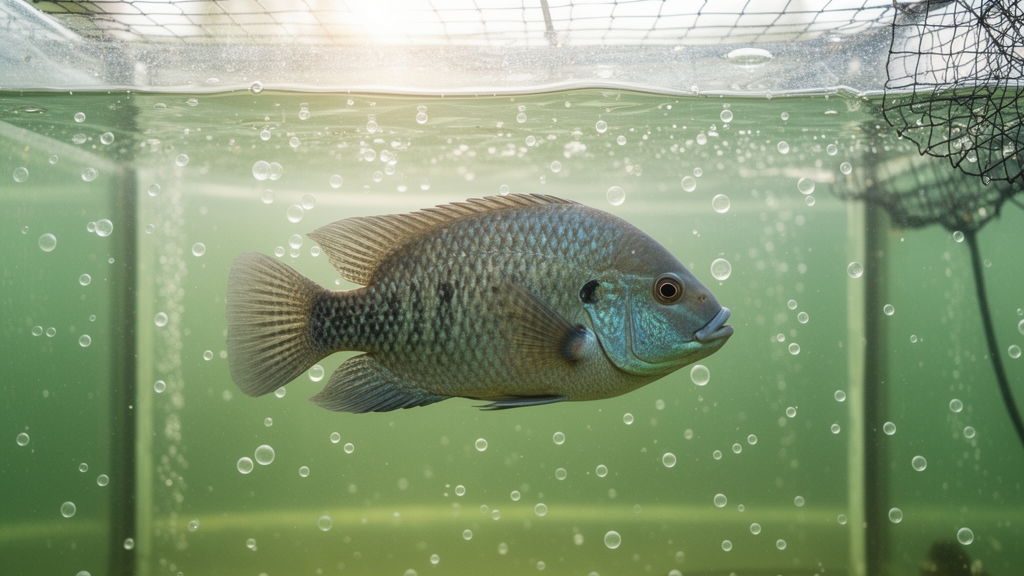
A new critical review warns that the tiny plastic particles drifting through the world’s fish farms may be quietly amplifying one of aquaculture’s most persistent chemical threats. Writing in Environmental Monitoring and Assessment, researchers from Aksaray University and Cukurova University in Turkey synthesize the evidence that microplastics act as carriers, or vectors, for synthetic pyrethroids, a widely used class of neurotoxic insecticides, and that this partnership may reshape how toxins accumulate in farmed fish and move up the food chain.
Synthetic pyrethroids are synthetic derivatives of pyrethrins, the natural insecticides found in chrysanthemum flowers, and they are prized in agriculture and aquaculture for their potency against pests and relatively short environmental persistence. Yet they are also highly lipophilic, meaning they dissolve readily into fats rather than water, and they act on the nervous systems of fish by disrupting sodium channels in nerve membranes. Because of their chemical affinity for organic surfaces, pyrethroids bind tightly to plastic debris, and the review argues that this binding turns microplastics into mobile reservoirs of pesticide contamination within aquaculture systems.
The physicochemical mechanics of this partnership hinge on sorption and desorption dynamics, the processes by which chemicals attach to and detach from particle surfaces. Polymer crystallinity, or the degree to which plastic chains are ordered rather than amorphous, governs how much chemical a given particle can hold. Weathering, the combined effect of sunlight, abrasion, and microbial activity, alters surface chemistry and roughness, often increasing the available binding sites over time. Shifting water parameters such as salinity, pH, and temperature further modulate how strongly pyrethroids cling to plastic or release back into the water column, meaning that vector efficiency is not a fixed property but a moving target that responds to the environment.
Once contaminated particles are ingested, the classic assumption has been the so-called Trojan Horse effect, in which microplastics smuggle their chemical cargo deep into animal tissues and release it under digestive conditions, amplifying internal exposure beyond what the water alone would deliver. The review challenges this paradigm, pointing out that the picture is more nuanced than the label suggests. Some studies indicate that microplastics can dilute rather than concentrate chemical exposure under certain conditions, and the authors emphasize significant gaps in commercially relevant in vitro digestion models that attempt to simulate what actually happens inside a fish gut. Without better models, the true magnitude of the vector effect remains uncertain.
What is clearer is that vulnerability is not evenly distributed across farmed species. Benthic organisms, those living on or near the pond bottom, and species that are consumed whole rather than filleted face disproportionate exposure because they ingest particles directly from sediments or from the water column without the partial filtering that larger, selectively feeding animals perform. Tissue-specific bioaccumulation patterns suggest that pyrethroids carried on plastic surfaces may concentrate in particular organs rather than distributing uniformly, complicating both toxicological assessment and food safety monitoring.
The review also dissects how different aquaculture architectures shape exposure pathways. Recirculating aquaculture systems, or RAS, which reuse water through mechanical and biological filtration, concentrate particles and dissolved chemicals in ways that open-sea cages do not, since the latter rely on natural currents to dilute and disperse contaminants. Semi-intensive ponds, which blend natural productivity with supplemental feeding, sit somewhere in between, with hydrodynamics driven largely by wind, aeration, and fish movement rather than engineered flow. Each configuration produces a distinct profile of particle residence time, chemical partitioning, and trophic structure, meaning that risk cannot be generalized across the industry.
Trophic transfer, the movement of contaminants through food webs as predators consume prey, adds another layer of concern. When smaller organisms ingest contaminated particles and are then eaten by larger fish, the associated pyrethroids can move upward through the food chain, potentially reaching concentrations that exceed what direct water exposure alone would produce. The review highlights evidence that this pathway matters in aquaculture settings, particularly where natural forage organisms supplement formulated feeds, and it underscores the vulnerability of whole-consumed species whose digestive tracts, and therefore particle burdens, are eaten along with the muscle tissue.
The toxicological consequences compound across multiple biological systems. Pyrethroids are neurotoxic, and co-exposure with microplastics has been linked in experimental studies to heightened neuro-stress, disrupted behavior, and altered neurotransmitter activity in fish. Beyond the nervous system, the combination appears to compromise immune function, leaving animals more susceptible to disease, and to disturb gut microbiota, the microbial community that supports digestion and immune regulation. These sublethal effects translate directly into economic consequences for farm performance, including reduced growth rates, elevated mortality, and increased treatment costs, all of which erode the margins on which aquaculture operations depend.
Against this backdrop, the review identifies a significant regulatory blind spot. Maximum Residue Limits, or MRLs, the legal ceilings on pesticide residues in food products, are typically set for individual chemicals assessed in isolation, without accounting for the possibility that microplastic carriage may alter bioavailability, tissue distribution, or persistence of the residue in edible tissue. The authors argue that current frameworks do not capture the synergistic threat posed by the convergence of plastic pollution and routine pyrethroid application, leaving a gap between what regulations assume and what aquaculture ecosystems actually deliver to the consumer.
Looking forward, the review proposes a set of mitigation strategies aimed at closing this gap. Targeted green pharmacology, the development of plant-derived or biologically based alternatives to synthetic pesticides, could reduce the chemical burden entering farm systems in the first place, and the authors point to growing evidence that certain botanical feed additives can help fish cope with xenobiotic stress. Advanced filtration technologies, including improved mechanical separation and possibly biofilm-based capture, offer engineering routes to reduce particle loads before they accumulate. Ultimately, the authors call for a holistic paradigm shift in aquaculture risk assessment, one that treats microplastics and pesticides not as separate problems but as an interacting system whose combined behavior determines the real exposure profile of farmed fish and, by extension, the safety of the seafood that reaches the market.
Subject of Research: Microplastics as vectors for synthetic pyrethroid pesticides in aquaculture ecosystems
Article Title: The accelerating role of microplastics as vectors for synthetic pyrethroids: a critical review of bioaccumulation and trophic transfer in aquaculture ecosystems
Article References: The accelerating role of microplastics as vectors for synthetic pyrethroids: a critical review of bioaccumulation and trophic transfer in aquaculture ecosystems. (n.d.). https://doi.org/10.1007/s10661-026-15850-9
Image Credits: AI Generated
DOI: 10.1007/s10661-026-15850-9
Keywords: microplastics, synthetic pyrethroids, aquaculture, bioaccumulation, trophic transfer, Trojan horse effect, food safety, neurotoxicity, pesticide vectors, recirculating aquaculture systems, maximum residue limits, green pharmacology
Cite Scienmag News
Violet Maxwell. (October 16, 2026). Microplastics Are Supercharging Toxic Pesticides in Farmed Fish, Review Warns. Scienmag. https://scienmag.com/microplastics-are-supercharging-toxic-pesticides-in-farmed-fish-review-warns/
Violet Maxwell. "Microplastics Are Supercharging Toxic Pesticides in Farmed Fish, Review Warns." Scienmag, 16 October 2026, https://scienmag.com/microplastics-are-supercharging-toxic-pesticides-in-farmed-fish-review-warns/. Accessed 16 October 2026.
Violet Maxwell. "Microplastics Are Supercharging Toxic Pesticides in Farmed Fish, Review Warns." Scienmag. October 16, 2026. https://scienmag.com/microplastics-are-supercharging-toxic-pesticides-in-farmed-fish-review-warns/


