


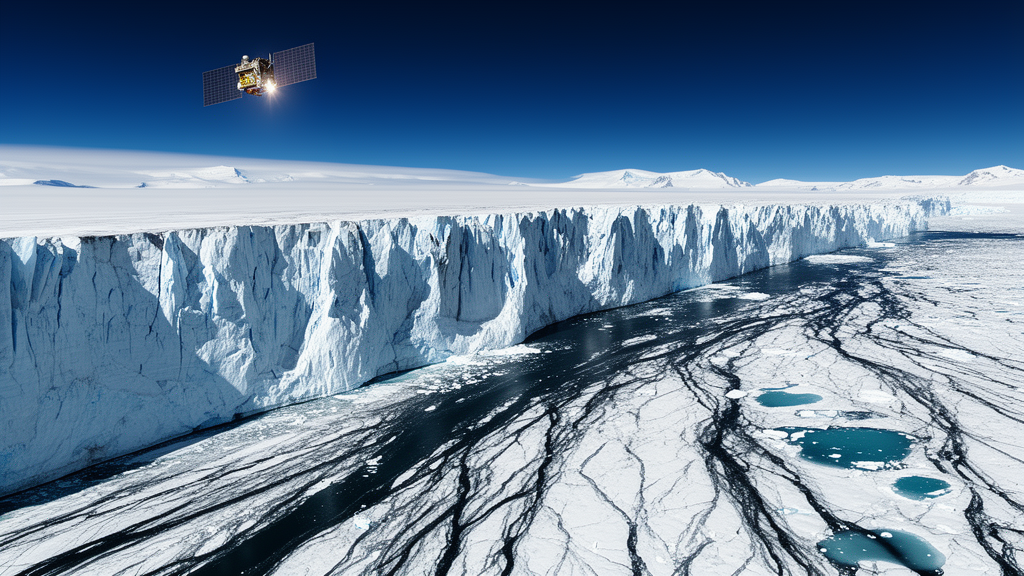
The towering ice cliffs that fringe the Greenland and Antarctic ice sheets have long been one of the most contested unknowns in sea level science. A new study led by the Woods Hole Oceanographic Institution (WHOI), published in Science, delivers the most comprehensive observational analysis yet of these frozen ramparts, using more than 15,000 satellite measurements to test a controversial theory that could determine how quickly the world’s ice sheets unravel in a warming climate.
The theory at the center of the new analysis, marine ice-cliff instability, rests on a simple mechanical premise. Ice is far weaker than rock, and when a glacier terminus rises more than roughly one hundred meters above the waterline, the stresses acting on that exposed face can approach the material strength of the ice itself. If the cliff fails, calving exposes an even taller face behind it, which in turn fails again, creating a runaway cycle in which a marine-terminating glacier could disintegrate far faster than conventional calving laws would allow. Because no one has ever watched this process unfold at a major ice-sheet margin, modelers have been left to argue from physics, laboratory analogs, and sparse case studies about whether such runaway collapse is a realistic possibility or a theoretical curiosity. That disagreement matters enormously: some of the highest published sea level projections for this century depend on parameterizations that allow cliff failure to accelerate ice loss from vulnerable basins such as Thwaites Glacier in West Antarctica.
Satellite laser altimetry, the measurement technique underpinning the survey, works by emitting short pulses of laser light from an orbiting instrument and precisely timing the round trip to the ice surface. Because the speed of light is known with great precision, the travel time translates directly into distance, and repeated passes over the same ground reveal how surface elevation changes through time. Applied to ice cliffs, this approach allows researchers to map where the ice surface meets the ocean, quantify how tall the exposed faces are, and track how those geometries evolve as glaciers thin and retreat. Compiling 15,330 individual observations into a single consistent dataset is what distinguishes this effort from earlier work, which typically relied on detailed studies of a handful of well-known glaciers or on idealized computer simulations whose assumptions the new measurements can now be checked against.
The comparison between cliff height, ice thickness, water depth, crevassing, and calving rates across thousands of locations gives scientists a kind of natural experiment. If marine ice-cliff instability operated unchecked wherever cliffs grew tall, the observational signature would be straightforward: the tallest cliffs should show the fastest retreat regardless of other conditions. Instead, the study found a more nuanced picture. Tall cliffs do sometimes fail rapidly, confirming that the mechanical processes described by the theory are real and observable in nature. But the data also show that glaciers frequently thin and retreat into settings where conditions become less favorable for continued rapid loss, allowing the ice margin to re-stabilize rather than collapse without bound. In other words, the feedback loop that drives instability can be interrupted by the very retreat it causes, as glaciers move into shallower water, narrower channels, or regions where the ice is thicker and better buttressed.
This finding helps explain a persistent tension in the sea level literature. Earlier modeling studies that included aggressive cliff-failure parameterizations produced dramatic scenarios, sometimes projecting several meters of sea level rise within a few centuries, while other models that treated cliffs more conservatively yielded far smaller contributions. The new observational dataset offers a way to adjudicate between these divergent assumptions. By identifying the specific conditions that drive rapid ice-cliff retreat and those that arrest it, the study gives modelers empirical targets to reproduce, narrowing the range of plausible futures that climate projections must span. Reducing that uncertainty is not an academic exercise; the difference between high and low ice-sheet scenarios translates into very different timelines for coastal adaptation decisions, from raising seawalls to relocating infrastructure.
The stakes are grounded in a measurable trend. Global mean sea level has climbed more than eight inches since 1880, and the pace has accelerated in recent decades as warming ocean water expands and land ice melts. Ice sheets are the largest potential contributor to future rise, holding enough frozen water to raise oceans by tens of meters over long timescales, and their behavior at marine margins is the key control on how quickly that reservoir is tapped. Where glaciers terminate in deep water, warm ocean currents can erode the ice from below, thinning the front and steepening the cliff. Where bedrock rises toward the interior, retreat can slow as the ice grounds in shallower water. Mapping which of these configurations dominates around the ice-sheet periphery is precisely what a global survey of cliff characteristics makes possible.
The researchers emphasize that the observational record, while now the most comprehensive available, is still short relative to the timescales over which ice sheets evolve. Every example of rapid cliff retreat documented so far proved to be short-lived, with the affected glaciers eventually re-stabilizing. Whether that pattern holds as continued warming pushes ice sheets into configurations they have not occupied in the historical record remains an open question, and one the study’s authors are careful not to overclaim. The value of the dataset lies partly in establishing a baseline: as satellites continue to observe the ice margins in coming years and decades, future measurements can be compared against this survey to detect whether the frequency, height, or persistence of unstable cliffs is changing.
The work also illustrates a broader shift in how ice-sheet science is conducted. A decade ago, debates about cliff instability were fought largely between competing model configurations, each with plausible but untested assumptions about how ice fails. Building a global observational benchmark changes the terms of that debate, requiring any credible projection to be consistent with what satellites actually see at the ice edge. The approach complements ongoing field campaigns and autonomous measurements at individual glaciers, which provide fine-grained process detail, by supplying the statistical breadth needed to distinguish general behavior from local idiosyncrasy. Funding from the National Science Foundation, NASA, the U.S. Department of Energy, the Natural Environment Research Council, and the DOMINOS project under the International Thwaites Glacier Collaboration reflects the multi-agency recognition that constraining sea level risk requires exactly this kind of sustained, large-scale observational investment.
For coastal planners and policymakers, the practical message of the study is one of tempered urgency. The worst-case runaway scenarios that have loomed largest in public discussion are not supported as an inevitability, since the observed record shows natural braking mechanisms at work. Yet the confirmation that tall cliffs can and do fail rapidly, and that ice sheets can lose mass in sudden pulses when conditions align, argues against complacency. The most defensible reading of the new evidence is that marine ice-cliff instability belongs in the family of processes models must represent, but governed by identifiable physical conditions rather than as an unconditional runaway. As the observational record lengthens and the dataset is extended, the conditions that separate rapid retreat from re-stabilization should come into sharper focus, steadily converting one of glaciology’s most contentious uncertainties into a quantifiable component of sea level forecasting.
Subject of Research: Marine ice-cliff instability and ice-sheet stability assessed through global satellite observations of ice cliffs
Article Title: Global survey sheds light on the forces shaping ice-sheet stability
Article References: Global survey sheds light on the forces shaping ice-sheet stability. (n.d.). Original publication
Image Credits: AI Generated
DOI: Not provided
Keywords: ice cliffs, marine ice-cliff instability, ice sheets, sea level rise, satellite laser altimetry, glacier retreat, calving, Antarctic Peninsula, Greenland, ice-sheet models, Woods Hole Oceanographic Institution, climate change
Cite Scienmag News
Grant Pearson. (October 16, 2026). Satellite survey of 15,000 ice cliffs tests theory behind rapid ice-sheet loss. Scienmag. https://scienmag.com/satellite-survey-of-15000-ice-cliffs-tests-theory-behind-rapid-ice-sheet-loss/
Grant Pearson. "Satellite survey of 15,000 ice cliffs tests theory behind rapid ice-sheet loss." Scienmag, 16 October 2026, https://scienmag.com/satellite-survey-of-15000-ice-cliffs-tests-theory-behind-rapid-ice-sheet-loss/. Accessed 16 October 2026.
Grant Pearson. "Satellite survey of 15,000 ice cliffs tests theory behind rapid ice-sheet loss." Scienmag. October 16, 2026. https://scienmag.com/satellite-survey-of-15000-ice-cliffs-tests-theory-behind-rapid-ice-sheet-loss/


