


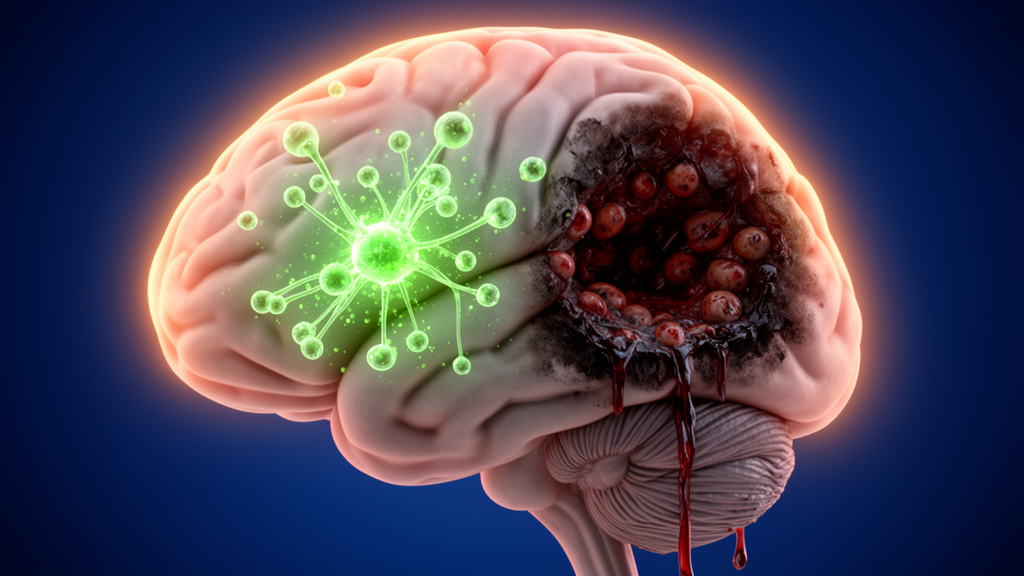
When doctors restore blood flow to a stroke patient’s brain, they are racing against a paradox. Reperfusion saves the penumbra, the salvageable tissue surrounding the infarct core, yet the returning oxygen itself ignites a secondary wave of destruction known as cerebral ischemia-reperfusion injury, or CIRI. Now a team of neurosurgeons and biochemists in China has shown that one of the most notorious gases in the laboratory, hydrogen sulfide, can shield neurons from this paradoxical damage by switching off a violent form of programmed cell death called necroptosis. The findings, published in Frontiers in Molecular Biosciences, offer a fresh molecular target for treating ischemic stroke, the cause of 80 to 85 percent of all strokes worldwide.
Necroptosis is not the quiet, tidy demolition of apoptosis. It is programmed necrosis, a caspase-independent form of cell demise in which organelles swell and the plasma membrane ruptures outright, spilling inflammatory contents into the surrounding brain tissue. The pathway is driven by a necrosome complex assembled from three proteins: receptor-interacting protein kinase-1 (RIPK1), receptor-interacting protein kinase-3 (RIPK3), and mixed lineage kinase domain-like protein (MLKL). When RIPK1 and RIPK3 phosphorylate MLKL, the executioner protein migrates to the membrane and tears it apart. Because necroptosis is triggered by energy depletion, oxidative stress, and reactive oxygen species (ROS) accumulation, it is tailor-made for the conditions that prevail during reperfusion injury.
Hydrogen sulfide has long been recognized as an endogenous gaseous signaling molecule with neuroprotective, antioxidative, anti-inflammatory, and anti-apoptotic roles in the central nervous system. Sodium hydrosulfide (NaHS), a stable exogenous H2S donor, releases the gas continuously both in vivo and in vitro. Yet the extent to which H2S’s neuroprotective effects depend on regulating neuronal necroptosis remained inadequately explored, and systematic biochemical and morphological evidence linking the gas to the necroptotic signaling pathway during ischemia-reperfusion injury was scarce. The new study set out to close that gap.
In vitro, the researchers established an oxygen-glucose deprivation (OGD) model using SH-SY5Y neuronal cells to simulate ischemia-reperfusion injury. Cell viability declined in a time-dependent fashion, falling to 78.6 percent after 2 hours of OGD, 57.6 percent after 4 hours, 39.3 percent after 6 hours, and 29.0 percent after 8 hours. Alongside this decline, the necroptotic rate rose sharply, ROS overaccumulated, mitochondrial membrane potential collapsed, and the expression levels of RIPK1, RIPK3, and MLKL climbed. Pretreatment with moderate doses of NaHS significantly enhanced cell viability, mitigated ROS overproduction, restored mitochondrial membrane potential, and inhibited OGD-induced neuronal necroptosis. Necrostatin-1 (Nec-1), a specific pharmacological inhibitor of RIPK1 kinase activity, produced comparable protection, and both agents effectively suppressed activation of the RIPK1-mediated signaling pathway.
The oxidative arm of the mechanism proved equally important. Necroptosis is often associated with excessive ROS generation, and previous research has shown that necroptosis itself generates substantial ROS, which in turn stimulates further RIPK1 expression, creating a self-amplifying loop of cellular damage. In the new experiments, the potent ROS scavenger N-acetylcysteine (NAC) increased cell survival from 50.65 percent to 80.57 percent after OGD, mirroring the effect of NaHS, which raised survival to 74.30 percent. NaHS and Nec-1 both significantly reduced ROS production and reversed the OGD-induced decline in mitochondrial membrane potential, indicating that OGD escalates ROS in a concentration-dependent manner and that H2S interrupts the vicious cycle at its source.
To translate these cellular findings into a living brain, the team established a mouse model of transient middle cerebral artery occlusion followed by reperfusion (MCAO/R). Two hours of filament-induced ischemia produced severe neurological dysfunction, cerebral hypoperfusion, brain edema, extensive infarction, and neuronal ultrastructural damage. Mice treated with NaHS or Nec-1 showed significantly improved neurological deficit scores on both the modified Bederson and Zea-Longa scales by the third and sixth days after modeling. Laser speckle contrast imaging revealed that both interventions markedly increased red and yellow perfusion signals within the ipsilateral infarct core, indicating preserved microcirculatory blood flow. Brain water content dropped significantly in both treatment groups, and TTC staining showed that infarct volume fell from 38.29 percent of the hemisphere in untreated animals to 27.55 percent with NaHS and 23.82 percent with Nec-1.
Transmission electron microscopy provided striking morphological confirmation. In sham-operated mice, neuronal nuclei displayed regular contours with evenly distributed chromatin, structurally intact mitochondria with clear cristae, and well-organized endoplasmic reticulum. In the MCAO/R group, neurons exhibited extensive chromatin condensation, pronounced mitochondrial swelling with disrupted cristae, disintegrated endoplasmic reticulum, and widespread cytoplasmic vacuolization, the hallmark ultrastructural signature of necrotic cell death. Remarkably, neuronal injuries affecting nuclei, mitochondria, and endoplasmic reticulum were significantly mitigated in both the NaHS and Nec-1 groups, where organelle structural integrity was substantially restored. Western blotting confirmed that both treatments downregulated RIPK1 and RIPK3 expression in the injured cortex, demonstrating that exogenous H2S inhibited MCAO/R-induced necroptosis by suppressing the RIPK1-RIPK3 signaling pathway in vivo.
The convergence of NaHS and Nec-1 on the same molecular target is the study’s most compelling technical achievement. Because Nec-1 reduces RIPK1 kinase activity by inhibiting RIPK1 serine phosphorylation at multiple residues, the fact that NaHS produced equivalent protection suggests that H2S directly targets RIPK1 and ROS, thereby attenuating RIPK1-mediated necroptosis. This interference disrupts subsequent signaling cascades by decreasing RIPK3 phosphorylation, inhibiting MLKL activation, and impeding necrosome complex assembly, ultimately halting necroptotic cell demise. The authors note that the direct interaction between H2S and downstream molecules of RIPK1, including RIPK3 or MLKL, was not thoroughly explored, and that H2S may also exert direct inhibitory effects on calcium influx and facilitate restoration of mitochondrial oxidative stress damage, pathways warranting further exploration.
Several limitations temper the translational enthusiasm. All phenotypic and mechanistic validations were performed in cell models and animal paradigms without verification in clinical tissue samples. The in vivo data were acquired from preliminary exploratory experiments with a relatively small sample size of three animals per group, which may undermine statistical power. The lack of gene knockout validation limits the robustness of the causal mechanistic evidence. Moreover, the study adopted a preconditioning strategy, administering H2S before ischemic injury, which cannot fully recapitulate the pathological characteristics of clinical ischemic stroke. Subsequent studies will focus on post-ischemic H2S administration to better simulate clinical scenarios and improve translational relevance.
Beyond the experimental constraints, the clinical transformation of H2S-based therapy faces inherent challenges. Direct inhalation of gaseous H2S is constrained by safety hazards and poor concentration controllability, while H2S-releasing donors serve as a more feasible alternative. H2S possesses a narrow therapeutic window and potential off-target adverse effects that cannot be overlooked in clinical practice, and heterogeneous therapeutic responses among individual patients may arise from variations in genetic background, metabolic status, and comorbidities. Nevertheless, the findings provide direct in vitro and in vivo evidence that H2S plays a significant role in inhibiting RIPK1-dependent necroptosis in the pathogenesis of cerebral ischemia-reperfusion injury, offering a novel theoretical basis for the clinical management of ischemic stroke and highlighting the potential of H2S-based interventions as a promising therapeutic agent for stroke treatment.
Subject of Research: Hydrogen sulfide protects against cerebral ischemia/reperfusion injury by inhibiting RIPK1-mediated neuronal necroptosis and ROS overaccumulation.
Article Title: Exogenous hydrogen sulfide alleviates cerebral ischemia/reperfusion injury via inhibiting RIPK1-mediated neuronal necroptosis and ROS overaccumulation
Article References: Huang, C., Shang, H., Fang, Z., Zhu, L., Chen, C., & Zang, Y. (2026). Exogenous hydrogen sulfide alleviates cerebral ischemia/reperfusion injury via inhibiting RIPK1-mediated neuronal necroptosis and ROS overaccumulation. Frontiers in Molecular Biosciences, 13, Article 1968646. https://doi.org/10.3389/fmolb.2026.1968646
Image Credits: AI Generated
DOI: 10.3389/fmolb.2026.1968646
Keywords: hydrogen sulfide, stroke, necroptosis, RIPK1, ROS, cerebral ischemia, neuroprotection, Exogenous, hydrogen, sulfide, alleviates, cerebral
Cite Scienmag News
Cassandra Pierce. (October 16, 2026). Hydrogen Sulfide Shields the Brain From Stroke Damage by Halting a Violent Form of Cell Death. Scienmag. https://scienmag.com/hydrogen-sulfide-shields-the-brain-from-stroke-damage-by-halting-a-violent-form-of-cell-death/
Cassandra Pierce. "Hydrogen Sulfide Shields the Brain From Stroke Damage by Halting a Violent Form of Cell Death." Scienmag, 16 October 2026, https://scienmag.com/hydrogen-sulfide-shields-the-brain-from-stroke-damage-by-halting-a-violent-form-of-cell-death/. Accessed 16 October 2026.
Cassandra Pierce. "Hydrogen Sulfide Shields the Brain From Stroke Damage by Halting a Violent Form of Cell Death." Scienmag. October 16, 2026. https://scienmag.com/hydrogen-sulfide-shields-the-brain-from-stroke-damage-by-halting-a-violent-form-of-cell-death/


