


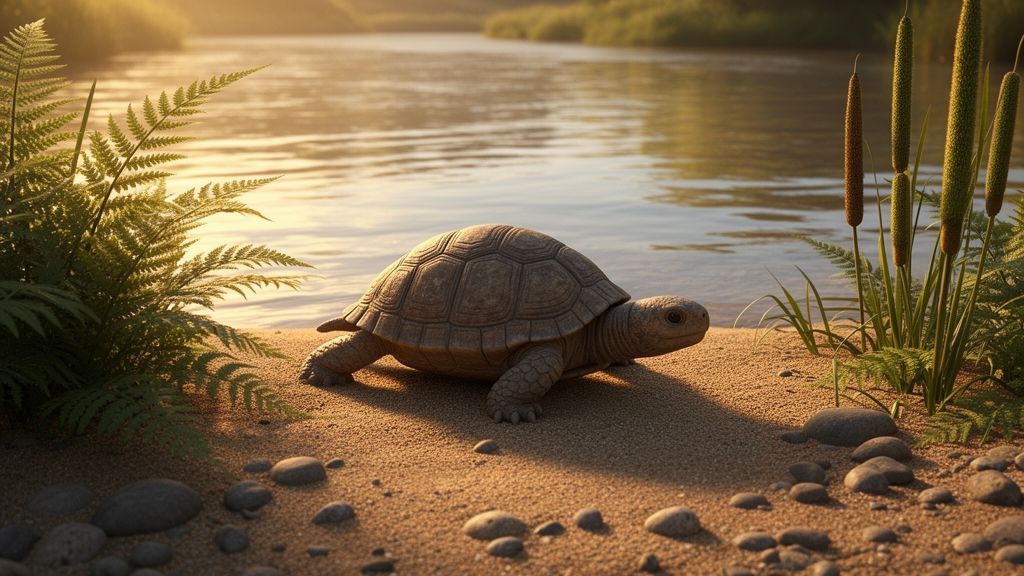
Deep in the limestone hills of southern France, a boulder that tumbled from a cliff beside a highway has yielded one of the most unexpected fossil discoveries in modern palaeontology: the first European turtle known from the very end of the Triassic period. The new animal, named Bartassochersis lopezi, lived roughly 200 million years ago during the Rhaetian stage, the final chapter of the Triassic before the end-Triassic mass extinction reshaped life on Earth. Its description, published in the Swiss Journal of Palaeontology, fills a stubborn gap in the fossil record and hints that the twilight of the Triassic was far richer in turtle diversity than anyone suspected.
The significance of the new French find becomes clearer when placed against the broader history of turtle palaeontology. For more than a century after the first Triassic turtles were described from German sandstones in the mid-nineteenth century, the known diversity of these early animals remained remarkably thin. By the 1990s, palaeontologists recognised only four valid named species worldwide: Proganochelys quenstedtii and Proterochersis robusta from Germany, Palaeochersis talampayensis from Argentina, and a Thai form now placed in the genus Thaichelys. This scarcity was not necessarily a reflection of how many turtles actually existed at the time, but rather of how few deposits had been searched and how incomplete the preserved material often was. Shell bones and isolated plates, the most common turtle fossils, can be difficult to distinguish between closely related forms, and entire species have sometimes rested on a handful of fragmentary elements.
The last two decades have transformed this picture. Renewed study of old museum specimens, together with new fieldwork across Europe, South America, North America, Greenland and Asia, has more than tripled the roster of Triassic turtle taxa. Germany has yielded Keuperotesta limendorsa, Poland has produced Proterochersis porebensis and related indeterminate material, Argentina has added the australochelyid Waluchelys cavitesta, and Greenland has contributed both an enigmatic specimen described decades ago and, more recently, the proganochelyid Ypomonetikochelys euryaspis. North American discoveries include Chinlechelys tenertesta and additional possible taxa. Even Switzerland, long absent from the map of early turtle occurrences, has produced evidence of Proganochelys quenstedtii. Yet almost all of this diversity belongs to the Norian stage, the middle part of the Late Triassic. The Rhaetian, the final stage before the end-Triassic extinction, had yielded only two verified records worldwide: Waluchelys cavitesta from Argentina and a single unnamed neural bone from France mentioned in the literature but never properly documented.
This gap has long puzzled researchers. The Norian record shows turtles already speciose and geographically widespread, spanning what are now Europe, Asia, North and South America, and Greenland. The Early and Middle Jurassic, by contrast, contain a wealth of finds that demonstrate turtles survived the extinction and diversified further. An apparent near-absence in the Rhaetian therefore seemed more likely to be an artefact of sampling than a genuine biological phenomenon. The problem is that Rhaetian terrestrial and coastal deposits are simply rarer than Norian ones in many regions, and those that do exist have historically been targeted for other fossils, particularly fish, marine reptiles and the early dinosaurs that dominate popular attention for this interval.
The Pégairolles-de-l’Escalette locality, which produced the new turtle, sits in the Lodève Basin on the south-eastern margin of the Massif Central in southern France. This basin is geologically unusual in that it preserves an almost unbroken sequence of continental sediments spanning roughly fifty million years, from the Late Carboniferous through the Triassic, accumulating to a thickness of about four kilometres. During the Late Carboniferous and Permian, the basin lay near the equator, cut off from the Tethys Ocean by the ancient Hercynian mountain range. Sedimentation began with river systems, shifted to deep and shallow lakes and floodplains during the Permian, and returned to fluvial conditions in the Triassic before grading upward into a shallow mixed siliciclastic-carbonate platform. The basin was finally flooded by the Hettangian transgression at the start of the Jurassic, which deposited the shallow marine carbonates that now cap the sequence in the foothills of the Larzac Plateau.
The Triassic succession at Pégairolles itself was documented in detail following highway construction in the 1980s and 1990s, when the RN9 road was upgraded to the A75. Two members make up the Rhaetian Formation there. The Lower Member, predominantly siliciclastic, comprises three units: a basal unit of fine grey-green sandstones about twelve metres thick, a middle unit of alternating marl and dolomite roughly fifteen metres thick, and an upper unit of light-coloured sandstone about ten metres thick. The Upper Member consists entirely of carbonate rocks, again in three divisions, including dolomitised calcarenites separated by carbonate mudstones. The Rhaetian age of this sequence was first proposed in the nineteenth century on the basis of the distinctive bivalve Rhaetavicula contorta, and later confirmed through stratigraphic relationships and, crucially, through palynological analysis of spore assemblages sampled densely along the whole outcrop.
The palaeoenvironmental reconstruction of the Lower Member is particularly relevant to understanding the habitat of Bartassochersis lopezi. The sediments were laid down in a coastal setting featuring lagoons and river mouths, an environment where freshwater and brackish conditions intermingled. The dolomite-rich middle unit points to arid or semi-arid conditions at times. This kind of coastal mosaic, with its mix of aquatic and terrestrial microhabitats, is consistent with what is known about early turtle ecology more broadly. The earliest stem turtles appear to have been amphibious animals, comfortable in water but also capable of activity on land, and their shell morphology suggests a lifestyle intermediate between fully aquatic and fully terrestrial modern groups. A lagoonal coastline would have offered exactly the sort of habitat in which such animals could thrive, foraging in shallow waters and basking on mudflats and sandbars.
The recovery of Bartassochersis as a proterochersid carries its own evolutionary implications. Proterochersids are among the most basal branches of the turtle lineage, characterised by a fully formed shell but retaining numerous primitive features lost in later groups. The family was previously known principally from the Norian of Germany and Poland, with a possible Argentine relative suggesting the group achieved a broad Pangaean distribution early in its history. Finding a proterochersid in the Rhaetian of France extends the temporal range of the family and demonstrates that these early turtles persisted through the ecological upheavals of the latest Triassic, at least in European coastal environments. The numerous unique, autapomorphic characters that distinguish the new genus also suggest that stem turtles were experimenting with a wider range of body plans at the end of the Triassic than the surviving Norian record had indicated.
Equally intriguing is the second find reported in the study: fragmentary material from the ‘Grès infraliasiques’ Formation belonging to an indeterminate but probably remarkably small-bodied turtle. Body size in early turtles has been a subject of ongoing debate, with most known Triassic species appearing to have been moderate to large animals. A very small form would represent an unfamiliar aspect of the group’s early diversity, and its presence in strata immediately preceding the Jurassic raises questions about whether miniaturisation played a role in turtle survival across the end-Triassic extinction, as it appears to have done for several other vertebrate lineages.
The authors’ broader conclusion deserves emphasis: previously uncharted regions and latest Triassic strata of Pangaea may still conceal unknown testudinates. The Rhaetian world was a single supercontinent, and its coastal margins, river deltas and lagoonal systems stretched across vast areas that have never been systematically prospected for early turtle remains. The French discovery, emerging from road-cut exposures that had been studied stratigraphically for decades before anyone recognised the turtle material, is a reminder that significant fossils often lie within well-known rock sequences. Careful re-examination of existing collections and targeted excavation in Rhaetian deposits of other regions could well reveal further surprises, gradually closing the apparent gap between the rich Norian record and the equally rich Jurassic one, and providing a more complete picture of how the earliest turtles weathered one of the most severe crises in the history of life on Earth.
Subject of Research: A newly described Rhaetian stem turtle from France and its implications for early turtle evolution
Article Title: Triassic turtles of France: the first European Rhaetian stem turtle taxon (clades Testudinata , Proterochersidae )
Article References: Szczygielski, T., Celestin, F., Adnet, S., & Guinot, G. (2026). Triassic turtles of France: the first European Rhaetian stem turtle taxon (clades Testudinata, Proterochersidae). Swiss Journal of Palaeontology, 145, 851-879. https://doi.org/10.3897/sjp.145.198341
Image Credits: AI Generated
Keywords: Bartassochersis lopezi, Triassic, Rhaetian, stem turtles, Proterochersidae, palaeontology, France, Lodève Basin, Testudinata, end-Triassic extinction, fossil record, turtle evolution
Cite Scienmag News
Gavin Prescott. (October 16, 2026). Ancient Turtle From France Rewrites the Story of the Last Triassic Turtles. Scienmag. https://scienmag.com/ancient-turtle-from-france-rewrites-the-story-of-the-last-triassic-turtles/
Gavin Prescott. "Ancient Turtle From France Rewrites the Story of the Last Triassic Turtles." Scienmag, 16 October 2026, https://scienmag.com/ancient-turtle-from-france-rewrites-the-story-of-the-last-triassic-turtles/. Accessed 16 October 2026.
Gavin Prescott. "Ancient Turtle From France Rewrites the Story of the Last Triassic Turtles." Scienmag. October 16, 2026. https://scienmag.com/ancient-turtle-from-france-rewrites-the-story-of-the-last-triassic-turtles/


