


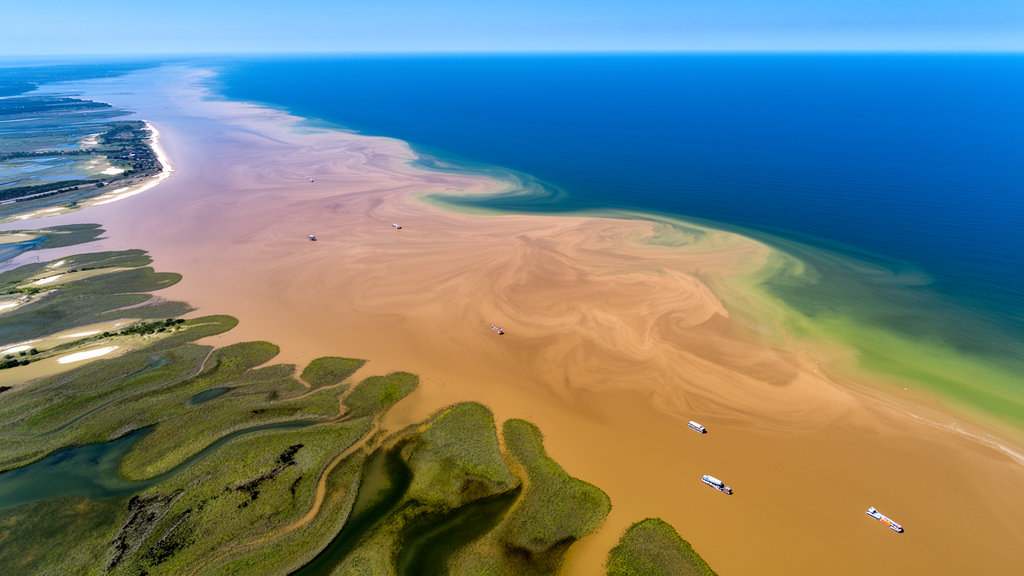
Every summer, an area of ocean larger than some U.S. states goes silent off the coast of Louisiana and Texas. Fish that can flee do; shrimp, crabs and bottom-dwelling fish that cannot simply suffocate. This is the Gulf of Mexico’s infamous dead zone, and according to a new mini review published in Frontiers in Ocean Sustainability, its root cause flows from more than 3 million square kilometers of North American farmland through a single river. The review, led by Md S. Zaman of Alcorn State University and South Texas College, with Ali S. Akanda of the University of Rhode Island and Syed M. Muniruzzaman of Xavier University of Louisiana, traces how more than a century of synthetic fertilizer use has turned the Mississippi River Basin into a nutrient pipeline that empties directly into one of America’s most productive marine ecosystems.
The story begins in 1909, when Fritz Haber’s development of ammonia synthesis made synthetic nitrogen fertilizer widely available and helped power the agricultural expansion of the Green Revolution. That chemical breakthrough fed billions of people, but it also unleashed a slow-motion environmental problem. Rain and melting snow wash excess nitrogen and phosphorus from farm fields into streams, rivers and eventually the ocean, a process known as eutrophication, from the Greek words for “well” and “nourishment.” Animal waste and untreated sewage add further nutrient loads. The result is an over-fertilization of aquatic ecosystems that the review identifies as one of the most persistent water quality challenges of the modern era.
The scale of the Mississippi’s contribution is staggering. The basin drains roughly 41 percent of the continental United States through five major sub-basins, the Missouri, the upper Mississippi, the Ohio and Tennessee, the Arkansas and Red, and the lower Mississippi, connecting 31 states before the river reaches the Gulf after a journey of about 3,782 kilometers from Minnesota. The review estimates that the river discharges an average of about 16,800 cubic meters of water per second, carrying an estimated 1.6 million metric tons of nutrient fertilizer into the Gulf each year. Roughly 30 percent of the nitrogen applied to agricultural fields is transported into surrounding water bodies through surface runoff, according to figures cited from the U.S. Department of Agriculture.
Once those nutrients arrive in the Gulf’s coastal waters, the chemistry of collapse begins. Nitrogen, which is generally more abundant than phosphorus in agricultural runoff, drives explosive growth of algae and phytoplankton faster than the ecosystem can process. When the algal masses die, they sink, and microbes decomposing them consume dissolved oxygen from the water. When dissolved oxygen falls below 2 milligrams per liter, the water becomes hypoxic; when oxygen disappears entirely, it becomes anoxic. Either condition renders vast stretches of the water column uninhabitable for most marine organisms, producing the seasonal dead zone that forms every summer off the Texas and Louisiana coasts.
The dimensions of that dead zone are sobering. The largest measured extent reaches about 23,000 square kilometers, with a mean annual area of roughly 14,325 square kilometers, and considerable variability from year to year. Although the long-term trend shows a slow decline, the annual measurements have exceeded the federal target of 5,000 square kilometers every year except 2000 and 2020. Bottom-dwelling species such as shrimp, crabs and bottom-feeding fish are particularly vulnerable because they cannot easily escape low-oxygen conditions, while more mobile species may temporarily migrate to oxygen-rich waters, disrupting food webs and concentrating fishing pressure elsewhere.
The economic stakes are enormous. The Gulf generates more than $200 billion annually in economic activity from fishing, shipping, tourism and oil industries in the coastal United States alone. It supplies 72 percent of the nation’s harvested shrimp, 66 percent of harvested oysters and 16 percent of commercial fish, and catches from the Gulf account for an estimated 40 percent of the annual U.S. fishing yield. A 2026 NOAA report based on 2023 data found that saltwater fishing supported 1.7 million jobs and generated $319 billion in sales nationwide. Against that backdrop, the Union of Concerned Scientists has estimated that eutrophication causes $2.4 billion in annual damage to Gulf fish stocks, as fishermen travel farther to find catchable fish and consumers pay the difference at the seafood counter.
Eutrophication also poses direct risks to human health. Harmful algal blooms, which have been documented in every U.S. coastal state, produce toxins that accumulate in shellfish and filter-feeding organisms and can move through the food web into fish. Consuming contaminated seafood can cause symptoms ranging from nausea, vomiting and diarrhea to neurological effects such as paresthesia, memory loss, disorientation and paralysis, and in severe cases paralytic or amnesic shellfish poisoning that can be fatal. Beyond algal toxins, nitrites and nitrates from fertilizer have been associated with methemoglobinemia, hypothyroidism, type 1 diabetes, hypertension and an elevated risk of several cancers, and because agricultural runoff can contaminate both surface water and groundwater, these compounds may reach drinking water supplies in coastal communities.
The review argues that mitigation requires a portfolio of strategies rather than a single fix. On land, farmers need training and incentives to apply fertilizer more precisely, reducing both environmental losses and input costs. Wetland preservation and reforestation along the Mississippi watershed could restore natural filters that slow runoff and allow plants to absorb excess nutrients before they reach the river. In the water itself, the authors point to aquaculture of clams and oysters, which filter water and regulate plankton populations, and to seaweed cultivation, which harnesses dissolved nutrients while producing commercially valuable products. Regulatory measures matter too: the European Union has mandated reductions in nitrogen and phosphorus inputs to coastal ecosystems, and similar approaches in the United States have contributed to measurable nutrient reductions in Chesapeake Bay.
Technology is emerging as a critical ally. Traditional water quality assessment is labor-intensive, costly and limited to small sections of a waterbody at a time, which makes it poorly suited to tracking a dead zone that can span thousands of square kilometers. Satellite remote sensing offers comprehensive coverage across large areas and the flexibility to support both short-term and long-term assessments. The review highlights NASA’s Plankton, Aerosol, Cloud, Ocean Ecosystem (PACE) mission, launched to provide higher accuracy and temporal frequency, as well suited for continuous monitoring of the Gulf’s hypoxic conditions. Public awareness campaigns, school programs and community workshops round out the strategy by building the political and behavioral support needed for lasting change.
The Gulf of Mexico is not alone. The review compares it with the Chesapeake Bay, the largest estuary in the United States, which suffers from nitrogen and phosphorus pollution from urban stormwater, wastewater and agricultural runoff, and with the Baltic Sea, the world’s largest expanse of brackish water, where decades of nutrient inputs from nine surrounding countries have devastated benthic ecosystems and fish stocks. All three systems show the same pattern: seasonal or persistent stratification, hypoxia, biodiversity loss and economic damage, with restoration efforts yielding only modest or slow progress. The authors conclude that addressing eutrophication demands collaboration among the U.S. Department of Agriculture, farmers, industries, scientists and local communities, combining sustainable farming practices, ecosystem restoration, innovative technologies and regulatory measures to restore balance to marine ecosystems and safeguard the long-term health of the oceans.
Subject of Research: Nutrient runoff from the Mississippi River Basin causing eutrophication and hypoxic dead zones in the Gulf of Mexico
Article Title: Nutrient runoff from the Mississippi watershed and ecosystem pollution risk in the Northern Gulf of Mexico
Article References: Nutrient runoff from the Mississippi watershed and ecosystem pollution risk in the Northern Gulf of Mexico. (n.d.). https://doi.org/10.3389/focsu.2026.1883415
Image Credits: AI Generated
DOI: 10.3389/focsu.2026.1883415
Keywords: eutrophication, Gulf of Mexico, dead zone, Mississippi River, nutrient runoff, hypoxia, harmful algal blooms, nitrogen pollution, agriculture, remote sensing, aquaculture, Chesapeake Bay
Cite Scienmag News
Violet Maxwell. (October 16, 2026). Mississippi’s Fertilizer Flood Feeds the Gulf of Mexico’s Colossal Dead Zone. Scienmag. https://scienmag.com/mississippis-fertilizer-flood-feeds-the-gulf-of-mexicos-colossal-dead-zone/
Violet Maxwell. "Mississippi’s Fertilizer Flood Feeds the Gulf of Mexico’s Colossal Dead Zone." Scienmag, 16 October 2026, https://scienmag.com/mississippis-fertilizer-flood-feeds-the-gulf-of-mexicos-colossal-dead-zone/. Accessed 16 October 2026.
Violet Maxwell. "Mississippi’s Fertilizer Flood Feeds the Gulf of Mexico’s Colossal Dead Zone." Scienmag. October 16, 2026. https://scienmag.com/mississippis-fertilizer-flood-feeds-the-gulf-of-mexicos-colossal-dead-zone/


