


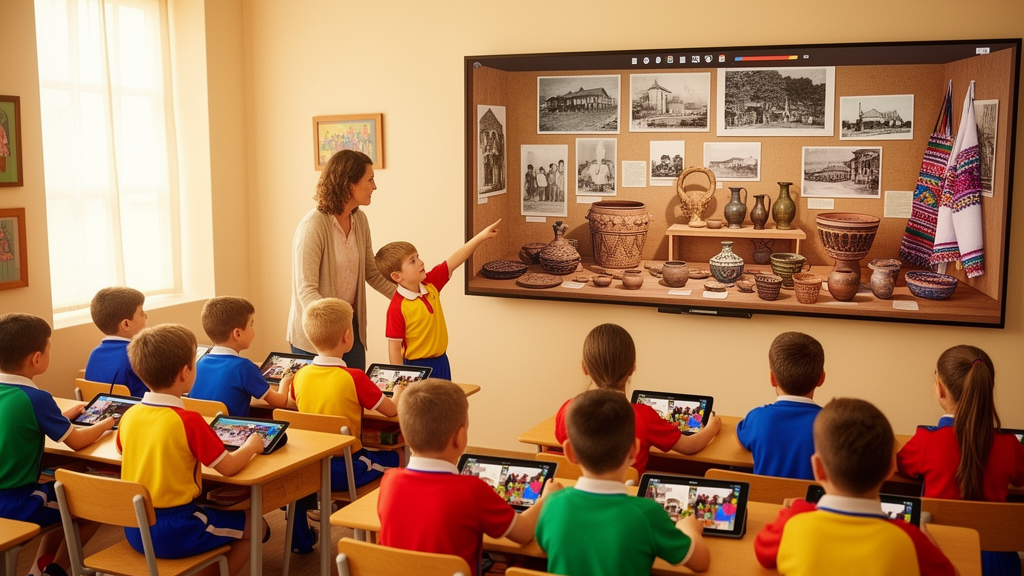
A team of researchers at the University of Extremadura in Spain has shown that a carefully designed virtual reality museum can dramatically improve how primary school children learn about their city’s cultural heritage. In a study published in Frontiers in Virtual Reality, 105 students aged nine to twelve from two public schools in Badajoz completed an immersive VR experience built around the city’s history, and their knowledge scores rose from an average of 1.19 points out of ten before the intervention to 8.39 points afterward. The gain of 7.20 points was statistically significant, with a t value of -35.050 and a p value below .001, and the researchers report that students were overwhelmingly enthusiastic about the experience, with every single participant saying they would like to repeat it.
The study addresses a persistent weakness in heritage education. Teaching about local monuments, historical events, and cultural figures in primary schools has traditionally relied on expository methods centered on memorizing dates, places, and names, an approach that the researchers argue limits the development of a deeper and more critical understanding of heritage as a social and cultural phenomenon. Cultural heritage, understood as the set of material and immaterial assets that shape a community’s collective memory, plays a central role in identity construction, sense of belonging, and social cohesion, and it also functions as a strategic economic resource through tourism and cultural industries. The team set out to test whether immersive technology could connect children’s personal experiences with the historical processes that shaped their surroundings in a way that conventional instruction rarely achieves.
The researchers built their virtual museum using Delightex, a platform for creating immersive 3D spaces that can be accessed through VR headsets or ordinary screens. The environment was organized into three themed rooms: History, Monuments, and Historical Figures. In the History room, students clicked on nine images of historical locations in Badajoz, each transporting them into a 360-degree panoramic scene where a narrated explanation described a specific stage in the city’s development, from the earliest human settlements to the contemporary city. The Monuments room used nine pictographic icons representing key buildings, each leading to a 360-degree view accompanied by an account of its historical background and significance. The third room took a different approach entirely: three interactive buttons launched a virtual roller-coaster ride during which students encountered significant historical figures from Badajoz, deliberately including both men and women to highlight contributions that traditional historical accounts have often marginalized.
Every learning unit followed a consistent three-step interaction pattern: a visual entry point, an immersive 360-degree scene with narrated content, and a closing interactive activity. The researchers describe this as combining exposure, immersion, and active response within a single cycle. The narrative across rooms was arranged according to a scaffolding logic, with the History room presenting content chronologically, the Monuments room building on that historical context thematically, and the Historical Figures room closing the experience biographically. Visual design choices were tailored to children aged nine to twelve, including high-contrast pictographic icons, brief narrated audio segments adapted to primary-level vocabulary, a consistent color-coding scheme to differentiate rooms, and simplified single-tap interaction points that minimized the technical burden of using headsets and controllers. The goal was to ensure the immersive medium itself did not become an obstacle to engagement with the heritage content.
The gamified dimension operated as an independent design layer distinct from the immersion itself. Each room concluded with a challenge-based activity designed to check comprehension rather than merely deliver information. In the History room, students completed an excavation-style activity after each 360-degree scene; the Monuments room included a complementary comprehension task for each site; and the Historical Figures room ended with an interactive game linked to the content presented during the roller-coaster sequence. The researchers argue that these mini-games reinforced content retention independently of the sense of presence generated by the 360-degree immersion, an important distinction for understanding which design elements drive learning.
The intervention took place during the second term of the 2024-2025 school year within regular Social Sciences class time, delivered across six sessions of approximately 50 minutes each. Each classroom was equipped with four Meta Quest 2 headsets, and students rotated through headset use while their classmates accessed the same content through 360-degree screen-based navigation on their own devices, allowing the whole class to participate in parallel. Sessions were jointly supervised by the classroom teacher and a member of the research team, who provided technical support and managed transitions between groups. The researchers note that Meta Quest headsets have gradually been integrated as educational resources in public schools in Extremadura through regional digitalization initiatives.
The study used a quantitative, quasi-experimental design without a control group, combining a ten-item multiple-choice knowledge test administered before and after the intervention with a twelve-item perception questionnaire rated on a four-point Likert scale. Both instruments were validated through expert judgment, with Aiken’s V values ranging from 0.96 to 1.00, and the questionnaire showed good internal consistency with a Cronbach’s alpha of 0.81. The sample of 105 students was drawn from two of Badajoz’s 39 schools through non-probability convenience sampling, comprising 47 girls and 58 boys across the fourth, fifth, and sixth grades, levels at which the regional curriculum specifically addresses local history and heritage content.
The perception results were striking. The item asking whether students would like to repeat the VR experience reached a mean of 4.00 on the four-point scale, indicating unanimous acceptance. Enjoying the virtual exploration of monuments scored 3.92, the statement that VR made history more fun scored 3.87, and perceived learning items such as understanding the history of Badajoz better scored 3.86. Perhaps most telling was what the data revealed about prior experience: 100 percent of responses to the items about using VR in class or for learning history fell into the strongly disagree category, meaning none of the children had previously encountered VR as a pedagogical resource. Despite this complete lack of familiarity, students interacted with the environment successfully, suggesting that immersive environments can be accessible to novice users when supported by clear structure, simple interaction patterns, and age-appropriate guidance.
Analysis of subgroup differences revealed nuanced patterns. Boys scored slightly higher on items related to technological familiarity and autonomy, while girls reported somewhat higher enjoyment and perceived learning, but the Mann-Whitney U test found no statistically significant differences between genders, confirming the experience was equally effective for both groups. Sixth-grade students showed the highest scores on most items, particularly technological autonomy and motivation, possibly reflecting greater cognitive maturity and digital experience, while fourth-graders scored lower on technological items but still highly on enjoyment. The Kruskal-Wallis test found significant differences between grades only on the item about regular VR use, with perceptions otherwise similar across grade levels. Notably, the correlation between pretest and posttest scores was very low and not significant, suggesting that initial performance did not predict final performance and that the improvement was broadly shared across the sample.
The authors are candid about the study’s limitations, including the absence of a control group, the convenience sample, and the possibility that self-reported enthusiasm among young children may partly reflect a novelty effect that would require repeated exposure or comparison with an equally novel non-technological activity, such as a museum visit, to rule out. They also note that navigation control in headset-based environments can influence cybersickness and postural stability in ways that vary across age groups, a consideration for future implementations. Still, they conclude that the educational value of VR depends less on technological novelty than on how effectively it is integrated into curriculum, classroom practice, and instructional design, and that immersive technologies should be understood not merely as resources for education but as media capable of transforming how students experience, interpret, and learn from cultural heritage. Future research directions include longitudinal studies of durability, qualitative investigations of user experience, and comparative studies across different immersive formats.
Subject of Research: Virtual reality-based local heritage learning in primary education
Article Title: Enhancing local heritage learning in primary education through virtual reality
Article References: Enhancing local heritage learning in primary education through virtual reality. (n.d.). https://doi.org/10.3389/frvir.2026.1904112
Image Credits: AI Generated
DOI: 10.3389/frvir.2026.1904112
Keywords: virtual reality, primary education, cultural heritage, immersive learning, gamification, Badajoz, educational technology, quasi-experimental study, student engagement, virtual museum, 360-degree imagery, Meta Quest 2
Cite Scienmag News
Courtney Benton. (October 16, 2026). Virtual Museum Transforms How Primary School Children Learn Local Heritage. Scienmag. https://scienmag.com/virtual-museum-transforms-how-primary-school-children-learn-local-heritage/
Courtney Benton. "Virtual Museum Transforms How Primary School Children Learn Local Heritage." Scienmag, 16 October 2026, https://scienmag.com/virtual-museum-transforms-how-primary-school-children-learn-local-heritage/. Accessed 16 October 2026.
Courtney Benton. "Virtual Museum Transforms How Primary School Children Learn Local Heritage." Scienmag. October 16, 2026. https://scienmag.com/virtual-museum-transforms-how-primary-school-children-learn-local-heritage/


