


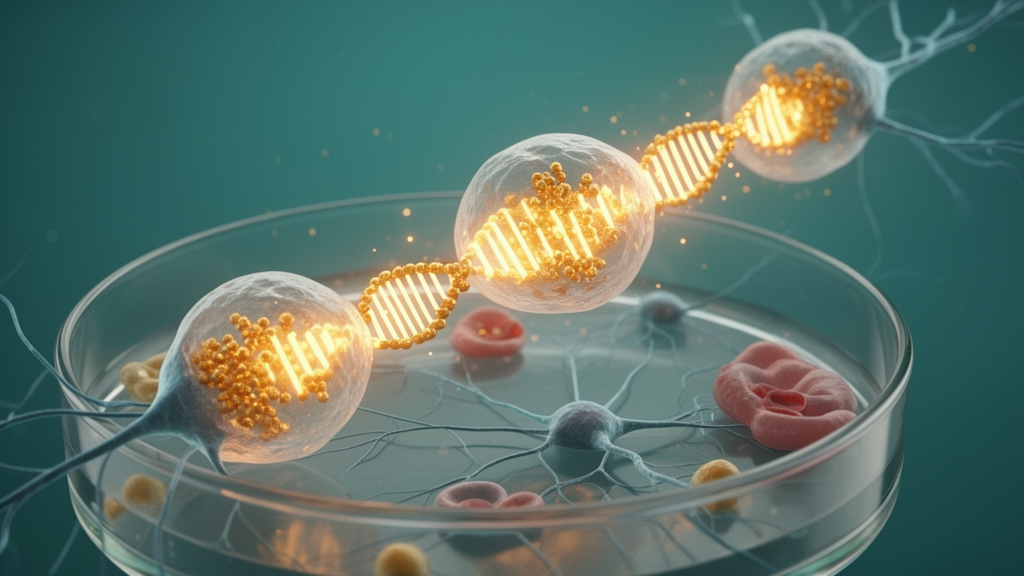
Scientists in South Africa have taken a careful, early step toward using CRISPR gene activation as a potential therapy for Parkinson’s disease, and their results reveal both the promise and the stubborn challenges of the approach. In a study published in Frontiers in Cellular Neuroscience, researchers at the University of KwaZulu-Natal used a modified CRISPR system not to cut DNA but to dial up the activity of two genes central to dopamine production, testing whether the technique could work in cell models that mimic the biochemical stress of Parkinson’s disease.
Parkinson’s disease is the second most common neurodegenerative disorder worldwide, affecting an estimated 11.7 million people, and its hallmark is the progressive death of dopamine-producing neurons in a brain region called the substantia nigra. That loss creates a dopamine deficit that underlies the tremors, stiffness, and slowed movement characteristic of the condition. The gold-standard treatment, levodopa, compensates for the missing dopamine but comes with long-term motor complications and ultimately depends on the survival of enough functional neurons to convert the drug into dopamine. This dependency has driven researchers to explore ways of boosting the brain’s own dopamine-manufacturing machinery instead.
The research team focused on two genes with complementary roles in that machinery. The first, DDC, encodes aromatic L-amino acid decarboxylase, the enzyme that chemically converts levodopa into dopamine. The second, GCH1, encodes GTP cyclohydrolase 1, the rate-limiting enzyme in producing tetrahydrobiopterin, an essential cofactor that tyrosine hydroxylase, the first enzyme in the dopamine synthesis pathway, cannot function without. Because these two genes sit at critical junctions of dopamine biosynthesis, the researchers reasoned that switching them on more strongly with CRISPR activation, or CRISPRa, might enhance the cell’s intrinsic capacity to produce dopamine.
Unlike conventional gene therapy, which delivers an extra copy of a gene packaged in a viral vector, CRISPRa works differently. It uses a catalytically inactive form of the Cas9 protein, called dCas9, fused to powerful transcriptional activator domains. Guide RNAs steer this complex to the promoter regions of target genes, where the attached activators recruit the cell’s own transcription machinery to boost gene expression from the native genomic location. Because no DNA is cut, the approach avoids the risks of double-strand breaks and avoids the capacity limits, immunogenicity, and manufacturing costs associated with viral vectors.
To test the concept, the team used two cell lines. Human embryonic kidney cells, or HEK293 cells, served as a robust, easily transfected non-neuronal comparison model. Human neuroblastoma SH-SY5Y cells, which display neuronal-like characteristics, were used to model Parkinsonian conditions. The researchers induced Parkinson-like toxicity in the SH-SY5Y cells by treating them with 6-hydroxydopamine, a neurotoxin that selectively damages dopaminergic neurons and is widely used to recreate features of the disease in laboratory settings. After this toxic exposure, they delivered the CRISPRa machinery.
The delivery system itself was notable for what it left out. Rather than using viral vectors or plasmid DNA, the researchers assembled the CRISPRa components as ribonucleoprotein complexes, combining dCas9-VP64 protein, an MS2-p65-HSF1 activator protein, and synthetic guide RNAs produced by in vitro transcription. These complexes were introduced into the cells using Lipofectamine 3000, a lipid-based transfection reagent. For DDC, a single guide RNA was used, while GCH1 was targeted with a dual-guide strategy aimed at both promoter and enhancer regions to maximize activation potential.
The results were revealing but tempered. In SH-SY5Y cells, CRISPRa targeting of DDC did produce a measurable increase in DDC gene expression relative to untreated controls, with statistically significant elevations at both 24 and 48 hours after transfection. However, when compared with the 6-OHDA-treated Parkinsonian control group, the CRISPRa-treated cells showed no significant difference in DDC expression. This means the neurotoxin itself had already altered DDC expression, making it impossible to clearly attribute the observed increase to CRISPRa activity rather than to the stress response triggered by 6-OHDA exposure.
GCH1 told a different story. Despite the dual-guide strategy targeting both promoter and enhancer regions, CRISPRa produced no significant increase in GCH1 expression in either cell line. The researchers noted that the overall analysis approached but did not reach statistical significance in SH-SY5Y cells, and they acknowledged that the small number of biological replicates in some groups, technical failures during quantitative PCR analysis, and possible limitations in delivery efficiency or chromatin accessibility at the target locus may all have contributed to the muted response.
On the safety front, the findings were more encouraging. In HEK293 cells, CRISPRa treatment had no significant effect on cell viability at either time point. In the Parkinsonian SH-SY5Y model, 6-OHDA significantly reduced viability compared with untreated controls, and the CRISPRa-treated groups showed similar reductions, but crucially, none of the CRISPRa-treated groups fared worse than the Parkinsonian control group. This suggests that the CRISPRa complexes themselves did not add toxicity beyond what the neurotoxin already caused.
The researchers are careful to frame these results as preliminary rather than definitive. They did not independently quantify transfection efficiency or confirm that the CRISPRa complexes successfully engaged their genomic targets, and they did not measure protein levels, enzyme activity, or actual dopamine production. Without those downstream validations, it remains unclear whether the modest transcriptional changes observed would translate into meaningful functional effects on dopamine biosynthesis. The team calls for future work incorporating non-targeting control guides, protein-level validation, enzymatic activity assays, direct dopamine measurements, and testing in more physiologically relevant models such as induced pluripotent stem cell-derived dopaminergic neurons before any conclusions about therapeutic potential can be drawn.
Subject of Research: CRISPR activation of dopamine biosynthesis genes DDC and GCH1 in cellular models of Parkinsonian neurotoxicity
Article Title: Assessment of the transcriptional and cellular effects of CRISPRa targeting Dopa decarboxylase and GTP cyclohydrolase 1 in HEK293 and SH-SY5Y cellular models of Parkinsonian neurotoxicity
Article References: Bhengu, S. Z., Singh, R., Ramsuran, V., & Msibi, Z. N. P. (2026). Assessment of the transcriptional and cellular effects of CRISPRa targeting Dopa decarboxylase and GTP cyclohydrolase 1 in HEK293 and SH-SY5Y cellular models of Parkinsonian neurotoxicity. Frontiers in Cellular Neuroscience, 20, Article 1883789. https://doi.org/10.3389/fncel.2026.1883789
Image Credits: AI Generated
DOI: 10.3389/fncel.2026.1883789
Keywords: CRISPRa, Parkinson's disease, DDC, GCH1, dopamine biosynthesis, SH-SY5Y cells, HEK293 cells, 6-hydroxydopamine, gene therapy, dCas9, neurodegeneration, transcriptional activation
Cite Scienmag News
Juliet Wilcox. (October 16, 2026). CRISPR Gene Activation Shows Early Promise but Modest Effects in Lab Models of Parkinson’s Disease. Scienmag. https://scienmag.com/crispr-gene-activation-shows-early-promise-but-modest-effects-in-lab-models-of-parkinsons-disease/
Juliet Wilcox. "CRISPR Gene Activation Shows Early Promise but Modest Effects in Lab Models of Parkinson’s Disease." Scienmag, 16 October 2026, https://scienmag.com/crispr-gene-activation-shows-early-promise-but-modest-effects-in-lab-models-of-parkinsons-disease/. Accessed 16 October 2026.
Juliet Wilcox. "CRISPR Gene Activation Shows Early Promise but Modest Effects in Lab Models of Parkinson’s Disease." Scienmag. October 16, 2026. https://scienmag.com/crispr-gene-activation-shows-early-promise-but-modest-effects-in-lab-models-of-parkinsons-disease/


