


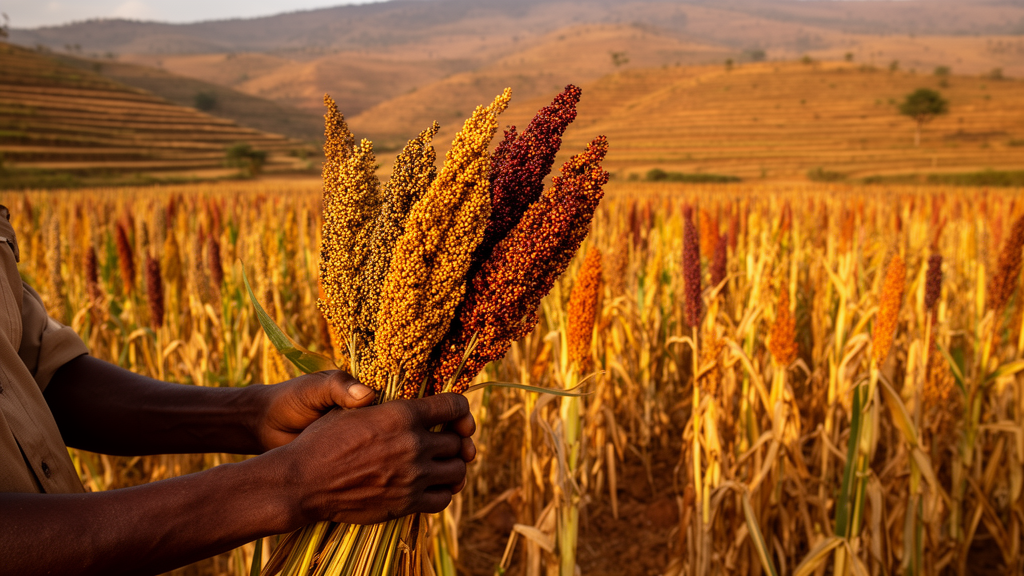
Sorghum has earned its nickname as the camel of crops for good reason. This diploid tropical C4 cereal, a member of the grass family Poaceae, tolerates water and temperature stress that would devastate most other cereals, while running photosynthesis with remarkable efficiency. For millions of impoverished people across the semi-arid tropics, it is a principal food crop, supplying energy, protein, minerals and vitamins from soils as demanding as the heavy Vertisols common throughout the tropics. Worldwide it ranks fifth among cereals, behind rice, wheat, barley and maize, in total production and area cultivated, yet its future in a warming climate may matter far more than its present standing in the league tables.
Ethiopia sits at the heart of that story. The country is Africa’s third largest sorghum producer after Nigeria and Sudan, cultivating 1.55 million hectares and harvesting 4.01 million tonnes of grain, an average productivity of 2.71 tonnes per hectare according to FAO figures for 2024. Demonstration fields have shown yields as high as 4.23 tonnes per hectare, a gap that hints at how much potential remains locked in the crop’s genetic base. Whether breeders can close that gap depends fundamentally on the magnitude of genetic variability, heritability and expected genetic advance present in the breeding population, because crop improvement advances only as far as the variation in the source material allows.
A new study conducted at the Sirinka Agricultural Research Center in northeastern Ethiopia, a promising dry-lowland sorghum zone at 1850 metres elevation, has now quantified exactly that potential. Researchers evaluated forty-nine early maturing sorghum genotypes, a panel composed of forty-five breeding lines, three improved varieties named Melkam, Girana-1 and Alene, and one farmer’s variety called Jigurity. The genotypes trace pedigrees involving locally adapted cultivars such as Dekeba, Meko, Teshale and Gambella1107 alongside international donor lines carrying known stress-resistance genetics. The trial was laid out in a seven by seven simple lattice design with two replications, planted in the first week of July when soil moisture was adequate, and managed with recommended fertilization of 121 kilograms per hectare of NPS fertilizer and 50 kilograms per hectare of urea, split between planting and the knee-height stage.
The team recorded thirteen quantitative traits following standard sorghum descriptors, combining plot-level measurements of days to flowering, days to maturity, grain-filling period, harvest index, above-ground biomass and grain yield with plant-level measurements of height, panicle dimensions, stalk diameter, panicle weight, thousand-seed weight and grain weight per panicle, averaging five randomly selected plants from the central two rows of each plot. Analysis of variance revealed highly significant differences, at a probability below 0.001, among the genotypes for every trait except stalk diameter and panicle width. That near-universal significance is the crucial signal for breeders: it demonstrates a high degree of genetic variability in the material that can be exploited in future improvement programs, and it aligns with previous Ethiopian studies that found comparable patterns of variation.
The raw ranges themselves are striking. Grain yield stretched from a meagre 0.40 tonnes per hectare for the genotype ETSC_14415-1-2 to 3.05 tonnes per hectare for ETSC_14252-4-1, around a mean of 1.71 tonnes per hectare. Plant height varied from a compact 121.5 centimetres to a towering 245.6 centimetres for the farmer’s variety Jigurity, a trait with real social weight since farmers favor tall sorghums that provide grain, livestock fodder and material for roofs and fences. Days to maturity ranged from 119.5 days for the variety Alene to 145.5 days, thousand-seed weight spanned 19.4 to 36.3 grams, and above-ground biomass ran from 6 to 16.65 tonnes per hectare. Panicle length covered 16.3 to 28.1 centimetres and harvest index, the fraction of total biomass that ends up as grain, ranged from under 3 percent to more than 37 percent.
Digging deeper into the genetics, the researchers partitioned phenotypic variance into genotypic and environmental components and computed coefficients of variation for each trait. Harvest index showed the highest values of genotypic and phenotypic coefficients of variation at 41.47 and 46.94 percent respectively, followed by grain yield at 31.76 and 36.29 percent, grain weight per panicle at 22.59 and 31.84 percent, and panicle weight at 20.72 and 30.23 percent. High values of both coefficients indicate that variation is largely genetic rather than environmental noise, and that these traits should respond positively to selection. Days to flowering, days to maturity and grain-filling period, by contrast, showed low coefficients, signaling narrow variation and limited scope for improvement through selection on those characters alone.
Heritability and genetic advance together sharpened the picture. Broad-sense heritability estimates ranged from 45.09 percent for grain-filling period to 82.78 percent for plant height, with days to maturity at 80.75 percent, harvest index at 78.06 percent, grain yield at 76.62 percent and days to flowering at 71.83 percent also scoring high. Crucially, grain yield, harvest index and plant height combined high heritability with high genetic advance as a percentage of the mean, 57.27 percent for yield and an exceptional 75.48 percent for harvest index. That combination points to strong additive gene action, meaning selection on these traits can be direct and effective. Days to maturity told a different story: high heritability paired with a low genetic advance of 8.13 percent implicates non-additive gene action, so progress there would demand different breeding tactics.
Multivariate analysis mapped the relationships among the genotypes. Using average linkage clustering on Euclidean distances across eleven traits, the panel resolved into three clusters at a 5.25 similarity level. Cluster I dominated with forty-one genotypes, Cluster II held five, and Cluster III contained just three: the high-performing breeding line ETSC_14252-4-1 and the improved varieties Melkam and Alene. Cluster III was the standout group, averaging 2.77 tonnes per hectare of grain yield, 56.98 grams of grain per panicle, a 32.80 percent harvest index and the earliest maturity at 124 days, making it a prime source of parents for yield-focused crossing. The largest inter-cluster distance, 43.1, separated Clusters II and III, far exceeding the statistically significant chi-square threshold, followed by 13.9 between Clusters I and II. Genotypes drawn from these distant clusters offer the strongest prospects for producing novel recombinants in hybridization programs, whereas the modest 10.4 distance between Clusters I and III reflects the overall similarity of early, small-seeded, low-biomass material in the panel.
Principal component analysis compressed the eleven traits into three components explaining 73.9 percent of total variability, with the first alone accounting for 44.8 percent and loading heavily on days to maturity, harvest index, grain yield, grain weight per panicle and days to flowering. The second component, adding 19.1 percent, was dominated by thousand-seed weight, grain-filling period, plant height and panicle length, while the third captured 10.1 percent through panicle weight and above-ground biomass. Traits with high loadings on the first two components are the most powerful discriminators among genotypes, giving breeders a reduced set of characters to measure when screening large collections. Taken together, the results hand Ethiopian sorghum breeders a concrete roadmap: select directly on grain yield, harvest index and plant height where additive genetic control is strong, and cross parents from Clusters II and III to maximize diversity in segregating populations. In a region where sorghum is not merely a crop but a pillar of food security, that hidden variation is genuine breeding gold.
Subject of Research: Phenotypic variability, heritability and genetic diversity of early maturing sorghum genotypes in northeastern Ethiopia
Article Title: Phenotypic variability of sorghum ( Sorghum bicolor L. Moench) for quantitative traits in Northeast Ethiopia
Article References: Beze, Y., Worede, F., & Dejene, T. (2025). Phenotypic variability of sorghum (Sorghum bicolor L. Moench) for quantitative traits in Northeast Ethiopia. Innovations in Agriculture, 8, 1-10. https://doi.org/10.3897/ia.2025.153508
Image Credits: AI Generated
Keywords: sorghum, Sorghum bicolor, genetic variability, heritability, genetic advance, Ethiopia, plant breeding, grain yield, harvest index, principal component analysis, cluster analysis, dry lowlands
Cite Scienmag News
Alan Morgan. (October 15, 2026). Hidden Diversity in Ethiopian Sorghum Reveals Breeding Gold for Drylands. Scienmag. https://scienmag.com/hidden-diversity-in-ethiopian-sorghum-reveals-breeding-gold-for-drylands/
Alan Morgan. "Hidden Diversity in Ethiopian Sorghum Reveals Breeding Gold for Drylands." Scienmag, 15 October 2026, https://scienmag.com/hidden-diversity-in-ethiopian-sorghum-reveals-breeding-gold-for-drylands/. Accessed 15 October 2026.
Alan Morgan. "Hidden Diversity in Ethiopian Sorghum Reveals Breeding Gold for Drylands." Scienmag. October 15, 2026. https://scienmag.com/hidden-diversity-in-ethiopian-sorghum-reveals-breeding-gold-for-drylands/


