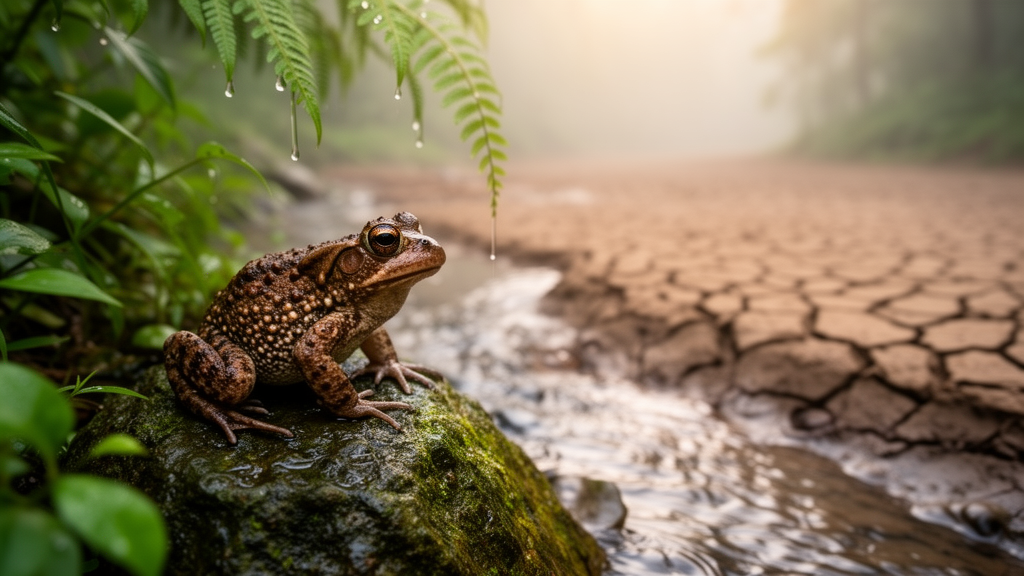
A modest, stream-dwelling frog confined to the mountain forests of northeastern Vietnam may be facing one of the starkest futures imaginable. New species distribution modeling published in the journal Herpetozoa predicts that the Mau Son Spiny Frog (Quasipaa acanthophora), a vulnerable amphibian endemic to the region, could lose more than 78 percent of its climatically suitable habitat by mid-century under every climate scenario examined — and up to 99.8 percent of it by the end of the century if greenhouse gas emissions follow their most extreme trajectory.
The study, led by researchers surveying the species across Lang Son, Bac Ninh and Quang Ninh provinces, applied the Maximum Entropy algorithm, commonly known as MaxEnt, to map where conditions today favor the frog and where those conditions are likely to shift. The results confirm what amphibian biologists have long feared for narrowly distributed tropical endemics: a species already squeezed by overharvesting for food and habitat loss has almost nowhere climatically left to go.
Quasipaa acanthophora was formally described in 2009 from Mau Son Mountain in Lang Son Province and is known only from tropical evergreen rain forests in northeastern Vietnam, with a possible extension across the border into southern China’s Guangxi. The International Union for Conservation of Nature lists the frog as Vulnerable, while Vietnam’s national Red Data Book ranks it as Endangered, reflecting the combined toll of collection for consumption and the steady degradation of lowland and montane forests. Like other amphibians, the species is an ectotherm whose metabolism, reproduction and development are all governed tightly by ambient temperature and moisture, making it exceptionally sensitive to climatic change.
To build their model, the team assembled 20 representative occurrence records, drawing on two coordinates from the Global Biodiversity Information Facility and 42 field-verified locations from 16 streams identified through interviews with local people and forest rangers. Because clustered records can bias predictive models, the researchers spatially filtered the data, retaining only one locality per square kilometer. Nineteen bioclimatic variables from the WorldClim 2.1 dataset at 30-arc-second resolution were screened for redundancy, and a pairwise Pearson correlation analysis removed highly correlated variables with coefficients above 0.75, leaving six: mean diurnal range, isothermality, temperature seasonality, maximum temperature of the warmest month, mean temperature of the coldest quarter and precipitation of the driest quarter.
A key methodological decision shaped the results. For species with restricted ranges, defining the modeling background too broadly can artificially inflate performance statistics by contrasting presence points with environmentally dissimilar areas the species could never reach. The team therefore drew a buffer of 18,492 square kilometers with a 40-kilometer radius around the occurrence points, sampled 10,000 background points within it, and tuned the model’s hyperparameters — testing six feature combinations and regularization values from 0.5 to 5 — using the Akaike Information Criterion. The optimal model combined linear, quadratic and hinge features with a regularization multiplier of 1.5 and achieved a mean area under the curve of 0.975, an omission rate of just 0.087, sensitivity of 0.913 and specificity of 0.936, figures that indicate very strong predictive discrimination.
The climate variable doing most of the work was the maximum temperature of the warmest month, followed by temperature seasonality; together they accounted for 89.8 percent of model contribution and 75.3 percent of permutation importance. The response curves defined a narrow climatic envelope: the frog’s suitable zone requires warmest-month maxima between 25.7 and 32.8 degrees Celsius, seasonal temperature variability with a standard deviation of roughly 4.5 to 6.0 degrees, mean temperatures of the coldest quarter between 11.28 and 17.8 degrees, and dry-quarter rainfall of 48 to 168 millimeters. These conditions describe the mild, humid microclimates along montane forest streams — precisely the kind of environment most exposed to intensifying heat and shifting monsoon dynamics in northern Vietnam.
At present, the model estimates 5,038.3 square kilometers of climatically suitable habitat under the minimum threshold, of which about 1,779 square kilometers — 35 percent — meets the stricter suitability criterion, with 1,567 square kilometers lying within tropical evergreen rain forest and just 231 square kilometers inside protected areas. The predicted distribution covers all known occurrence regions and also flags candidate areas for future surveys: northern Lang Son, Thai Nguyen and Cao Bang provinces, and southern Guangxi in China. Notably, the model also identified climatically suitable conditions on islands in Hai Phong City and Quang Ninh Province, including areas near Bai Tu Long National Park, Ha Long Bay and Cat Ba National Park, although previous herpetofaunal surveys have never recorded the frog there, and the species’ dependence on stream microhabitats and limited dispersal ability likely prevent it from crossing marine barriers.
The future projections are where the study turns alarming. Averaging outputs across three global circulation models from the sixth Coupled Model Intercomparison Project — MRI-ESM2-0, MIROC6 and the Beijing Climate Center model, chosen for their ability to capture regional monsoon dynamics, ocean-atmosphere interactions and tropical cyclone behavior — the researchers ran three Shared Socioeconomic Pathways: SSP2-4.5, the middle-of-the-road scenario with roughly 2.7 degrees of warming by 2100; SSP3-7.0, with 3.2 to 4.1 degrees; and SSP5-8.5, the fossil-fueled development pathway with 4.7 to 5.1 degrees. Across every scenario and every time window in the 2050s, 2070s and 2090s, suitable habitat contracted by more than 78 percent. The best remaining case, under SSP2-4.5 by the 2050s, leaves approximately 1,107 square kilometers, or about 22 percent of current habitat. The worst case, under SSP5-8.5 by the 2090s, leaves just 9.61 square kilometers — 0.19 percent of what exists today.
Multivariate environmental similarity surface, or MESS, analyses sharpened the concern by quantifying where future predictions extrapolate beyond the conditions the model was trained on. By the 2050s under SSP2-4.5, interpolated conditions analogous to today’s climate covered at most 26.77 percent of the projected suitable area; by the 2090s under SSP5-8.5, as much as 96.64 percent of the analogous conditions within the buffer zone had been replaced by marginal or fully extrapolated environments. In plain terms, the climate the frog currently experiences is projected to effectively vanish from the landscape, and remaining patches of future suitability cluster along the China–Vietnam border region. Because the species is a forest specialist, the effective habitat loss is even steeper once the projections are overlaid with forest cover, as most climatically suitable cells fall outside remaining evergreen forest.
The authors acknowledge the constraints inherent in modeling a species known from only 20 filtered records, but argue their safeguards — the restricted buffer background, averaging across three climate models, comparison of bootstrap, cross-validation and subsampling replication procedures, and explicit hyperparameter tuning rather than default settings — make the projections as robust as the data allow. They also caution that the models do not incorporate future land-use change, even though agriculture, mining and tourism development continue to erode Vietnamese forests, and intensifying typhoons linked to climate change have already degraded coastal habitats in Quang Ninh Province where the frog occurs. Climate change therefore compounds, rather than replaces, the direct human pressures.
Unlike widespread generalists, narrowly endemic stream amphibians are unlikely to track shifting climates by dispersing to new habitats, a pattern documented for other threatened herpetofauna in the same forests, including tiger geckos of the genus Goniurosaurus, crocodile lizards and warty newts. The practical response the researchers propose is habitat protection: preserving evergreen forest canopies maintains the stable, humid microclimates that buffer the frog against macroclimatic warming. Overlaying current highly suitable habitat with protected-area boundaries, they identify two priority sites — Tay Yen Tu Nature Reserve in Bac Ninh and Dong Son–Ky Thuong Nature Reserve in Quang Ninh — as the core areas where conservation efforts should concentrate. They further recommend population monitoring, assessments of harvesting pressure, evaluation of stream habitat quality and work to maintain connectivity among occupied and potential sites. For a species whose entire climatic future may amount to a few scattered square kilometers along a mountain border, those protected forests may be the last, best refuge it will ever have.
Subject of Research: Projected climate-driven habitat loss of the forest-specialist Mau Son Spiny Frog in northern Vietnam
Article Title: Projected contraction of climatically suitable habitat for the forest-specialist anuran Quasipaa acanthophora under climate change in northern Vietnam
Article References: Projected contraction of climatically suitable habitat for the forest-specialist anuran Quasipaa acanthophora under climate change in northern Vietnam. (n.d.). https://doi.org/10.3897/herpetozoa.39.e201361
Image Credits: AI Generated
DOI: 10.3897/herpetozoa.39.e201361
Keywords: Quasipaa acanthophora, amphibian conservation, species distribution modeling, MaxEnt, climate change, Vietnam, habitat loss, endemic species, tropical evergreen forest, IUCN Red List, SSP scenarios, herpetology
Cite Scienmag News
Sloane Callahan. (October 15, 2026). Climate change could strip Vietnam’s spiny frog of nearly all its habitat, model warns. Scienmag. https://scienmag.com/climate-change-could-strip-vietnams-spiny-frog-of-nearly-all-its-habitat-model-warns/
Sloane Callahan. "Climate change could strip Vietnam’s spiny frog of nearly all its habitat, model warns." Scienmag, 15 October 2026, https://scienmag.com/climate-change-could-strip-vietnams-spiny-frog-of-nearly-all-its-habitat-model-warns/. Accessed 16 October 2026.
Sloane Callahan. "Climate change could strip Vietnam’s spiny frog of nearly all its habitat, model warns." Scienmag. October 15, 2026. https://scienmag.com/climate-change-could-strip-vietnams-spiny-frog-of-nearly-all-its-habitat-model-warns/