


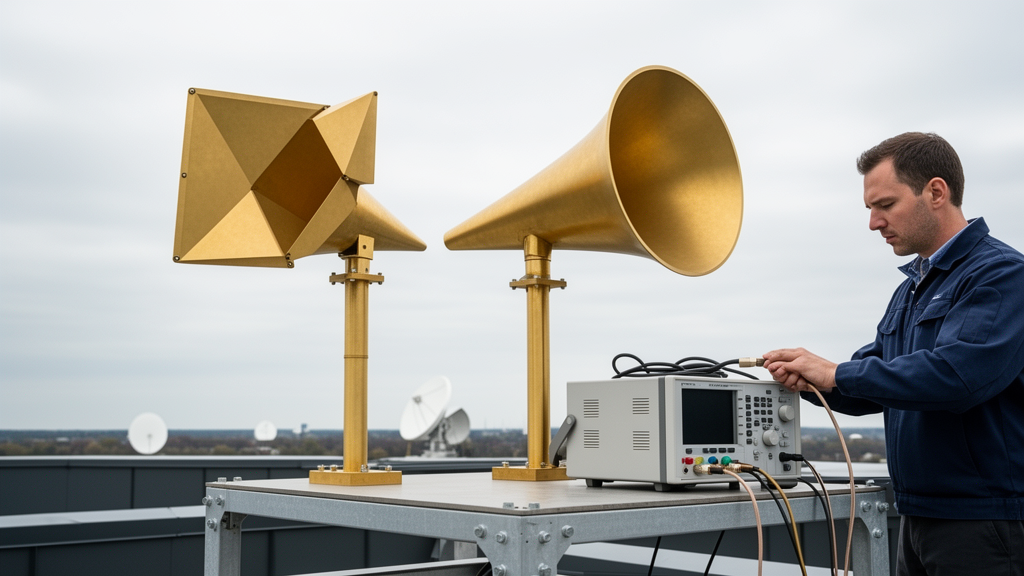
Horn antennas have quietly carried the world’s satellite traffic for decades, from Cold War radar installations to modern geostationary communications platforms. Now, researchers at the National University of Science and Technology Politehnica Bucharest have delivered one of the most thorough head-to-head comparisons yet between the two classic horn geometries, the pyramidal and the conical, in the X-band frequency range of roughly 8 to 12 gigahertz that satellites and ground stations rely on every day. Their conclusion is nuanced but clear: the boxy pyramid wins on raw gain, while the elegant cone is the shape that satellite engineers should keep betting on.
The study, published in Frontiers in Antennas and Propagation by Hatice-Andreea Topal and Teodor Lucian Grigorie, is notable less for any single record-breaking number and more for its methodology. Rather than analyzing one antenna in one simulator, the team designed both structures analytically using classical horn theory implemented in Matlab, then validated each design in two independent electromagnetic environments, Ansys HFSS and CST Studio Suite. This cross-platform approach is a kind of computational sanity check that many antenna papers skip, and it paid off: the two simulators produced results in close agreement, with only minor differences attributable to their fundamentally different numerical engines.
The pyramidal horn, fed by a standard WR-90 rectangular waveguide with interior dimensions of 22.86 by 10.16 millimeters, was designed around a target gain of 22.70 decibels at a central frequency of 10 gigahertz. The aperture measures 178.5 by 145.8 millimeters, with an axial flare length of roughly 323 millimeters. In simulation, the antenna exceeded expectations, delivering a maximum gain of 23.63 decibels with an extraordinarily narrow half-power beamwidth of between 6 and 10 degrees. The reflection coefficient, a measure of how much signal bounces back toward the transmitter instead of radiating into space, dipped as low as minus 39.43 decibels at 8.22 gigahertz in HFSS and an impressive minus 56.18 decibels at 8.07 gigahertz in CST, both comfortably below the minus 10 decibel threshold that defines good impedance matching.
Those numbers matter because a well-matched antenna wastes almost none of the precious power an amplifier sends its way. The Smith chart analysis from the simulations showed the input impedance hugging the ideal 50-ohm target, landing near 50 plus or minus 3 ohms with negligible reactance, which corresponds to a voltage standing wave ratio of approximately 1.05. In practical terms, the pyramidal horn is a highly efficient, laser-focused energy projector, ideal for applications demanding pinpoint directivity and clean linear polarization.
The conical horn tells a different story. Fed by a BY89 circular waveguide 23.825 millimeters in diameter, with a dominant TE11 mode cutoff frequency of 8.67 gigahertz, the cone achieved a maximum gain of 16.43 decibels and a much wider beamwidth of about 30 degrees. Its reflection coefficient stayed below minus 10 decibels across the entire 9-to-12-gigahertz operating range, bottoming out at minus 43 decibels at 11.22 gigahertz in HFSS. That wider, symmetric beam is not a weakness; it is exactly what a reflector feed needs to illuminate a parabolic dish uniformly without spilling energy over the edges.
The real magic of the cone, however, is polarization. By exciting two orthogonal TE11 modes with equal amplitudes and a 90-degree phase difference through a bimodal wave port, the researchers generated circular polarization with an axial ratio below 3 decibels across the main lobe. This is a decisive advantage in satellite communications, where circularly polarized signals tolerate the orientation mismatch that inevitably arises between a moving spacecraft and a ground antenna. The conical design achieved circular polarization discrimination of 57 to 62 decibels on the principal axis, approaching the performance of the corrugated horns flown on operational satellites, yet without any corrugations or added polarizer hardware.
The comparative metrics sharpen the choice further. The conical horn posted an aperture efficiency of roughly 74 percent against about 64 percent for the pyramid, and its slightly higher radiation efficiency, about 96 percent versus 94 percent, follows from its smaller inner surface area and thus lower ohmic loss. Both exceed the 90 percent mark comfortably. In the satellite link budget, a 10 percent aperture efficiency improvement can translate into an additional half to one decibel of system gain, a meaningful margin when every watt counts. The pyramidal horn still dominates where linear polarization and maximum directivity are the goals, with a cross-polarization discrimination of about 62 decibels, far beyond the 30-decibel minimum recommended for satellite systems.
The dual-simulator exercise also yielded instructive engineering lessons about the tools themselves. Ansys HFSS, built on the frequency-domain finite element method with an adaptive tetrahedral mesh, consumed roughly 15 gigabytes of memory and delivered the highest accuracy on curved geometries. CST Studio Suite, using the time-domain finite integration technique with a hexahedral mesh, required only about 1.5 gigabytes and produced broadband results in a single run, though its Fourier-transform-based frequency extraction introduced a shift of roughly 1 gigahertz in the location of the reflection coefficient minimum. A gain discrepancy of 1.63 decibels between platforms for the conical horn fell squarely within the sub-2-decibel spread documented in prior comparative studies of the two solvers.
Beyond the immediate results, the study lays deliberate groundwork for what comes next. The smooth-wall conical horn is the direct geometric ancestor of the conical corrugated horn, the gold-standard feed for satellite reflector systems thanks to its symmetric radiation pattern and minimal cross-polarization. The researchers, working within a broader doctoral project, plan to add corrugations to the validated cone, optimize the corrugation depth and pitch to suppress surface currents, and fabricate a prototype for measurement. The present results serve as the reference baseline against which that upgraded design will be judged.
In an era when mega-constellations and flexible geostationary spacecraft are pushing antenna engineering to new heights, there is something almost reassuring about a study that goes back to fundamentals. The horn antenna, first sketched in the late nineteenth century and battle-tested through radar, radio astronomy, and every satellite generation since, still responds beautifully to careful analytical design and rigorous simulation. What this comparison shows is that the choice between pyramid and cone is not about which antenna is better, but about which task you need done, and for the circularly polarized world of satellite communications, the cone remains the shape of the future.
Subject of Research: Comparative electromagnetic design and simulation of pyramidal and conical horn antennas for X-band satellite communication systems
Article Title: Design and electromagnetic analysis of pyramidal and conical horn antenna for X-band satellite communication systems
Article References: Topal, H.-A., & Grigorie, T. L. (2026). Design and electromagnetic analysis of pyramidal and conical horn antenna for X-band satellite communication systems. Frontiers in Antennas and Propagation, 4, Article 1828476. https://doi.org/10.3389/fanpr.2026.1828476
Image Credits: AI Generated
DOI: 10.3389/fanpr.2026.1828476
Keywords: horn antenna, X-band, satellite communication, pyramidal horn, conical horn, circular polarization, waveguide, Ansys HFSS, CST Studio Suite, reflection coefficient, gain, reflector feed
Cite Scienmag News
Denise Maddox. (October 16, 2026). Pyramidal or Conical? Engineers Compare Two Horn Antennas for X-Band Satellite Links. Scienmag. https://scienmag.com/pyramidal-or-conical-engineers-compare-two-horn-antennas-for-x-band-satellite-links/
Denise Maddox. "Pyramidal or Conical? Engineers Compare Two Horn Antennas for X-Band Satellite Links." Scienmag, 16 October 2026, https://scienmag.com/pyramidal-or-conical-engineers-compare-two-horn-antennas-for-x-band-satellite-links/. Accessed 16 October 2026.
Denise Maddox. "Pyramidal or Conical? Engineers Compare Two Horn Antennas for X-Band Satellite Links." Scienmag. October 16, 2026. https://scienmag.com/pyramidal-or-conical-engineers-compare-two-horn-antennas-for-x-band-satellite-links/


