


Rechargeable aqueous zinc-ion batteries have long been touted as the safe, inexpensive workhorses that could anchor the grid-scale energy storage systems of the future, but a stubborn bottleneck has kept them from fulfilling that promise: finding cathode materials that can swallow and release zinc ions quickly, repeatedly, and without falling apart. Now, a team at the Indian Institute of Technology Indore has shown that an almost embarrassingly simple fix, swapping a quarter of the vanadium atoms in a promising cathode for ordinary iron, dramatically improves nearly every performance metric that matters. The study, published in Frontiers in Batteries and Electrochemistry, demonstrates that iron substitution simultaneously widens the crystal lattice, rewires the electronic structure, and suppresses the chemical dissolution that quietly kills vanadium-based electrodes.
The cathode in question is vanadium dioxide, or VO2, a compound whose open, tunnel-like framework, built from interconnected VO6 octahedra, gives zinc ions ready-made channels to travel through. On paper, VO2 offers a high theoretical capacity for zinc storage. In practice, however, its electronic conductivity is poor, because of the large energy separation between the oxygen 2p states that dominate its conduction band and the vanadium 3d states that dominate its valence band. That gap chokes off charge transport, increases polarization, and degrades performance precisely where batteries need it most, at the high current densities demanded by fast charging and grid balancing. To make matters worse, the strong electrostatic pull between highly polarizing zinc ions and the oxide framework slows diffusion, while vanadium species gradually dissolve into the electrolyte during cycling.
Transition-metal doping has emerged as the go-to strategy for rescuing VO2, with nickel and tungsten among the dopants previously shown to help. Yet iron, despite being earth-abundant, cheap, and environmentally benign, has been surprisingly neglected as a dopant for this application. The IIT Indore team, led by Dhirendra K. Rai with Govind Kumar Maurya and Amit Kumar Singh as co-first authors, reasoned that iron offers a rare combination of advantages. The six-coordinate iron(III) ion has an effective ionic radius of 0.645 angstroms, noticeably larger than the 0.58 angstrom radius of the vanadium(IV) ion it replaces, so substituting iron should physically stretch the lattice and widen the tunnels through which the 0.74 angstrom zinc ions must pass. Moreover, because iron(III) carries a different charge than vanadium(IV), it is an aliovalent dopant, and such substitutions can introduce charge-compensating defects that modify the electronic landscape.
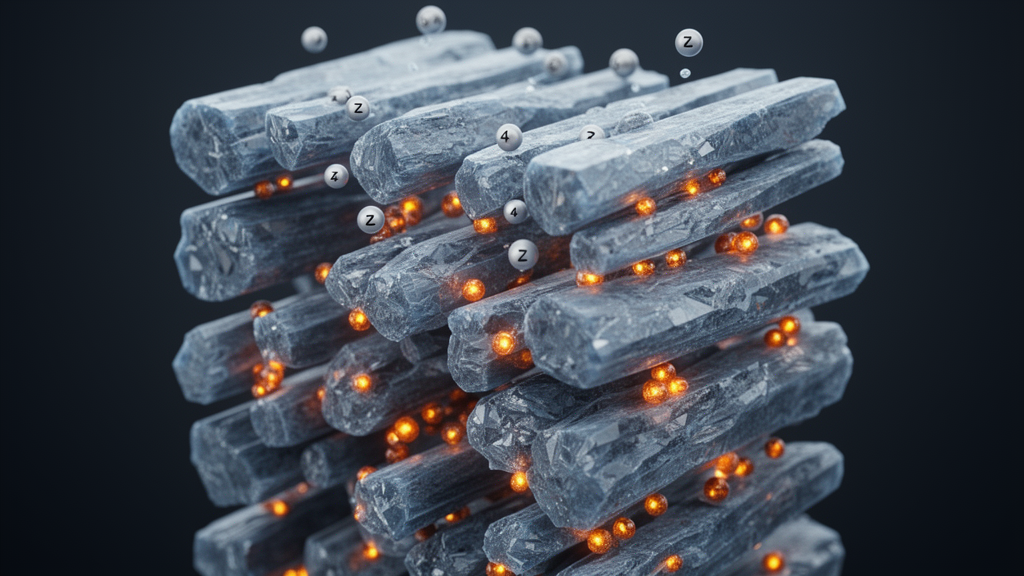
The researchers synthesized a series of iron-substituted cathodes, Fe(x)V(1-x)O2 with iron fractions of 15, 25, and 35 percent, using a one-step hydrothermal method that is about as industrially friendly as battery chemistry gets. Vanadium pentoxide, oxalic acid, hydrogen peroxide, and iron nitrate are dissolved in water, then heated in a sealed Teflon-lined autoclave at 180 degrees Celsius for 24 hours, yielding a blue precipitate of belt-shaped particles roughly 100 to 125 nanometers wide and about a micron long. Powder X-ray diffraction confirmed that all the doped samples retained the triclinic VO2 structure with no impurity phases, and Rietveld refinement of the diffraction patterns quantified the swelling: the unit-cell volume of the 25 percent iron sample grew by about 1.18 percent compared with pristine VO2, expanding from 272.64 to 275.854 cubic angstroms.
Inductively coupled plasma optical emission spectroscopy verified that the iron content matched the intended stoichiometry, while X-ray photoelectron spectroscopy revealed a coexistence of vanadium(IV) and vanadium(V) states alongside both iron(II) and iron(III), along with oxygen species in defect-modified local environments. Raman spectroscopy added an intriguing fingerprint: a new vibrational mode at around 820 wavenumbers after doping, attributed to the formation of V-O-Fe bonds, direct evidence that iron had woven itself into the vanadium oxide framework rather than merely sitting on the surface. Elemental mapping by energy-dispersive X-ray spectroscopy showed iron distributed uniformly throughout the material, with no iron-rich clusters or phase segregation.
When the team assembled the powders into coin cells with zinc foil anodes and a 3 molar zinc triflate aqueous electrolyte, the electrochemical results were striking. The optimized composition, Fe0.25V0.75O2, delivered a specific capacity of 380.11 milliampere-hours per gram at a current density of 0.1 amperes per gram, comfortably above the 339.95 milliampere-hours per gram achieved by pristine VO2 under identical conditions. More impressive still was the behavior under stress. When the current was cranked up fifty-fold to 5 amperes per gram, the doped electrode retained 56 percent of its initial capacity, versus just 32 percent for the undoped material. And when the current was dialed back down, the doped electrode recovered 95.6 percent of its original capacity, against only 74.5 percent recovery for pristine VO2, a sign that the doped framework withstands the strain of aggressive cycling far better.
Impedance spectroscopy helped explain why. The interfacial charge-transfer resistance of the doped electrode dropped from 58.67 ohms to 25.59 ohms, and the Warburg coefficient, a measure of diffusion-related impedance, fell from 7.04 times ten to the fourth to 2.04 times ten to the fourth ohm-seconds to the one-half, indicating much faster ion transport. Cycling tests reinforced the picture of a tougher material: the doped electrode kept 81.11 percent of its capacity after 50 cycles at 0.1 amperes per gram, where pristine VO2 retained a mere 28.85 percent, and it held 82.75 percent after 500 demanding cycles at 2 amperes per gram, compared with 32.78 percent for the undoped cathode. Post-cycling microscopy showed the pristine electrode fragmenting and accumulating surface deposits, while the doped electrode resisted morphological degradation noticeably better.
Perhaps the most consequential number came from analyzing the electrolyte after 100 charge-discharge cycles: the dissolved vanadium concentration fell from 0.78 parts per million for pristine VO2 to just 0.06 parts per million for the doped sample, a reduction of approximately 92.3 percent. The team attributes this to an inductive effect within the local V-O-Fe environment. Because the larger, lower-valent iron(III) ion polarizes surrounding oxide ions less strongly than vanadium(IV) does, substituting it redistributes electron density across the V-O-Fe linkage and stabilizes the neighboring vanadium-oxygen bonds, making vanadium far less eager to leach into the electrolyte. Kinetic analysis of cyclic voltammetry data using Dunn’s method added a further nuance: the capacitive contribution to charge storage rose from roughly 75 percent in pristine VO2 to about 85 percent in the doped material at a scan rate of 0.6 millivolts per second. The authors caution that this should be read as evidence of faster, less diffusion-limited charge storage, potentially including rapid proton insertion alongside zinc ions, rather than purely surface-level charge storage.
To understand the electronic side of the story, the team turned to density functional theory calculations with on-site Coulomb corrections for the strongly correlated d electrons. The calculations predicted that substituting iron narrows the band gap of VO2 from about 1.6 to 0.8 electronvolts, as iron 3d states hybridize with the pre-existing vanadium 3d and oxygen 2p states, pushing more electronic states up to the Fermi level and easing charge-carrier mobility. Differential charge-density maps visualized the corresponding redistribution of electrons around the iron-oxygen-vanadium environment. Strikingly, the prediction matched experiment: Tauc analysis of optical absorption data gave a band gap of 1.86 electronvolts for pristine VO2 but only 0.84 electronvolts for the doped material, an experimental confirmation of the computational picture. Better electronic conductivity, faster charge transfer, and wider ion pathways thus form a coherent, mutually reinforcing explanation for the performance gains.
There is, of course, a limit to the magic. Pushing the iron content to 35 percent actually reduced capacity below the 25 percent optimum, because every vanadium atom replaced is one fewer multielectron-active redox center available to store charge. Beyond a certain point, the kinetic benefits of doping can no longer compensate for the lost storage capacity, and the trade-off tips the other way. Even so, the overall message is hard to overstate for a field hunting affordable solutions: a dopant that costs pennies, extracted from one of the most abundant elements in the Earth’s crust, delivered capacity, rate capability, cycling stability, and dissolution resistance that compete with or exceed cathodes doped with scarcer, pricier metals. If aqueous zinc-ion batteries are to move from laboratory curiosity to the racks of grid-scale storage facilities, engineering tricks as simple, scalable, and cheap as this one may be exactly what tips the balance.
Subject of Research: Iron-substituted VO2 cathodes for aqueous zinc-ion batteries
Article Title: Engineering the structural and electronic properties of VO2 through Fe substitution for high-performance aqueous zinc-ion batteries
Article References: Maurya, G. K., Singh, A. K., Chaudhary, N., Gupta, S., Singh, K., Bhowmik, S., & Rai, D. K. (2026). Engineering the structural and electronic properties of VO2 through Fe substitution for high-performance aqueous zinc-ion batteries. Frontiers in Batteries and Electrochemistry, 5, Article 1923272. https://doi.org/10.3389/fbael.2026.1923272
Image Credits: AI Generated
DOI: 10.3389/fbael.2026.1923272
Keywords: aqueous zinc-ion batteries, VO2 cathode, iron doping, vanadium dioxide, energy storage, band gap engineering, Rietveld refinement, DFT calculations, vanadium dissolution, hydrothermal synthesis, pseudocapacitance, grid-scale batteries
Cite Scienmag News
Denise Maddox. (October 15, 2026). Cheap Iron Doping Supercharges Vanadium Dioxide Cathodes for Zinc-Ion Batteries. Scienmag. https://scienmag.com/cheap-iron-doping-supercharges-vanadium-dioxide-cathodes-for-zinc-ion-batteries/
Denise Maddox. "Cheap Iron Doping Supercharges Vanadium Dioxide Cathodes for Zinc-Ion Batteries." Scienmag, 15 October 2026, https://scienmag.com/cheap-iron-doping-supercharges-vanadium-dioxide-cathodes-for-zinc-ion-batteries/. Accessed 15 October 2026.
Denise Maddox. "Cheap Iron Doping Supercharges Vanadium Dioxide Cathodes for Zinc-Ion Batteries." Scienmag. October 15, 2026. https://scienmag.com/cheap-iron-doping-supercharges-vanadium-dioxide-cathodes-for-zinc-ion-batteries/


