


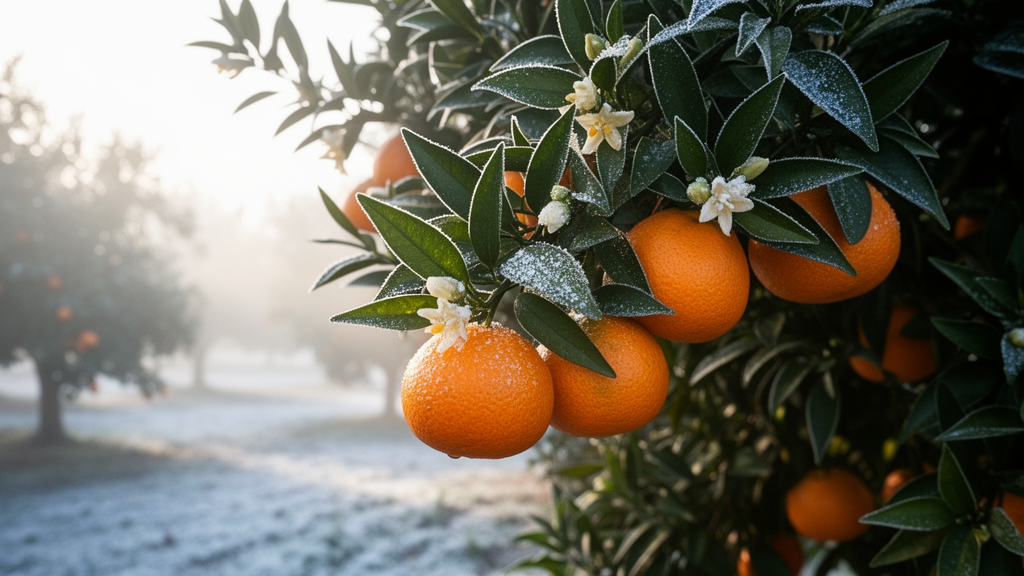
On the Mediterranean island of Corsica, citrus farming is more than an agricultural tradition; it is a protected brand. ‘Clementine de Corse’ and ‘Pomelo de Corse’ both carry Protected Geographical Indication status, and more than 80 percent of clementines and 67 percent of pomelos are sold under these quality labels. Yet the island’s citrus calendar has a stubborn hole. Clementine harvests wind down between December and January, while pomelo picking does not begin until May or June. In the intervening months, imported fruit floods local markets, squeezing growers who depend on freshness and regional identity as their selling points. A new field study, published in Frontiers in Plant Physiology, suggests that an experimental triploid mandarin hybrid known as W9 could close that gap, and the reason lies in an unexpected place: the way its leaves manage reactive oxygen molecules through the cold season.
The hybrid W9 was born from a breeding program launched in the early 2000s at the INRAE research center in San Giuliano, Corsica, crossing Fortune mandarin, used as the female parent, with Ellendale tangor, a mandarin-sweet orange hybrid prized for flavor and late maturity around April. Fortune was chosen because it reliably produces a high proportion of triploid offspring, while Ellendale contributed organoleptic quality and lateness. Triploid plants carry three sets of chromosomes instead of the usual two, a configuration that makes them almost entirely seedless, a trait consumers strongly prefer. The W9 selection was picked by scientific experts and producers through sensory and pomological evaluation, grafted onto the widely used C35 citrange rootstock, and planted in a commercial-style orchard to see how it would perform under real growing conditions rather than in a greenhouse.
Polyploidy, the possession of extra chromosome sets, is a common phenomenon in plants and has become a deliberate tool in fruit breeding. Polyploid plants often show thicker leaves, altered stomatal density, improved water-use efficiency, and better management of reactive oxygen species, the chemically reactive molecules such as hydrogen peroxide that accumulate when photosynthesis is stressed. Tetraploid rootstocks have been studied extensively for drought, salinity, and even disease resistance, but triploidy applied at the scion level, the fruiting top of the grafted tree, remains poorly documented. Previous work on W9’s siblings showed enhanced tolerance to natural chilling and a greater capacity to recover from water deficit, hinting that the triploid condition itself might confer physiological advantages. The new study set out to test whether those laboratory and nursery findings would hold up across a full year of open-field weather.
The researchers monitored three eight-year-old varieties in an orchard at Aléria, all grafted onto the same diploid C35 citrange rootstock: the diploid clementine, the diploid ‘Star Ruby’ grapefruit (the pomelo of Corsican production), and the triploid W9. Sampling took place on sunny days in four seasons, from July 2023 through April 2025, with mean temperatures ranging from 25.1 degrees Celsius in summer to just 9.3 degrees in winter. On each date, the team measured gas exchange parameters including net photosynthetic rate, stomatal conductance, transpiration, and intrinsic water-use efficiency, along with chlorophyll fluorescence, which reveals the efficiency of the photosystem II machinery. Leaves were then flash-frozen in liquid nitrogen for biochemical analysis of oxidative stress markers, ascorbate pools, and the activities of four key antioxidant enzymes.
The results painted a picture dominated first by season and only second by genotype. A principal component analysis showed that the first two components explained 56.74 percent of total variance, with warm-period samples clustering on the side of high photosynthetic performance and cold-period samples on the side of activated ascorbate metabolism. All three varieties saw their photosynthetic rates, stomatal conductance, and transpiration drop significantly between the warm summer-autumn period and the cold winter-spring period, and their maximum quantum efficiency of photosystem II fell below 0.75, a classic sign of cold-induced photoinhibition. Pomelo maintained the highest photosynthetic values across nearly all seasons, peaking at 13.28 micromoles of carbon dioxide per square meter per second in autumn, while clementine and W9 tracked each other closely, with W9 edging ahead in gas exchange during spring.
The striking differences emerged in the redox data. During spring, its harvest window, W9 consistently maintained the lowest levels of hydrogen peroxide and malondialdehyde, the latter a breakdown product of lipid peroxidation that serves as a fingerprint of oxidative damage to cell membranes. In the multivariate analysis, W9’s spring samples grouped near reduced ascorbate, the active antioxidant form of vitamin C, while clementine’s spring samples clustered with dehydroascorbate, the oxidized form, reflecting an inability to keep pace with oxidative pressure. Quantitatively, W9 reached 6.43 micromoles of reduced ascorbate per gram of fresh weight in spring, the highest of any variety in any season, and its ascorbate-to-dehydroascorbate ratio stood at 1.86 in spring, compared with just 0.65 for clementine.
The enzymatic machinery behind this stability tells a coherent mechanistic story. W9 showed higher catalase activity than clementine in winter and spring, and in spring its ascorbate peroxidase activity reached 0.35 units per milligram of protein, above both references. Most telling was dehydroascorbate reductase, the enzyme that recycles oxidized ascorbate back into its reduced, radical-scavenging form. DHAR activity declined in pomelo and clementine during winter but remained elevated in W9 through winter and spring. The authors conclude that W9 does not simply manufacture more ascorbate through the Smirnoff-Wheeler biosynthetic pathway; it recycles the existing pool more efficiently, keeping the antioxidant arsenal charged precisely when cold nights and rising spring light create the most dangerous conditions for photoinhibition and reactive oxygen formation. Notably, proline, an osmoprotectant often implicated in stress tolerance, did not differ among varieties in spring, indicating that W9’s advantage rests on enzymatic and redox pathways rather than osmotic adjustment.
Why would three chromosome sets produce this effect? The researchers point to a possible gene dosage effect, in which extra copies of antioxidant genes amplify the expression of catalase, ascorbate peroxidase, and DHAR, along with larger cell compartments and more efficient compartmentalization of redox reactions observed in earlier anatomical studies of related triploid hybrids. Genetic parentage likely matters too: Fortune mandarin is known to be cold-tolerant, and chilling tolerance in citrus is consistently linked to strong reactive oxygen scavenging, whereas the Ellendale tangor parent is cold-sensitive and prone to excess electron leakage during cold periods. The authors also caution that scion-rootstock interactions cannot be ruled out, since even with all trees on the same C35 citrange rootstock, bidirectional signaling between root and shoot, including hormone transport, may differ depending on the scion’s ploidy. Testing W9 on a broader range of rootstocks would establish whether its redox superiority is a constitutive triploid trait or a product of this particular grafting combination.
The practical implications reach beyond plant physiology. Because W9 ripens late, its harvest coincides exactly with the production gap that currently forces Corsican retailers to rely on imports, and its ability to hold redox homeostasis during fruit maturation, when the developing crop acts as a heavy metabolic sink that induces systemic oxidative stress, promises more stable yields and fruit quality in that window. The study also delivers the first seasonal antioxidant profile of ‘Star Ruby’ grapefruit under natural Corsican conditions, confirming its effective acclimation through robust photosynthesis. Combining clementine, pomelo, and W9 in island orchards could build a continuous production calendar from winter into late spring, reinforce the value of geographical indications, and reduce the climate-related widening of the off-season gap. For a sector built on quality rather than volume, a seedless, late-ripening, cold-resilient mandarin may prove to be exactly the missing piece.
Subject of Research: Seasonal physiological and antioxidant responses of a new late-ripening triploid mandarin hybrid in Mediterranean field conditions
Article Title: Physiological and redox status properties of a new late-ripening triploid hybrid mandarin: a seasonal field evaluation
Article References: Allegrini, B., Venturini, L.-M., Oustric, J., Julhia, L., Froelicher, Y., Berti, L., Lourkisti, R., & Santini, J. (2026). Physiological and redox status properties of a new late-ripening triploid hybrid mandarin: a seasonal field evaluation. Frontiers in Plant Physiology, 4, Article 1896981. https://doi.org/10.3389/fphgy.2026.1896981
Image Credits: AI Generated
DOI: 10.3389/fphgy.2026.1896981
Keywords: triploid citrus, mandarin hybrid, redox homeostasis, chilling tolerance, antioxidant enzymes, ascorbate, photosynthesis, Corsica, late ripening, polyploidy, oxidative stress, Mediterranean agriculture
Cite Scienmag News
Drew Townsend. (October 15, 2026). Triploid Mandarin Hybrid W9 Keeps Its Antioxidant Edge Through the Cold Season. Scienmag. https://scienmag.com/triploid-mandarin-hybrid-w9-keeps-its-antioxidant-edge-through-the-cold-season/
Drew Townsend. "Triploid Mandarin Hybrid W9 Keeps Its Antioxidant Edge Through the Cold Season." Scienmag, 15 October 2026, https://scienmag.com/triploid-mandarin-hybrid-w9-keeps-its-antioxidant-edge-through-the-cold-season/. Accessed 15 October 2026.
Drew Townsend. "Triploid Mandarin Hybrid W9 Keeps Its Antioxidant Edge Through the Cold Season." Scienmag. October 15, 2026. https://scienmag.com/triploid-mandarin-hybrid-w9-keeps-its-antioxidant-edge-through-the-cold-season/


