


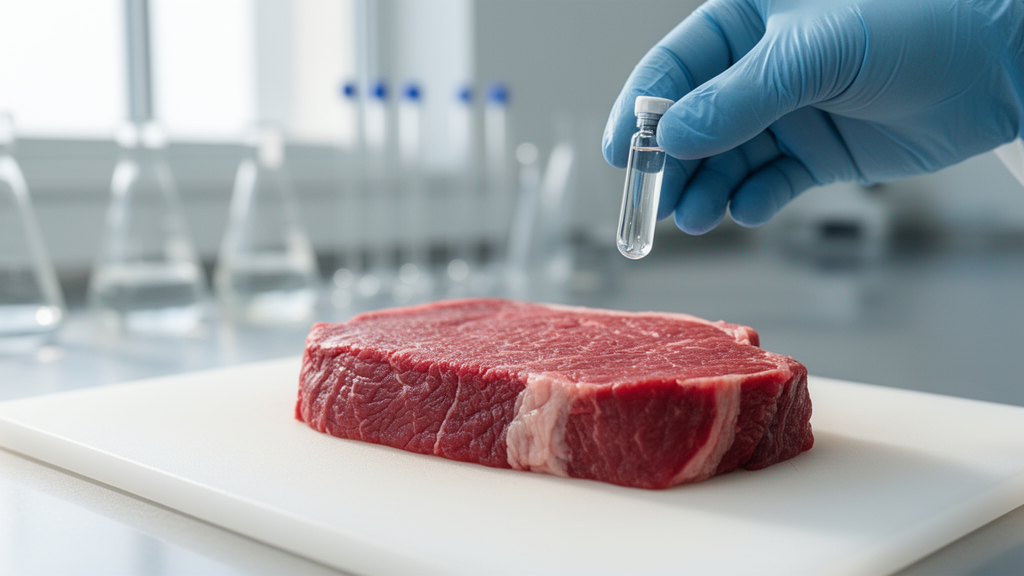
Chemists in China have created a family of ten new hybrid molecules that combine two of medicinal chemistry’s most reliable building blocks, and the standout compound does something remarkable: it neutralizes free radicals in laboratory tests more potently than vitamin C, and it also keeps raw beef patties looking freshly cut during a week of refrigerated storage. The work, published in Frontiers in Chemistry by Tao Wang, Lingling Xiao, Yanling Ren and colleagues at Guizhou Light Industry Polytechnic University, illustrates how a rational molecular design strategy can yield candidates with potential value in both drug discovery and food preservation.
The team’s approach rests on the hybrid-molecule concept, in which two distinct bioactive pharmacophores are covalently joined into a single chemical skeleton so that their complementary strengths reinforce one another. The first fragment is indole, a ring system found throughout nature in molecules such as tryptophan and serotonin, and in approved drugs including indomethacin and sumatriptan. Indole derivatives are known to combat oxidative damage through several routes: directly scavenging reactive oxygen species, chelating pro-oxidant metal ions, boosting endogenous antioxidant enzymes, and dampening inflammation. Because the indole core tolerates chemical modification at many positions, chemists can fine-tune its lipophilicity, solubility, and metabolic stability with relative precision.
The second fragment, thiosemicarbazide, is a sulfur- and nitrogen-rich unit whose electron-donating heteroatoms readily surrender hydrogen atoms and electrons to neutralize free radicals. It can also coordinate metal ions through its sulfur and nitrogen atoms, blocking the Fenton-like reactions that generate highly destructive hydroxyl radicals. Thiosemicarbazide derivatives have separately shown anti-inflammatory, anticancer, and antiviral activity, and the moiety often improves how candidate drugs bind their biological targets and survive metabolism. Fusing these two fragments was therefore a deliberate bet that the whole molecule would exceed the sum of its parts.
Synthesis proceeded from commercially available 3-indolepropionic acid in three steps: esterification in methanol with sulfuric acid catalysis, conversion to a hydrazide using hydrazine monohydrate, and final condensation with a series of isothiocyanates under reflux. The ten products, labeled 4a through 4j, were obtained as brown crystalline solids in yields of 51 to 62 percent and were fully verified by proton and carbon-13 nuclear magnetic resonance spectroscopy together with high-resolution mass spectrometry. For the champion compound, designated 4i, the mass spectrometric peak for its sodium adduct matched the calculated value for the formula C18H17ClN4OS to within five parts per million, confirming the proposed structure unambiguously.
Radical-scavenging assays delivered the first headline result. In the ABTS test, every derivative inhibited the radical in a concentration-dependent fashion, and at six micrograms per milliliter six of the ten compounds achieved complete scavenging. The half-maximal inhibitory concentrations spanned 0.96 to 2.21 micrograms per milliliter, several of which undercut vitamin C’s benchmark of 1.87. Compound 4i, which carries a 4-chlorophenyl substituent on the thiosemicarbazide nitrogen, led the field at 0.96 micrograms per milliliter, followed closely by the allyl-substituted 4e at 1.00. In the more demanding DPPH assay, 4i again performed best among the series at 2.95 micrograms per milliliter, approaching vitamin C’s 1.99. The pattern suggests that the para-chloro aromatic group enhances the electron distribution across the molecule in a way that favors radical capture.
To understand what such a molecule might do inside living systems, the researchers turned to computational modeling against human peroxiredoxin 5, a thioredoxin-dependent peroxidase that defends cells against oxidative damage. Molecular docking placed 4i deep in the enzyme’s catalytic pocket, anchored by conventional hydrogen bonds to the residues Gly92 and Val94, while its two aromatic rings engaged in amide-pi stacking with Gln68 and Ala90 and additional alkyl and pi-alkyl contacts with Val70 and Arg86. A 100-nanosecond molecular dynamics simulation in GROMACS then tested whether this pose would hold up under realistic thermal motion. The protein backbone and the ligand equilibrated within roughly 20 nanoseconds and thereafter fluctuated around stable averages of about 0.25 and 0.30 nanometers respectively, the protein’s radius of gyration held near 1.44 nanometers, and the complex maintained one to five hydrogen bonds throughout the trajectory. Energy decomposition singled out Val70 and Val69 as the dominant contributors to binding, and the calculated binding free energy of approximately minus 45 kilojoules per mole remained favorable across the simulation.
The authors are careful to frame these simulations as predictions rather than proof. Molecular dynamics energy estimates do not constitute experimental validation of true binding affinity, and no enzyme-level assay has yet tested whether 4i actually modulates peroxiredoxin 5’s catalytic function. Computational ADMET predictions from the Deep-PK platform, alongside a SwissADME drug-likeness analysis, suggested favorable absorption, distribution, metabolism, excretion, and safety characteristics, and the compound satisfies all four criteria of Lipinski’s rule of five, a widely used screen for oral bioavailability potential. But the researchers themselves stress that such in silico results are preliminary and cannot substitute for pharmacological or toxicological experiments.
Where the compound produced genuinely tangible results was in meat. The team dissolved 4i in edible alcohol at nominal concentrations of 0.005, 0.01, and 0.015 percent by meat weight, mixed it into minced beef tenderloin from cross-bred yellow cattle, and shaped the meat into 50-gram patties stored at 4 degrees Celsius for seven days alongside a vitamin C-treated group and an untreated control. Discoloration in fresh beef is driven largely by oxidation of myoglobin, the heme protein responsible for meat’s red hue. When the oxygenated form, oxymyoglobin, is oxidized to brown metmyoglobin, shoppers perceive the meat as stale. By day seven, metmyoglobin accounted for 76.39 percent of the myoglobin in the untreated controls, whereas patties treated with 0.015 percent 4i accumulated only 49.76 percent, a statistically significant improvement that also beat vitamin C at the same concentration.
Instrumental color measurements reinforced the visual evidence. The redness parameter, a*, declined in every group over storage, but the decline was dose-dependently blunted by 4i, leaving the highest-treated patties with the brightest redness on day seven. pH, which rises during storage as microbes proliferate and proteins break down into alkaline products, climbed less steeply in the 4i groups than in either the control or the vitamin C group, an important secondary benefit because elevated pH correlates with poorer color stability. Photographs captured the difference plainly: untreated samples began browning visibly by day three and were severely discolored by day seven, while the 0.015 percent 4i patties retained the most appealing appearance of any treatment.
The dual promise of this single small molecule, as both an antioxidant lead for drug development and a candidate protective agent for fresh meat, is what makes the study notable, but the authors are equally clear about the distance to any practical application. No residue data, acceptable daily intake values, or toxicological results exist yet for 4i, so consumer exposure and dietary risk cannot be evaluated, and comprehensive food-safety assessment is mandatory before any real-world use. The meat findings may also reflect factors beyond direct radical scavenging, including pH shifts, microbial metabolism, and oxygen availability. What the study firmly establishes is that fusing indole with thiosemicarbazide is a viable blueprint for designing potent antioxidants, and that compound 4i, with its vitamin C-surpassing ABTS activity, stable predicted binding to a human antioxidant enzyme, and demonstrable color-protecting power in beef, has earned a place in the pipeline for further structural optimization, enzyme validation, and in vivo evaluation.
Subject of Research: Synthesis and antioxidant evaluation of novel indole-thiosemicarbazide derivatives for drug leads and beef preservation
Article Title: Novel indole derivatives containing a thiosemicarbazide moiety as potential antioxidant agents for fresh beef preservation
Article References: Wang, T., Xiao, L., Ren, Y., Wu, M., Liu, Y., Tang, J., Wan, S., & Peng, J. (2026). Novel indole derivatives containing a thiosemicarbazide moiety as potential antioxidant agents for fresh beef preservation. Frontiers in Chemistry, 14, Article 1994186. https://doi.org/10.3389/fchem.2026.1994186
Image Credits: AI Generated
DOI: 10.3389/fchem.2026.1994186
Keywords: antioxidants, indole derivatives, thiosemicarbazide, free radical scavenging, molecular docking, molecular dynamics, peroxiredoxin 5, ADMET, meat preservation, myoglobin oxidation, beef color stability, medicinal chemistry
Cite Scienmag News
Louis Brooks. (October 15, 2026). Designer Molecules That Outperform Vitamin C Could Keep Fresh Beef Red for Longer. Scienmag. https://scienmag.com/designer-molecules-that-outperform-vitamin-c-could-keep-fresh-beef-red-for-longer/
Louis Brooks. "Designer Molecules That Outperform Vitamin C Could Keep Fresh Beef Red for Longer." Scienmag, 15 October 2026, https://scienmag.com/designer-molecules-that-outperform-vitamin-c-could-keep-fresh-beef-red-for-longer/. Accessed 15 October 2026.
Louis Brooks. "Designer Molecules That Outperform Vitamin C Could Keep Fresh Beef Red for Longer." Scienmag. October 15, 2026. https://scienmag.com/designer-molecules-that-outperform-vitamin-c-could-keep-fresh-beef-red-for-longer/


