


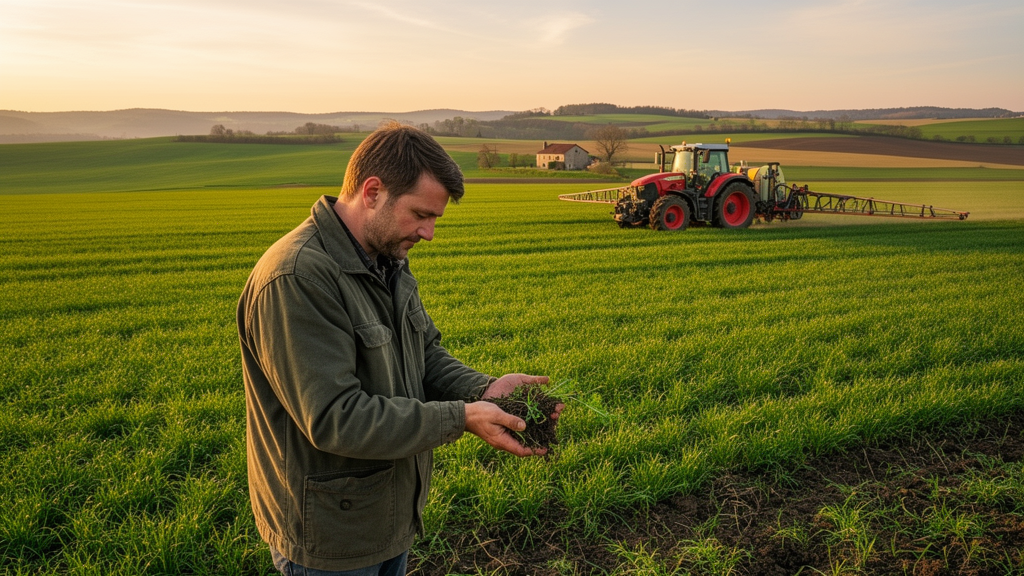
Europe wants half its pesticides gone by 2030, and nowhere is that ambition harder to deliver than in weed control. Chemical herbicides are cheap, reliable, and woven into the daily mechanics of nearly every European cropping system. The alternatives—mechanical hoes, cover crops, mulches, camera-guided precision sprayers, and wholesale ecological redesign—are technically mature, yet they remain marginal on the continent’s farmland. A new study drawing on twenty real-world case studies across seven countries now offers the most detailed explanation yet for this stubborn adoption gap: the alternatives work, society benefits from them, but the farmers who deploy them mostly lose money.
The research, published in Frontiers in Environmental Economics by Luciano Pagano of the University of Pisa and colleagues within the EU-funded OPER8 thematic network, set out to do something unusually ambitious. Rather than testing weed-management techniques in experimental plots, the team assembled a portfolio of twenty non-chemical weed management practices that had already been deployed under commercial conditions by farmers in France, Italy, Greece, Spain, Latvia, the United Kingdom, and Sweden. These cases, sourced from so-called Operational Groups and innovation networks, were then aggregated into five functional clusters: mechanical weeding, cover crops, mulching, precision farming, and ecological management. The cluster-level approach was deliberate. The authors argue that policies such as the Common Agricultural Policy need to address families of practices with comparable cost structures and co-benefits, not one-off showcase examples.
The analytical machinery behind the comparison is substantial. Each practice was benchmarked against its conventional herbicide-based counterpart over a twenty-year horizon using cost–benefit analysis, with all flows discounted at 4 percent and normalized per hectare. Machinery was assumed to be replaced on ten-year economic cycles, shorter tools on seven-year cycles, and transaction costs—the often-invisible expenses of learning, coordination, and monitoring—were explicitly included at 40.2 euros per hectare per year. Uncertainty was probed through sensitivity analysis of the discount rate and a Monte Carlo procedure running 1,000 simulations per case with low, default, and high values for each monetized variable. The resulting headline metric was the net present value per hectare, a single number telling farmers whether an alternative would enrich or impoverish them over two decades.
Money alone, however, cannot capture what these practices do for soil, water, biodiversity, and rural communities. The team therefore built a second, qualitative branch of assessment: a traffic-light indicator composed of nineteen indicators, ten social and nine environmental, ranging from occupational safety and farmers’ education to soil erosion, biodiversity, and greenhouse-gas emissions. Each indicator was weighted according to its causal proximity to the practice and its expected time horizon, with direct, short-term effects counting more heavily. Farmers and stakeholders scored every indicator on a five-point Likert scale through questionnaires and seven national workshops involving 161 participants, including a thirty-one-expert European workshop that co-designed the criteria. The weighted scores were then rescaled to a zero-to-100 composite Socio-Environmental Impact Score, with green status awarded above 67 points.
The two branches were finally fused into what the authors call a Dual-Axis Sustainability Matrix, a portfolio-analysis device plotting median net present value on one axis and socio-environmental score on the other. Its four quadrants—win–win innovations, trade-offs, public-good-dominant innovations, and non-viable options—form a diagnostic map of where Europe’s weed-control transition stands. The picture that emerges is not a binary split between viable and hopeless techniques but a continuum, in which nearly everything generates environmental value while almost nothing generates private profit.
The single glaring exception is cover crops. Across three cases in France, Greece, and Italy, living vegetative covers between crop rows produced the only positive median net present value in the entire portfolio, at plus 2,902 euros per hectare, while simultaneously scoring 70.6 points on the socio-environmental scale—high enough for a green light. The Monte Carlo simulations reinforced this: the median probability that cover crops beat their herbicide baseline was 0.88, far above any other cluster. The agronomy is straightforward—legume–grass mixtures suppress weeds, build soil fertility, control erosion, and feed pollinators—but the economics are the real revelation. With low-to-medium capital requirements dominated by seeds and management rather than machinery, cover crops are the closest Europe has come to a self-scaling herbicide alternative.
Everything else struggles. Mechanical weeding, with five cases spanning inter-row hoes, finger rollers, and hot-foam systems, came closest to breaking even among the losers at a median of minus 2,859 euros per hectare, with a medium socio-environmental score of 61.9. Precision farming—GPS-guided, camera-equipped spot spraying across six cases—posted minus 4,329 euros per hectare and the lowest socio-environmental score of the five clusters at 55.5, reflecting the heavy capital burden of digital equipment and data management. Mulching fared worst in pure financial terms: despite generating the highest median benefits in the portfolio at 18,491 euros per hectare, its median net present value collapsed to minus 20,690 euros, crushed by recurring costs of organic materials, labor, transport, and application that recur every season and scale with treated area. Unlike machinery, whose fixed costs can be diluted through cooperative sharing or contractor services, mulch must be bought and hauled again and again.
Perhaps most striking is ecological management, the cluster of system-level redesigns such as false seedbeds, cultural control, grazing, and agroforestry tested in Greece and Spain. It earned the highest socio-environmental score of all, 71.8, rewarding carbon sequestration, erosion prevention, and landscape-scale biodiversity, yet it carried a median net present value of minus 17,584 euros per hectare. This is the textbook profile of a public good: benefits that accrue to society at large, diffuse across the landscape, and arrive years after the farmer has absorbed the costs. The authors interpret this pattern through the lens of temporal asymmetry—costs are paid early and privately, while ecological dividends are delayed and shared—which they identify as the central governance challenge of the entire agro-ecological transition.
What follows for policy is a differentiated prescription rather than a single subsidy formula. The study argues that mechanical and precision weeding, hovering near viability, would respond best to cooperative machinery rings, shared services, investment support, training, and soft loans that de-risk digital adoption. Cover crops, already profitable, need instruments that stabilize adoption and reward verified ecosystem outcomes, making them natural candidates for result-based eco-schemes. Ecological management and mulching, whose public benefits outstrip private returns, require longer-term architecture: payments for ecosystem services, collective or landscape-scale contracts, and risk-sharing instruments such as performance-linked insurance and blended finance. Digitalization, the authors stress, is not a side note but a potential enabler—remote sensing, in-field sensors, and digital field records could make result-based payments verifiable and credible, provided advisory capacity and data governance keep the system inclusive.
The authors are candid about the limits of their evidence. Twenty purposively selected cases, clustered into groups of three to six, yield descriptive rather than statistically representative results, and the participating farms were drawn from innovation networks already committed to herbicide-free experimentation, which may flatter both economic and socio-environmental performance. The traffic-light indicator, for all its structure, remains a judgement-based composite. Yet the framework itself may prove the study’s most durable contribution. By refusing to collapse financial performance and socio-ecological value into a single metric, the dual-axis approach offers a transferable diagnostic for other transitions where private and public value diverge—carbon farming, nutrient management, biodiversity schemes—and a concrete evidence base for the performance-based governance that the reformed Common Agricultural Policy and the Green Deal will demand. The message for Europe’s policymakers is stark: the tools to quit herbicides exist, but until incentives catch up with the value farmers create for everyone else, adoption will remain a moral appeal rather than a business decision.
Subject of Research: Economic and socio-environmental evaluation of non-chemical weed management practices across European farming systems
Article Title: Bridging private and public benefits in sustainable weed management: insights from the OPER8 European network
Article References: Pagano, L., Antichi, D., Darra, N., Kriezi, O., Travlos, I., Rodríguez-Rigueiro, F. J., Mosquera-Losada, M. R., Prezman, F., Guilbert, C., Tatnell, L., Cook, S., Smee, M., Bērziņa, I., Tramacere, L. G., Fountas, S., & Vergamini, D. (2026). Bridging private and public benefits in sustainable weed management: insights from the OPER8 European network. Frontiers in Environmental Economics, 5, Article 1746729. https://doi.org/10.3389/frevc.2026.1746729
Image Credits: AI Generated
DOI: 10.3389/frevc.2026.1746729
Keywords: non-chemical weed management, cover crops, cost-benefit analysis, Common Agricultural Policy, European Green Deal, agro-ecological transition, precision farming, ecosystem services, result-based payments, sustainable agriculture, OPER8 network, socio-environmental assessment
Cite Scienmag News
Alan Morgan. (October 15, 2026). Europe’s Weed-Killing Dilemma: Why Farmers Lose Money on Green Alternatives. Scienmag. https://scienmag.com/europes-weed-killing-dilemma-why-farmers-lose-money-on-green-alternatives/
Alan Morgan. "Europe’s Weed-Killing Dilemma: Why Farmers Lose Money on Green Alternatives." Scienmag, 15 October 2026, https://scienmag.com/europes-weed-killing-dilemma-why-farmers-lose-money-on-green-alternatives/. Accessed 15 October 2026.
Alan Morgan. "Europe’s Weed-Killing Dilemma: Why Farmers Lose Money on Green Alternatives." Scienmag. October 15, 2026. https://scienmag.com/europes-weed-killing-dilemma-why-farmers-lose-money-on-green-alternatives/


