


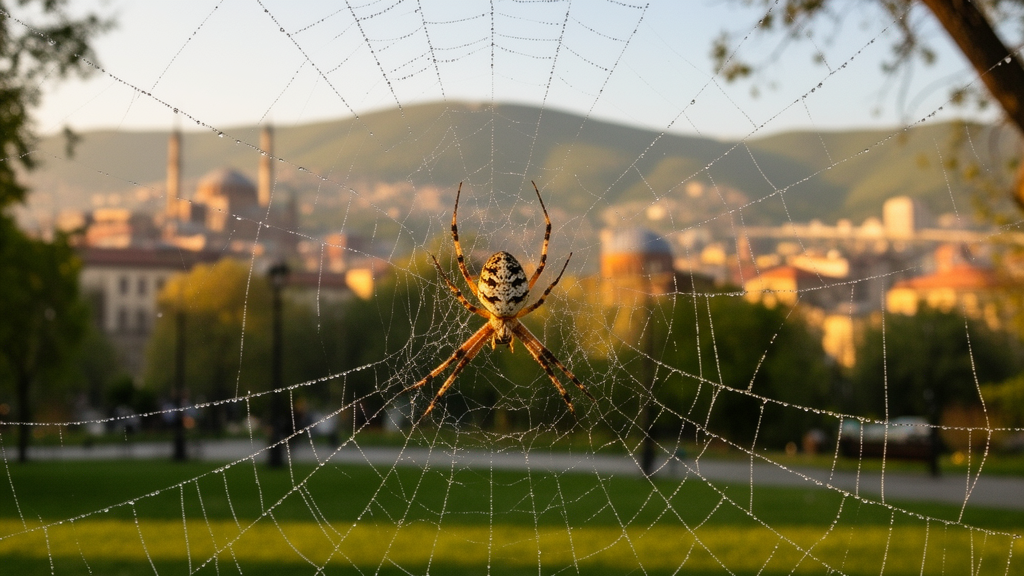
In the sprawling capital of Georgia, where apartment blocks have crept steadily outward into steppe and scrubland over the past two decades, spiders have been quietly documenting the story of urbanisation in their own way. A new study published in the journal Caucasiana reports three species never before recorded in the country, one of which is entirely new to the entire Caucasus region. All three were found within or near Tbilisi, a city whose built-up footprint has expanded by roughly fifteen percent since the early 2000s, and the findings add fresh weight to a growing scientific consensus: cities, for all their concrete and traffic, remain surprisingly productive frontier zones for arachnology.
The new country records are Tolokonniella stigmatisata, a tiny mesh-web weaver now placed in the recently erected family Lathyidae, and Scotargus pilosus, a yellowish-orange sheet-web spider belonging to the family Linyphiidae. Alongside them, the ground spider Drassodes serratichelis, a member of the family Gnaphosidae, makes its first appearance in the Caucasus ecoregion. Each identification was confirmed through careful morphological examination of the spiders’ genital structures, the gold standard in spider taxonomy, using specimens preserved in the scientific collections of Ilia State University’s Institute of Zoology in Tbilisi.
What makes these records remarkable is the historical baseline against which they are measured. In the early 2000s, an exhaustive survey by Georgian arachnologist Pkhakadze documented 252 spider species from Tbilisi and its surroundings, a figure long treated as the definitive account of the city’s arachnid fauna. Since then, despite the relentless growth of the urban fabric, continued research has pushed the city’s species count to 371. That total includes 119 species added to the local fauna in the past two decades, 63 of which were first records for Georgia as a whole, 22 new to the Caucasus region, and three species entirely new to science.
The researchers are careful to interpret this apparent boom with appropriate caution. Rising species numbers, they argue, most likely reflect intensified sampling effort, improved taxonomic resolution, and the inclusion of previously underexplored habitats rather than any genuine enrichment driven by urbanisation. Species richness alone, they warn, can be a misleading metric in landscapes under transformation. Urban expansion tends to disproportionately harm ground-dwelling and habitat-specialist spiders while favouring a limited cast of synanthropic generalists, meaning that accumulating records of flexible or newly arriving species can mask the quiet local extinction of ecological specialists.
Spiders are, in many respects, ideal indicators for tracking this kind of ecological change. They are extraordinarily diverse, occupy a wide range of ecological niches, and respond sensitively to alterations in habitat structure, microclimate, and landscape connectivity, the very variables that urban development reshapes most dramatically. Because different spider families specialise in different microhabitats, from leaf litter and stone surfaces to building interiors, shifts in spider assemblages can reveal how a city’s changing anatomy ripples through its invertebrate communities long before those effects become visible at the level of birds or mammals.
Each of the three new records carries its own biogeographical intrigue. The male Drassodes serratichelis was found in June 2023 not in some remote gorge but inside an apartment in the Dighomi Massive district, at 440 metres above sea level. The species is known from the Balearic Islands eastward to Kalmykia and has even been introduced to the United States, but it had never been confirmed in the Caucasus. Intriguingly, the Tbilisi specimen matched the published diagnosis of the species in every respect except for one: it possessed a small ventral tibial apophysis on its palps, a structure the species is otherwise described as lacking. The authors assigned it to D. serratichelis nonetheless, suggesting that this small anatomical quirk may represent intraspecific variation.
Tolokonniella stigmatisata, collected under a stone in steppe habitat in Dighomi Village in May 2023, extends the known range of a species otherwise distributed from Portugal to the Ural River, with prior Caucasian records from Russia and Azerbaijan. Its placement is itself a story of modern taxonomy in motion. The family Lathyidae was established only recently, in 2025, following integrative taxonomic work that pulled several genera out of the sprawling catch-all family Dictynidae, distinguished in large part by the detailed conformation of the female epigyne. The genus Tolokonniella was created at the same time to house species formerly assigned to Lathys that share a specific set of genital characters, a reminder that even familiar European spiders can hide unexpected evolutionary depth.
The most evocative of the three may be Scotargus pilosus, a member of a small genus of Palaearctic sheet-web weavers generally associated with caves and dark crevices, of which only a single species is known from continental Eurasia. The researchers documented six specimens, five females and one male, collected between March 2021 and March 2024 from steppe and heathland sites under stones in and near Tbilisi, including the Kvernaki Ridge near Gori. The species boasts a trans-Palaearctic distribution stretching from the Iberian Peninsula to the Russian Far East, and within the Caucasus it was previously known only from Azerbaijan and Dagestan, making both the species and its genus new to Georgia.
Perhaps the most interesting detail about S. pilosus is ecological rather than distributional. In Iran, the species has so far been recorded exclusively from caves, yet in Georgia the researchers repeatedly found it in the open, sheltering beneath stones in arid steppe habitats during early spring and late autumn. This behavioural flexibility suggests that the species may exploit subterranean and under-stone microhabitats interchangeably, and that the apparent cavernicolous habits of some Scotargus populations may reflect sampling bias as much as genuine ecological restriction. For a genus whose four Canarian relatives are also cave-associated, the Georgian observations add a genuinely novel data point to a sparse global record.
Taken together, the three records underscore how much remains unknown even in well-studied European and Caucasian landscapes, and how cities can paradoxically serve as gateways for documenting regional biodiversity. Tbilisi’s rapid growth has fragmented and consumed open habitats, a process known to threaten specialist arthropods, yet the city’s semi-natural enclaves, its steppe remnants, rocky slopes, and even apartment interiors, continue to yield species never before catalogued in the country. As the authors note, distinguishing genuine ecological change from the artefacts of increased research effort will require exactly the kind of sustained, specimen-based survey work that produced these findings. For now, the message is clear: beneath the stones of a growing capital, the Caucasus spider fauna is still being written, one overlooked species at a time.
Subject of Research: First country and regional records of spider species from Tbilisi, Georgia
Article Title: Spiders in a Growing City: New Country and Regional Records of Spiders ( Araneae ) from Tbilisi, Georgia
Article References: Seropian, A., Bulbulashvili, N., & Egidunashvili, V. (2026). Spiders in a Growing City: New Country and Regional Records of Spiders (Araneae) from Tbilisi, Georgia. Caucasiana, 5, 31-39. https://doi.org/10.3897/caucasiana.5.e189638
Image Credits: AI Generated
DOI: 10.3897/caucasiana.5.e189638
Keywords: spiders, Araneae, Tbilisi, Georgia, Caucasus, urbanisation, biodiversity, taxonomy, Linyphiidae, Gnaphosidae, Lathyidae, new species records
Cite Scienmag News
Margaret Porter. (October 15, 2026). City Spiders Rewritten: Three New Records Turn Tbilisi Into a Caucasus Arachnid Hotspot. Scienmag. https://scienmag.com/city-spiders-rewritten-three-new-records-turn-tbilisi-into-a-caucasus-arachnid-hotspot/
Margaret Porter. "City Spiders Rewritten: Three New Records Turn Tbilisi Into a Caucasus Arachnid Hotspot." Scienmag, 15 October 2026, https://scienmag.com/city-spiders-rewritten-three-new-records-turn-tbilisi-into-a-caucasus-arachnid-hotspot/. Accessed 15 October 2026.
Margaret Porter. "City Spiders Rewritten: Three New Records Turn Tbilisi Into a Caucasus Arachnid Hotspot." Scienmag. October 15, 2026. https://scienmag.com/city-spiders-rewritten-three-new-records-turn-tbilisi-into-a-caucasus-arachnid-hotspot/


