


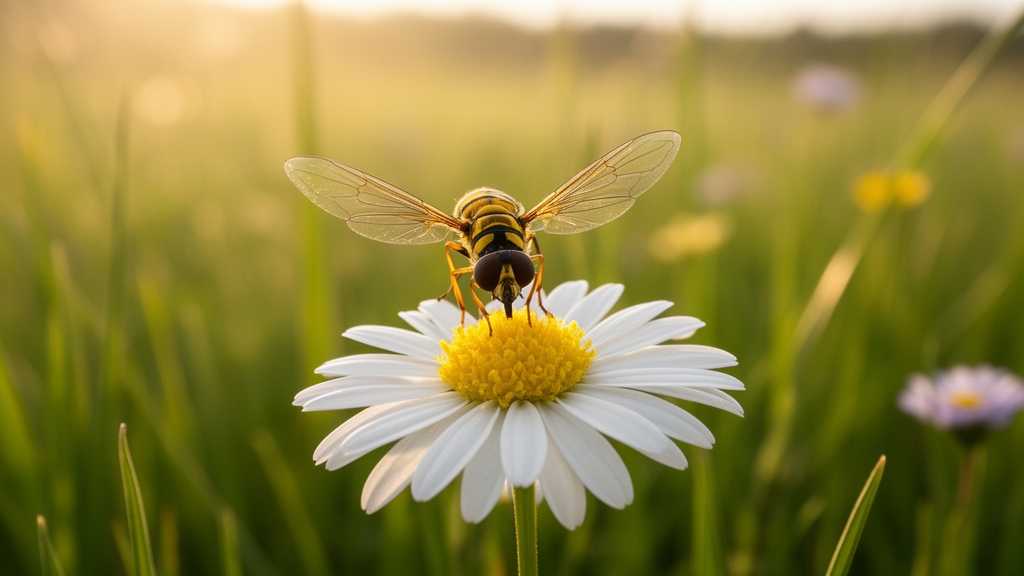
It is one of the unsung heroes of the European countryside: a slender, wasp-mimicking fly that spends its adult days sipping nectar from daisies and thistles, pollinating crops and wildflowers as it goes, and its larval days devouring aphids by the hundreds. Now scientists have taken a major step toward capturing that entire double life inside a computer. A team modelling the hoverfly Sphaerophoria scripta has published a formal, individual-based model designed to run within the Animal, Landscape and Man Simulation System (ALMaSS), a simulation framework that reconstructs agricultural landscapes at a resolution of just one square metre. The goal is ambitious: to predict how hoverfly populations respond to weather, landscape change and, crucially, pesticide exposure, with the model ultimately feeding into regulatory risk assessments for agrochemicals.
The choice of species is no accident. Sphaerophoria scripta is among the most common aphid-eating hoverflies in Central Europe, active from May to October with peaks in August, and found everywhere from open grasslands and flower-rich urban wastelands to the edges of farm fields. Adults are mixed feeders, spending roughly two-thirds of their daylight hours feeding on nectar and pollen, which makes them effective pollinators of crops and wild plants alike. Their larvae, meanwhile, are voracious generalist predators that attack more than thirty genera of aphids, including notorious crop pests such as the peach–potato aphid Myzus persicae, as well as thrips, spider mites and even caterpillars. Few other insects deliver pollination and biological pest control in a single package.
What sets the new model apart from earlier attempts is its level of spatial and ecological detail. Previous individual-based hoverfly models either simplified the landscape into just fields and margins, or focused narrowly on a single life stage such as overwintering females. The prototype Sphaerophoria model instead embeds every individual — egg, larva, pupa and adult female — within ALMaSS’s dynamic, one-metre-resolution landscape, complete with realistic crop rotations, pesticide application schedules, daily vegetation growth and simulated weather. Aphid prey can be supplied either by a parallel, already-published aphid model that simulates four pest species, allowing predator and prey to interact within the same simulated world. A companion model for the saprophagous drone fly Eristalis tenax is also under development, broadening coverage of the hoverfly guild’s functional diversity.
Temperature emerges as the master variable of hoverfly development. Drawing on decades of laboratory and field studies, the authors fitted thermal response curves for each immature stage. Eggs and pupae follow simple linear degree-day models: eggs need about 55.6 degree-days above a threshold of roughly 6 degrees Celsius, meaning development takes around twelve days at 10 degrees but barely two and a half days at 30. Pupae require about 146 degree-days, with emergence ceasing at or below 10 degrees. Larval development is trickier: it peaks at an intermediate optimum of about 20.6 degrees and falls off at both extremes, so the modellers used a Gaussian thermal performance curve rather than a straight line. Food complicates the picture further, because larval development slows measurably as aphid availability drops — a relationship the team captured with a scaling factor derived from experiments in which larvae developed in roughly fifteen days when offered just five aphids a day, but in under ten when given sixty.
Those feeding numbers matter because a hoverfly larva is essentially a small eating machine with a life-or-death deadline. Laboratory work shows that Sphaerophoria larvae consume on the order of 130 to 365 aphids in total during development, depending on aphid species, and that consumption rises steeply through mid-development before tapering just before pupation. First-instar larvae are the most fragile: the model assumes they die after a single day without food, while older larvae can survive two and three days of starvation respectively, assumptions borrowed from closely related species of similar size. The larvae also show a classic Holling Type II functional response — consumption rises quickly at low aphid densities then saturates as handling time becomes the bottleneck — with third instars out-eating second instars, and with an opportunistic streak that even extends to cannibalism when food runs short.
Adult females face their own energetic arithmetic, and the model reconstructs it with striking granularity. Since direct measurements of Sphaerophoria scripta energetics are scarce, the team used allometric scaling from better-studied relatives: estimated body masses between roughly 6.6 and 33 milligrams yielded predicted flight energy costs of about 0.001 to 0.004 watts, a gut capacity of one to three and a half microlitres of nectar, and a maximum starvation endurance of around five to six days. The energetic budget implies a female must refill her gut about twice a day on 50 percent sugar nectar just to keep going. Flight speeds are similarly scaled, with maximum dashes estimated near eight metres per second and typical foraging speeds of around one metre per second. Daily activity follows a thermally driven rhythm: flies stir only when temperatures pass roughly 16 degrees, peak in a 20-to-25-degree window, switch to a two-peaked pattern on hot days to avoid midday heat, and stop entirely in rain or strong wind.
Reproduction adds another layer of behavioural sophistication. Females cannot mature a single egg without pollen — sugar alone leaves them sterile and short-lived, with pollen-fed females surviving an average of 31 days versus nine and a half without. Under optimal greenhouse conditions, a female begins laying five to six days after emergence and produces 228 to 551 eggs over her lifetime, peaking about a third of the way through her oviposition period. The model encodes this as a fecundity function tied to female body mass, modulated by temperature and photoperiod, and gated by aphid availability: eggs are laid singly, and only where local aphid biomass exceeds a threshold calibrated so that hatching larvae will find enough prey. In a neat touch of behavioural realism, females in the model preferentially target dense, young aphid colonies, guided in reality by plant and aphid volatiles that the oviposition probability function abstracts into a logistic response.
Death, too, is modelled mechanistically. Immature mortality depends on temperature and humidity through polynomial functions fitted to data from the related species Sphaerophoria rueppellii, where dry conditions proved brutal — at 50 percent relative humidity, larval mortality hit 100 percent. Parasitoid wasps add a delayed, insidious threat: species such as Diplazon laetatorius lay eggs inside larvae, which keep feeding normally before dying at the pupal stage, sometimes wiping out 20 to 80 percent of hoverfly immatures in intensively managed crops. The model handles this with a two-step, landscape-modulated parasitism probability, and also simulates agricultural mortality, assigning probabilities that ploughing, harrowing and other soil-disturbing operations crush overwintering pupae, while mechanical weeding disturbs eggs and larvae on crop plants.
Overwintering and migration round out the life cycle. Sphaerophoria scripta survives winter mainly as fully grown larvae tucked into soil or leaf litter, entering a cold-induced quiescence that ends when spring days warm. The final autumn generation faces a fork: some females stay and produce the overwintering brood, while others — the model will eventually allow a probabilistic split — embark on the long migrations documented along mountain passes and coastlines, where females consistently dominate the migrant crowds, likely thanks to their larger fat reserves. For the first version aimed at pesticide risk assessment, the team deliberately sets migration to zero, keeping exposure effects local and interpretable.
The authors are candid about the gaps. Many parameters come from other Sphaerophoria species or allometric extrapolations, upper thermal limits could not be estimated from existing data, and several quantities — adult background mortality, overwintering survival, pollen intake rates — will be determined during calibration using pattern-oriented modelling against field observations. Yet even as a prototype, the framework represents a significant upgrade in how regulators and ecologists can interrogate the fate of a non-target beneficial insect: not as a static laboratory test species, but as a population of virtual individuals living out full lives across a simulated farm landscape, generation after generation, under whatever climate, crop and chemical futures we care to explore.
Subject of Research: Agent-based modelling of the aphidophagous hoverfly Sphaerophoria scripta for pesticide risk assessment
Article Title: The Formal Model for the hoverfly Sphaerophoria scripta ( Diptera , Syrphidae ) agent-based model in the Animal Landscape and Man Simulation System (ALMaSS)
Article References: Ziółkowska, E., Sowa, G., Duan, X., & Topping, C. J. (2026). The Formal Model for the hoverfly Sphaerophoria scripta (Diptera, Syrphidae) agent-based model in the Animal Landscape and Man Simulation System (ALMaSS). Food and Ecological Systems Modelling Journal, 7, Article e169793. https://doi.org/10.3897/fmj.7.169793
Image Credits: AI Generated
DOI: 10.3897/fmj.7.169793
Keywords: hoverflies, Sphaerophoria scripta, agent-based model, ALMaSS, biological control, pollination, pesticide risk assessment, aphids, thermal development, landscape ecology, overwintering, parasitoids
Cite Scienmag News
Gavin Prescott. (October 15, 2026). Virtual Hoverflies: New Agent-Based Model Puts a Two-Species Ecosystem Warrior on the Map. Scienmag. https://scienmag.com/virtual-hoverflies-new-agent-based-model-puts-a-two-species-ecosystem-warrior-on-the-map/
Gavin Prescott. "Virtual Hoverflies: New Agent-Based Model Puts a Two-Species Ecosystem Warrior on the Map." Scienmag, 15 October 2026, https://scienmag.com/virtual-hoverflies-new-agent-based-model-puts-a-two-species-ecosystem-warrior-on-the-map/. Accessed 15 October 2026.
Gavin Prescott. "Virtual Hoverflies: New Agent-Based Model Puts a Two-Species Ecosystem Warrior on the Map." Scienmag. October 15, 2026. https://scienmag.com/virtual-hoverflies-new-agent-based-model-puts-a-two-species-ecosystem-warrior-on-the-map/


