


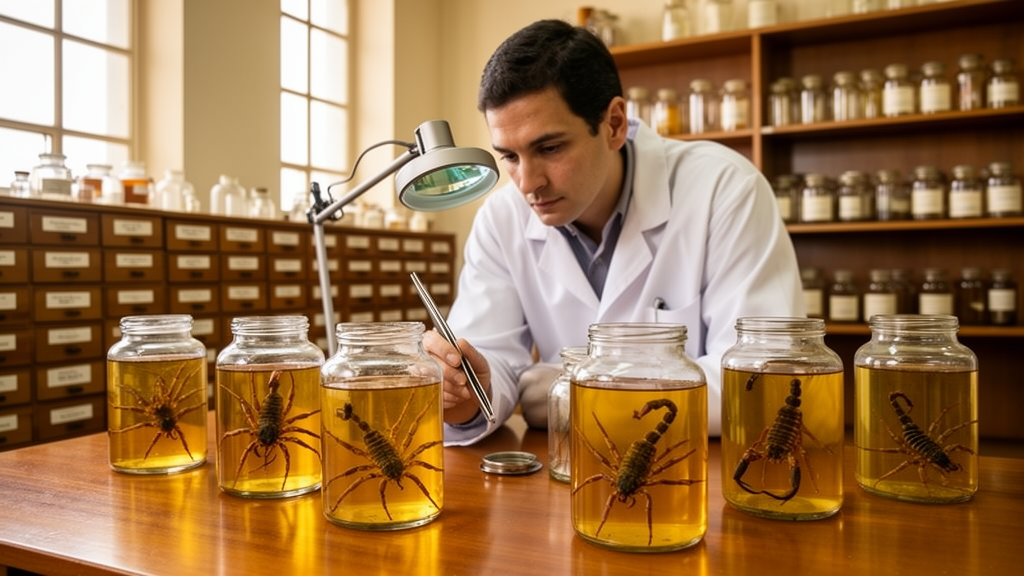
Deep in the basement of the Institute of Biology at the Federal University of Bahia, behind drawers of preserved spiders, scorpions and whip spiders, sits one of the most quietly remarkable biodiversity repositories in Brazil. The Arachnida Collection of the Natural History Museum of Bahia, known as ARAC/MHNBA, has just received its first full scientific audit, published in the journal Natural History Collections and Museomics. The verdict: nearly 50 years after its founding, this university-based collection holds approximately 15,000 cataloged specimens, spans nine arachnid orders, and stands as the only collection in Brazil’s entire Northeast region with openly accessible data online.
The numbers matter because Brazil’s scientific collections are strikingly lopsided. Of 342 zoological collections analyzed in a recent national assessment, more than 60 percent are concentrated in the wealthy Southeast and South regions, home to the century-old giants at the Museu de Zoologia de São Paulo, the Instituto Butantan and the Museu Nacional in Rio de Janeiro. Of the 24 arachnological collections registered on Brazilian virtual platforms such as SpeciesLink and SiBBr, nearly half sit in the Southeast, and 29 percent still publish no data at all — including some of the oldest and most medically relevant holdings in the country.
That gap became tragically concrete in recent decades. The 2010 fire at the Butantan Institute destroyed roughly 30 percent of its arachnological collection, and the 2018 blaze at the Museu Nacional consumed its entomological and arachnological holdings entirely — around five million invertebrates, gone in an evening. Disasters like these exposed how fragile centralized repositories can be, and how vital smaller, regional collections are for preserving faunal representation that would otherwise exist nowhere. ARAC/MHNBA, born in 1980 from environmental consulting work during the construction of the Pedra do Cavalo Hydroelectric Dam on the Paraguaçu River, is exactly the kind of distributed insurance policy Brazilian biodiversity needs.
The new audit, compiled from the collection’s Heritage Books and its SpeciesLink records updated through March 2026, dissects the collection into nine subcollections: Araneae, Scorpiones, Opiliones, Amblypygi, Pseudoscorpiones, Thelyphonida, Solifugae, Parasitiformes and Acariformes. Spiders dominate, accounting for more than half of all records, with 8,293 specimens spread across 47 families, 143 genera and 127 species. Scorpions follow with 5,139 specimens across five families and 44 species, including the first record ever accessioned — a Bothriurus asper collected at the Raso da Catarina Ecological Station in 1982.
The collection’s taxonomic credentials are stronger than its modest size suggests. It safeguards type specimens — the name-bearing reference specimens that anchor species definitions — for five species, including the holotypes of the corinnid spiders Ianduba mugunza and Ianduba abara and paratypes of the jumping spider Aillutticus soteropolitano and the scorpion Tityus aba. It also holds three species flagged on Brazil’s official national Red List: the critically endangered tarantula Typhochlaena seladonia, the endangered tree spider Ybyrapora diversipes and the endangered scorpion Troglorhopalurus translucidus, a cave-associated species from Bahia’s limestone karst.
Perhaps the most striking statistic is taxonomic resolution. More than 60 percent of all cataloged specimens are identified to species level — an unusually high figure for a regional collection — with scorpions reaching an exceptional 94.6 percent, every single specimen determined at least to genus. The audit attributes this to a decades-long collaboration with arachnologists Antonio Brescovit and Sylvia Lucas of the Butantan Institute, who identified material and trained undergraduate curatorial assistants, and, more recently, a 2025 partnership with Adriano Kury at the Museu Nacional that sharply improved the harvestman subcollection. The unresolved groups tell the mirror-image story: mites, pseudoscorpions, solifuges, amblypygids and thelyphonids languish at coarse identifications because no arachnid taxonomist works at UFBA, forcing specimens to be shipped to experts elsewhere.
Geographically, the collection is a portrait of the Northeast. Nearly 90 percent of records come from that region, covering all nine of its states across 219 municipalities, with Bahia itself represented in 169 municipalities — roughly 40 percent of the state’s total. Scattered records extend to 21 Brazilian states and even abroad, with 22 specimens from Uruguay, Peru and Mexico, mostly arriving through donations. Yet the audit also maps the blind spots: within Bahia, records cluster in Salvador’s metropolitan region and the Chapada Diamantina, leaving roughly 60 percent of the state’s territory with no representation at all, a void the authors link directly to the footprint of local research projects rather than any biological reality.
The temporal patterns reveal something unexpected. Although the collection grew slowly for decades, the 2020s — just six years of data — account for a roughly 31 percent jump in cumulative records. The surge traces to the COVID-19 pandemic, when suspended teaching freed the curation team to undertake a complete review, re-identifying and validating specimens against world catalogs during the museum’s physical relocation to new facilities. Decades of backlog material from amblypygids, pseudoscorpions and solifuges, some collected in the 1980s and 1990s, finally entered the catalog. The pandemic, ironically, became the collection’s most productive era.
The collection’s origin story is equally telling. Nearly half of all specimens arrived as donations, and about a fifth of the total traces to academic research projects — undergraduate, master’s and doctoral work — reflecting a collection whose fate is welded to student training rather than institutional funding. A crucial early driver was public health: the partnership with Bahia’s toxicological information center, CIATox-BA, which needed accurate species identifications to guide clinical treatment of spider and scorpion envenomations. That feedback loop — clinicians needing identifications, researchers needing specimens, the collection needing both — kept the spider and scorpion subcollections growing and precisely curated for four decades.
The authors close with a warning and a roadmap. Because ARAC/MHNBA lacks formal institutional recognition, every subcollection is effectively one curator’s departure away from abandonment; they argue university collections must be written into institutional development plans, as national assessments have recommended, and note that Brazil still lacks a binding national policy for scientific biological collections, with Bill of Law No. 1.993/2024 still winding through Congress. Their future plans include photographing the collection for online release and building new taxonomic partnerships. In an era when museomics treats specimens as sources of DNA and collectomics demands richer digital narratives around every vial, this Bahian basement collection — online since 2016, growing through a pandemic, and democratizing arachnid knowledge for a neglected region — makes the case that the future of biodiversity science may depend as much on small, open, regional repositories as on the famous giants.
Subject of Research: Taxonomic, temporal and geographic analysis of the Arachnida collection at the Federal University of Bahia, Brazil
Article Title: The Arachnological Collection ( Chelicerata , Arachnida ) at the Federal University of Bahia, Brazil: taxonomic status, temporal patterns, geographic coverage and data availability
Article References: Andrade-de-Sá, J., Oliveira-Santana, R., & Brazil, T. K. (2026). The Arachnological Collection (Chelicerata, Arachnida) at the Federal University of Bahia, Brazil: taxonomic status, temporal patterns, geographic coverage and data availability. Natural History Collections and Museomics, 3, Article e197964. https://doi.org/10.3897/nhcm.3.197964
Image Credits: AI Generated
Keywords: arachnology, natural history collections, biodiversity informatics, Brazil, SpeciesLink, open data, spiders, scorpions, museomics, taxonomic resolution, Northeast Brazil, collection management
Cite Scienmag News
Margaret Porter. (October 15, 2026). Brazil’s Only Open-Data Arachnid Collection in the Northeast Reveals Its Hidden Treasures. Scienmag. https://scienmag.com/brazils-only-open-data-arachnid-collection-in-the-northeast-reveals-its-hidden-treasures/
Margaret Porter. "Brazil’s Only Open-Data Arachnid Collection in the Northeast Reveals Its Hidden Treasures." Scienmag, 15 October 2026, https://scienmag.com/brazils-only-open-data-arachnid-collection-in-the-northeast-reveals-its-hidden-treasures/. Accessed 15 October 2026.
Margaret Porter. "Brazil’s Only Open-Data Arachnid Collection in the Northeast Reveals Its Hidden Treasures." Scienmag. October 15, 2026. https://scienmag.com/brazils-only-open-data-arachnid-collection-in-the-northeast-reveals-its-hidden-treasures/


