


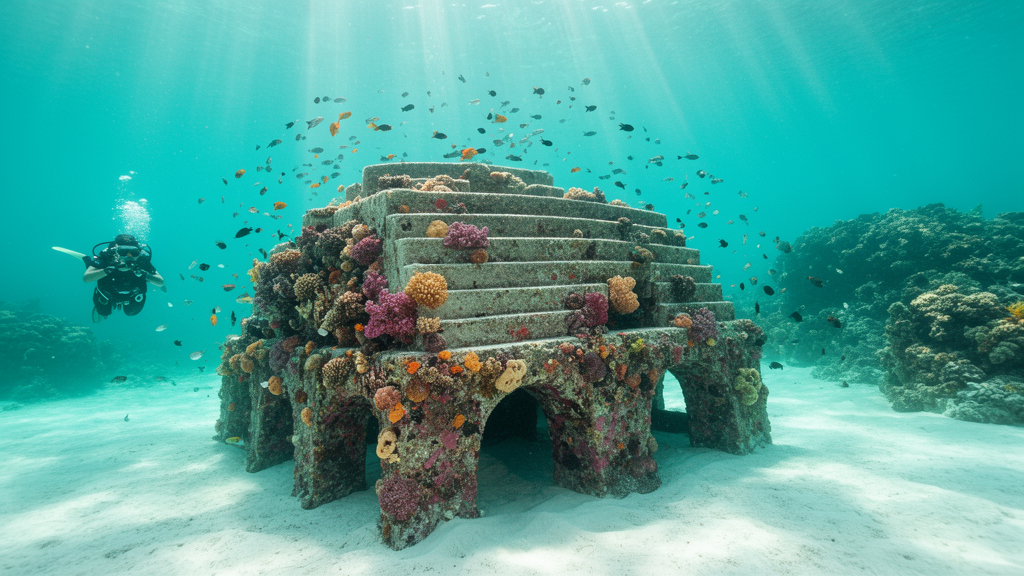
The coral reefs and shallow hardbottom communities of the Florida Keys are losing the very thing that makes them work: three-dimensional structure. A new perspective article published in Frontiers in Marine Science argues that a modernized, ecologically informed version of an ancient practice deploying manmade structures in the sea could buy time for one of the world’s most valuable marine ecosystems. The authors, researchers affiliated with Monroe County’s Office of Artificial Reefs and the Florida Fish and Wildlife Conservation Commission, propose a concept they call habitat support structures: engineered objects designed not simply to attract fish, but to fill specific gaps in habitat architecture left behind by dying sponges, octocorals, and stony corals.
The urgency is rooted in decades of documented decline. Warming waters, severe bleaching events, unprecedented disease outbreaks, hurricanes, and deteriorating water quality have driven stony coral mass mortality across the Western Atlantic and Caribbean, causing reefs to flatten and become structurally homogeneous. In Florida, current estimates put live coral cover at roughly two percent, equivalent to a relative reduction of more than ninety percent. In 2023, a marine heat wave pushed two foundational branching coral species, the acroporids, to functional extinction in Florida despite decades of active restoration. Seagrass meadows and sponge communities have suffered repeated die-offs for similar reasons, and projections suggest up to ninety percent of coral reef ecosystems worldwide could be severely degraded by 2050.
Structural complexity matters because it is the physical substrate of biodiversity. Complex habitats offer more microhabitats and ecological niches for feeding, breeding, foraging, settlement, and refuge from predators, which supports greater species richness and abundance. Many of these structures are biogenic, built by the organisms that live within them, so losing those species triggers negative feedbacks that further erode biodiversity and ecosystem functioning. Reef fish biomass, abundance, richness, and diversity all correlate positively with reef rugosity, and researchers have linked the flattening of Caribbean reefs to a decline in reef fishes that began in the 1990s. The economic stakes are equally high: recent estimates project that coral reef degradation in Florida could increase coastal flood risk for more than 7,300 people, at a cost of 823.6 million dollars annually.
The authors draw on two Florida case studies to illustrate what habitat deficits look like in practice. The first is nearshore hardbottom, the most extensive hardbottom community in South Florida, covering roughly 67,000 hectares, or about one-third of the nearshore habitat in the Florida Keys and Florida Bay ecosystem. These shallow waters, less than three meters deep and within about two kilometers of shore, sit atop consolidated limestone riddled with solution holes and colonized by sponges, octocorals, and macroalgae. Sponges dominate the heterotrophic biomass, with mean densities exceeding 80,000 individuals per hectare across more than sixty species, and in the 1990s they covered on average nine percent of the seafloor, some exceeding a meter in diameter.
That structure is now collapsing. Recurring planktonic cyanobacterial blooms since the early 1990s have caused spatially extensive mortality of many structure-providing sponge species. In one study, researchers tracked hundreds of sponges across twenty-seven sites covering more than one square kilometer of seafloor and found that one hundred percent died following back-to-back cyanobacterial blooms. Juvenile Caribbean spiny lobsters, which settle and shelter in these habitats before migrating to deeper reefs, occupied fewer natural dens afterward and shifted into artificial structures provided as part of the study; juvenile lobster abundance rose seventy-six percent in experimental plots with artificial structures and fell twenty-three percent in control plots. Today, octocorals are markedly reduced, fine-grain sedimentation has increased, solution holes have filled, and present-day fish species richness on this hardbottom is just thirty to forty percent of what it was when surveys began in the 1990s.
The second case study is the offshore coral reef, where modelling work quantifies how much structure matters relative to coral cover itself. One study modelled the densities of one hundred fish species across Florida’s Coral Reef and found that maximum hard relief, a measure of vertical structure, explained more variation in fish densities and was linked to more species than live coral cover. On low-coral-cover reefs like Florida’s, coral cover and complexity are decoupled, which makes the near-total loss of branching acroporids, the region’s predominant framework builders, especially consequential. The Western Atlantic and Caribbean have far lower functional redundancy than the Indo-Pacific, which hosts more than one hundred acroporid species, so the loss of each structure-performing species is magnified.
Perhaps the most striking evidence comes from a separate modelling study that compared management interventions for reef fish biomass on Florida’s Coral Reef. Under the model’s specific assumptions, adding artificial structures to raise maximum hard relief by 1.2 meters produced an average predicted increase in fish biomass of seventy-two percent, the single most effective measure tested. That compared with fifty-two percent for extensive coral restoration, six percent for fishing closures, and five percent for moderate coral restoration, and the pattern held across snapper-grouper species, grazers, aquarium species, and all species combined. Notably, combining habitat-based management with fishing closures yielded a modelled reef-wide average increase of eighty-nine percent, hinting at powerful synergies. The authors caution this is one study, one location, and one metric, but they also note that because the 2023 heat wave forced restoration programs to shift from branching to slow-growing massive corals, the expected benefits of coral-restoration scenarios would likely be even lower if the models were rerun today.
The habitat support structure concept is a deliberate departure from the checkered history of artificial reefs. Structures have been deployed in the sea for thousands of years, and past efforts, including discarded tires and surplus equipment dumped to enhance recreational fishing, produced mixed and sometimes harmful outcomes. A long-running debate asked whether artificial reefs generate new biomass or merely aggregate fish from surrounding habitat with no net benefit. Scientists now broadly agree this attraction-versus-production framing is a false dichotomy: when designed and sited appropriately, artificial reefs can both attract fish and improve fishery yields, enhance productivity, and increase ecosystem services, though small or poorly designed structures that concentrate fishing effort can worsen localized overfishing. The authors define a habitat deficit as a condition in which habitat structure is insufficient to support the ecosystem services or species historically associated with that habitat, and they propose prioritizing structure placement where departures from reference conditions are largest and restoration of structure is most likely to restore services.
Design and placement would be guided by local ecology rather than generic templates. Advances in 3D printing now allow complex, biomimetic geometries, including structures mimicking branching acroporids with micro-scale surface roughness suited to coral settlement, and one study found that adding structures to a degraded reef increased coral recruitment by four hundred to six hundred percent. Structures need not physically replicate natural components; low-relief modules with spires and cavity-like caves could functionally mimic the sponges and solution holes of nearshore hardbottom. Materials that erode more slowly than coral skeleton could maintain functional significance longer than reefs that now have a net negative accretion rate. Crucially, the authors argue structures should be optimized across connected habitat types to support ontogenetic migrations, the life-stage movements that carry spiny lobsters and many reef fishes from shallow inshore nurseries to offshore adult habitats, with acoustic telemetry helping to identify the corridors between them. Pilot testing, clearly defined objectives, and long-term monitoring are essential, as are adaptive regulatory frameworks, since the Florida Keys National Marine Sanctuary’s current management was not developed with structure-based interventions in mind.
The authors are candid about limits. Habitat support structures cannot address the root causes of decline, including warming seas, hurricanes, and poor water quality, and they cannot replace the full ecological functions of living organisms, such as biogeochemical cycling, chemical settlement cues, and energy transfer through food webs. Poorly conceived deployments risk aggregating organisms without increasing production, altering trophic interactions, or facilitating undesirable species, so evaluation must look beyond simple abundance to recruitment, survival, connectivity, and ecosystem-level outcomes. Yet with expert consensus shifting, a recent survey found proactive genetic preservation now surpasses active coral outplanting as the top conservation priority, the authors contend that waiting for biological restoration to scale is inadvisable. Combining structural and biological interventions, including hybrid designs where 3D-printed and natural staghorn corals together enhanced fish richness, abundance, biomass, and diversity in one recent experiment, may offer the best path forward. Structures, in their view, are one tool in the ecosystem restoration toolbox, but a tool whose time may now have come.
Subject of Research: Use of engineered habitat support structures to mitigate structural habitat deficits in the declining Florida Keys marine ecosystem
Article Title: The potential for habitat support structures to address habitat deficits in a declining marine ecosystem
Article References: Koch, H. R., Sharp, W. C., & Hunt, J. H. (2026). The potential for habitat support structures to address habitat deficits in a declining marine ecosystem. Frontiers in Marine Science, 13, Article 1980513. https://doi.org/10.3389/fmars.2026.1980513
Image Credits: AI Generated
DOI: 10.3389/fmars.2026.1980513
Keywords: Florida Keys, coral reefs, habitat support structures, artificial reefs, structural complexity, nearshore hardbottom, spiny lobster, coral restoration, habitat deficit, biodiversity, sponges, ecosystem restoration
Cite Scienmag News
Margaret Porter. (October 15, 2026). Engineered Reef Structures Could Rapidly Rebuild Lost Complexity in the Florida Keys. Scienmag. https://scienmag.com/engineered-reef-structures-could-rapidly-rebuild-lost-complexity-in-the-florida-keys/
Margaret Porter. "Engineered Reef Structures Could Rapidly Rebuild Lost Complexity in the Florida Keys." Scienmag, 15 October 2026, https://scienmag.com/engineered-reef-structures-could-rapidly-rebuild-lost-complexity-in-the-florida-keys/. Accessed 15 October 2026.
Margaret Porter. "Engineered Reef Structures Could Rapidly Rebuild Lost Complexity in the Florida Keys." Scienmag. October 15, 2026. https://scienmag.com/engineered-reef-structures-could-rapidly-rebuild-lost-complexity-in-the-florida-keys/


