


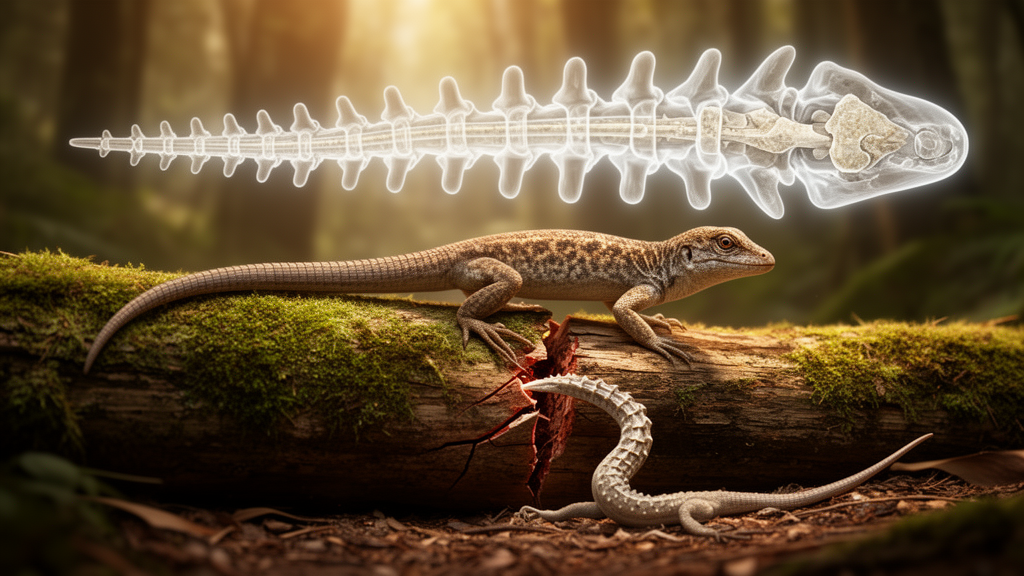
Some 130 million years ago, in the lakeside forests of what is now Liaoning Province in China, two small lizards carried very different escape plans in their tails. A new study published in the Swiss Journal of Palaeontology has used high-resolution X-ray computed tomography to peer inside the compressed fossils of two Early Cretaceous lizards from the famous Jehol Lagerstätten, Yabeinosaurus sp. and Dalinghosaurus longidigitus, and found that the specialized breaking points that allow lizards to shed their tails were already strikingly diverse among Cretaceous squamates. The findings, viral in their implications for how one of the most widespread anti-predator strategies in the reptile world evolved, show that tail-shedding anatomy was far from uniform more than 100 million years ago.
Tail shedding, known scientifically as caudal autotomy, is a familiar spectacle to anyone who has watched a gecko drop its tail in front of a predator. The detached tail wiggles violently, distracting the attacker while the lizard flees, a strategy that reduces the risk of fatal injury. In most lizards, this dramatic self-amputation happens intravertebrally, along a transverse suture across the caudal vertebra called the fracture plane. The position of this plane relative to the transverse processes, the lateral projections of the vertebra, varies among modern squamates and has long been used as a phylogenetic character to help reconstruct lizard family trees. But until now, little was known about the three-dimensional morphology of these autotomic structures in extinct lizards, particularly early taxa preserved in compressed slabs where the fracture plane is barely exposed.
The research team, working at the Institute of Vertebrate Paleontology and Paleoanthropology in Beijing, selected two Jehol lizards with exceptionally preserved tails. The Yabeinosaurus specimen, SDUST-V1001, comes from the Lower Cretaceous Jiufotang Formation at Xiaotaizi in Jianchang County, Liaoning Province, and preserves a nearly complete articulated skeleton missing only the tip of the tail. The Dalinghosaurus specimen, IVPP V14295, comes from the slightly older Yixian Formation at Sihetun in Beipiao City, and preserves 32 caudal vertebrae in articulation. Both taxa are abundant in the Jehol biota, yet only a fraction of specimens preserve the tail in suitable condition, so the researchers examined multiple fossils to identify those that would maximize scan resolution and contrast. Six species of extant lizards were also scanned for comparison, including the tokay gecko, the green anole, the five-lined skink, the Argentine black and white tegu, the Chinese crocodile lizard, and the desert night lizard.
The CT reconstructions revealed that both fossil taxa possess fracture planes, but with distinct morphologies that separate them as clearly as fingerprints. In Yabeinosaurus, the fracture plane traverses directly through the transverse processes, partitioning them into anterior and posterior segments, with the anterior segment consistently longer than the posterior. This condition is present in certain species of extant Scincinae, Xantusiidae, Anguidae, and Shinisauridae. In Dalinghosaurus, by contrast, the fracture plane lies posterior to the transverse processes, resembling the condition in extant gekkotans, lacertids, and some iguanians. The fracture plane in Yabeinosaurus crosses both the vertebral centrum and the neural arch, creating distinct anterior and posterior segments throughout the vertebral series, while in Dalinghosaurus it is confined to the vertebral centrum, extending only to the base of the neural arch.
Perhaps the most surprising discovery came from Dalinghosaurus, which exhibits a fan-shaped pseudospine encompassing the fracture plane, a structure previously unrecognized in this genus. In lateral view, the pseudospine originates posterior to the prezygapophysis and occupies roughly half the neural arch’s anteroposterior length. Previous researchers had identified this dorsal projection as the neural spine, but the new CT data led the team to reinterpret it as a pseudospine based on two observations. First, the projection’s position, sitting at the fracture plane, corresponds to that of the pseudospine in extant iguanians, gekkonids, and shinisaurids. Second, its distinct fan shape is identical to that of the pseudospine in the extant desert iguana, Dipsosaurus dorsalis, despite the contrasting condition of the neural spine, which is low and undeveloped in Dalinghosaurus but elongated in Dipsosaurus.
The pseudospine is a specialized structure that, in some taxa, creates predetermined breaking points along the tail, reinforcing the fracture plane and making autotomy more efficient. The fact that Dalinghosaurus possessed such a structure more than 100 million years ago suggests that the machinery for efficient tail shedding was already sophisticated in Early Cretaceous squamates. Moreover, Dalinghosaurus shows partial fusion of the fracture plane, restricted to the neural arch and not involving the centrum or transverse processes. In extant lizards, fusion of the fracture plane may begin at the dorsal margin of the neural arch and progress ventrally toward the transverse processes as an individual reaches adult size, and a caudal vertebra becomes functionally non-autotomic when fusion reaches the level of the transverse processes. The incomplete fusion in the Dalinghosaurus specimen suggests that the individual was likely approaching skeletal maturity, and implies that autotomic capability may have varied through ontogeny.
The Yabeinosaurus specimen also yielded intriguing behavioral evidence. Several caudal vertebrae exhibited twisting along the fracture plane during fossilization, with the anterior and posterior segments preserved at an angle to each other. This twisting indicates a weak association of the two skeletal segments following the decay of soft tissues, corroborating the fracture plane as a weak zone for tail shedding. The specimen preserves 27 to 28 caudal vertebrae, with a segment of regenerated tail about 40 millimeters in length, suggesting that this individual had already shed and regrown part of its tail during its lifetime, a rare direct record of autotomy in a Mesozoic lizard.
The phylogenetic implications of the study are considerable. The position of the fracture plane relative to the transverse processes has been used as a morphological character in broad-scale squamate phylogenetic analyses, which have historically relied more heavily on cranial osteological characters than on postcranial ones. The new CT-based observations demonstrate that the pseudospine and fracture plane show consistent morphological variation in both extant and fossil species, and that the shape of the pseudospine and its position relative to the fracture plane offer new morphological characters that can be incorporated into future phylogenetic analyses. The ability to extract such characters from fragmentary postcranial material is particularly valuable for fossil squamates, in which cranial remains are often incomplete or absent. The relative lengths of the segmented transverse processes, for example, are not merely allometric but may carry phylogenetic signal, with Yabeinosaurus displaying a pronounced asymmetry resembling that of extant xantusids, while some extant scincids show the reverse configuration.
The earliest reptilian fracture planes occur in a Permian captorhinid, and among rhynchocephalians, the tuatara Sphenodon and several fossil relatives possess the structure. In Squamata, caudal autotomy is considered ancestral for the crown group, whose origin is currently inferred to have occurred during the Triassic. However, no Triassic fossils have been unequivocally assigned to crown Squamata, and the earliest definitive fossil evidence of the fracture plane among crown squamates comes from Late Jurassic taxa, including Schoenesmahl dyspepsia, approximately 50 million years after the inferred origin of the clade. The new findings from the Jehol lizards demonstrate that fracture plane morphology was already disparate among Early Cretaceous squamates, filling in a crucial gap in the fossil record of this widespread anti-predator strategy.
Beyond its phylogenetic value, the study highlights the power of high-resolution CT imaging of compressed fossils for resolving the three-dimensional anatomy of autotomic structures. Fossils preserved in compressed limestone, shale, or mudstone slabs, where unidirectional flattening obscures details such as transverse process morphology, the exact trajectory of the fracture plane, and the presence of a pseudospine, have previously been described largely in two dimensions. The new tomographic workflow, which involves importing TIFF image stacks, segmenting bony tissue from the rock matrix using region growing, and dividing reconstructed three-dimensional models of autotomic caudal vertebrae into two segments bordered by the fracture plane, enables more robust morphological comparisons and provides novel characters for future phylogenetic analyses. As more fossil squamates are examined using similar methods, the fracture plane and its associated structures may emerge as key characters for reconstructing the evolution of caudal autotomy, one of the most widespread and ecologically significant antipredator strategies among lepidosaurs.
Subject of Research: Tail shedding in two Cretaceous lizards: autotomic structures revealed by X-ray CT scanning
Article Title: Tail shedding in two Cretaceous lizards: autotomic structures revealed by X-ray CT scanning
Article References: Hou, S., Zhou, C.-F., & Yi, H. (2026). Tail shedding in two Cretaceous lizards: autotomic structures revealed by X-ray CT scanning. Swiss Journal of Palaeontology, 145, 999-1010. https://doi.org/10.3897/sjp.145.198907
Image Credits: AI Generated
Keywords: Tail, shedding, Cretaceous, lizards, autotomic, structures, revealed, X-ray, scanning, scientific research
Cite Scienmag News
Gavin Prescott. (October 15, 2026). Cretaceous Lizards Already Had Distinct Tail-Shedding Designs, CT Scans Reveal. Scienmag. https://scienmag.com/cretaceous-lizards-already-had-distinct-tail-shedding-designs-ct-scans-reveal/
Gavin Prescott. "Cretaceous Lizards Already Had Distinct Tail-Shedding Designs, CT Scans Reveal." Scienmag, 15 October 2026, https://scienmag.com/cretaceous-lizards-already-had-distinct-tail-shedding-designs-ct-scans-reveal/. Accessed 15 October 2026.
Gavin Prescott. "Cretaceous Lizards Already Had Distinct Tail-Shedding Designs, CT Scans Reveal." Scienmag. October 15, 2026. https://scienmag.com/cretaceous-lizards-already-had-distinct-tail-shedding-designs-ct-scans-reveal/


