


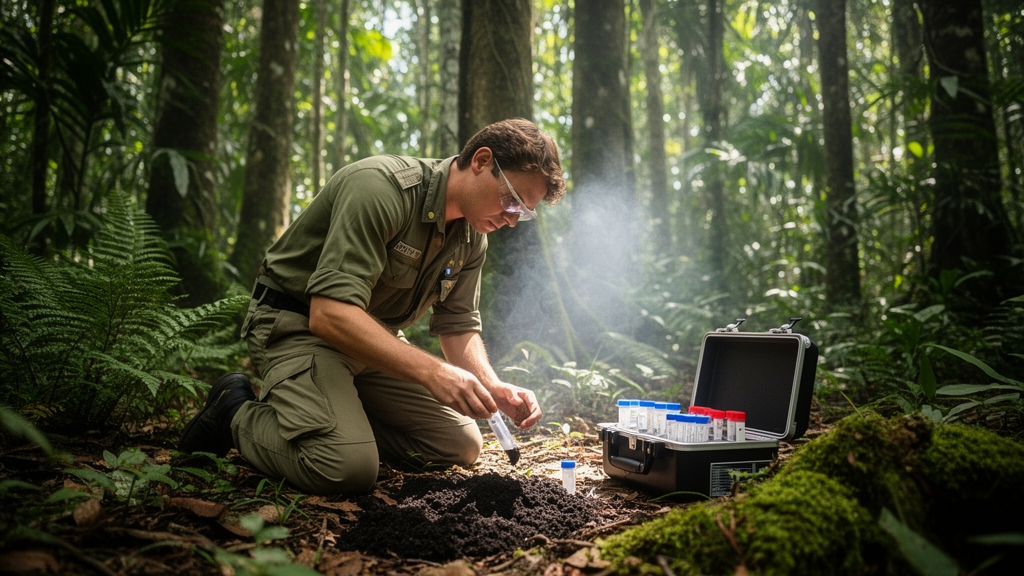
Deep beneath the rainforest floor of French Guiana lies a world so dense with life that it accounts for roughly 60 percent of all species described on Earth. Now, scientists have pulled back the curtain on this hidden biodiversity with an unprecedented molecular survey, publishing a dataset that catalogs nearly 70,000 distinct genetic signatures from a single tropical territory. The resource, known as GUYASOILeDNA, represents the first large-scale environmental DNA metabarcoding effort to characterize soil life across multiple kingdoms in this corner of the Amazon.
The dataset, described in the journal Metabarcoding and Metagenomics, draws on 1,410 soil samples collected between 2016 and 2023 across a striking mosaic of habitats. Researchers sampled terra firme forests, seasonally flooded forests, white-sand forests, and cloud forests, along with coastal savannas of high conservation value, cattle pastures, and even urban soils gathered through a citizen science initiative involving school students. Each sample was analyzed for four DNA markers targeting bacteria, eukaryotes, fungi, and insects, yielding a combined total of 69,881 operational taxonomic units, or OTUs, from more than 426 million sequencing reads.
Environmental DNA metabarcoding works by extracting the genetic material that organisms leave behind in soil, from shed cells and fragments to whole microscopic bodies. By amplifying specific gene regions and sequencing them in bulk, researchers can detect cryptic, hard-to-identify, and even entirely undescribed taxa without ever seeing them. For this project, the team used the V5-V6 regions of the bacterial 16S rRNA gene, the V7 region of the eukaryotic 18S rRNA gene, the fungal ITS1 region, and the mitochondrial 16S rRNA gene for insects. Samples were desiccated with silica gel in the field, extracted using a phosphate-based buffer protocol, and amplified with a double-indexing strategy that labeled each PCR product with a unique tag combination for later identification.
The bioinformatics pipeline was equally rigorous. Raw reads were demultiplexed, assembled, filtered, and clustered at 97 percent similarity, with the LULU algorithm applied to remove erroneous OTU occurrences. Quality control was performed with the metabaR package to exclude contamination, flag failed PCRs, and reduce tag-jump bias. Read standardization used the scaling with ranked subsampling method to correct for differences in sequencing depth while preserving the original community structure. Taxonomic assignment relied on marker-specific reference databases, including SILVA for bacteria and eukaryotes, curated UNITE databases for fungi, and both published and newly generated local records for insects.
Beyond taxonomy, the researchers went a step further by assigning functional roles to the organisms they detected. Using the Soil Food Web Ontology as a unifying framework, along with databases such as Bacteria and Archaea Traits, FAPROTAX, FungalTraits, and FUNGuild, they provided trophic or functional guild assignments for 51 percent of all OTUs. Bacteria were classified into groups including phototrophs, chemoheterotrophs, parasites, and taxa involved in nitrogen, iron, manganese, and sulfur cycles. Fungi were sorted into saprotrophs, mycorrhizal partners, plant pathogens, and other guilds. Insects were labeled as detritivores, omnivores, predators, and more, with termites further divided into soil-feeding and wood-feeding groups.
The results paint a vivid picture of tropical soil communities. Bacterial communities were dominated by Pseudomonadota, Acidobacteriota, and Actinomycetota in read proportions, while eukaryotic communities were dominated by fungi and animals. Within fungi, the classes Agaricomycetes, Sordariomycetes, Eurotiymycetes, and Dothideomycetes were the most prevalent. Insects were led by Blattodea, the order that includes both cockroaches and termites, followed by Hymenoptera, Coleoptera, and Diptera. Functionally, bacteria were dominated by oligotrophic taxa, consistent with the nutrient-limited character of many tropical soils, while fungi were driven by saprotrophs and pathogens, and animals were primarily detritivores.
The dataset also includes rich associated metadata. Soil physicochemical properties such as granulometry, pH, total nitrogen, organic carbon, available phosphorus, and the carbon-to-nitrogen ratio were measured at specialized laboratories in France. Environmental layers covering geology, topography, bioclimates, and vegetation were extracted from remote-sensing databases, including elevation from the Shuttle Radar Topography Mission and 19 bioclimatic variables from CHELSA. This combination of biological and environmental data allows researchers to explore how soil communities respond to gradients of land use, climate, and soil chemistry.
Evaluation of the dataset revealed both its strengths and its gaps. OTU accumulation curves showed different degrees of saturation across markers, with bacterial communities approaching an asymptote more closely than eukaryotes and fungi, while insect OTUs remained far from saturation, indicating that additional sampling would be needed to fully characterize insect diversity. A Multivariate Environmental Similarity Surface analysis showed that approximately 45 percent of French Guiana territory fell within the environmental space represented by the sampling points, mainly corresponding to the littoral and middle regions. Negative values were predominantly observed in the southern part of the territory and in certain coastal areas, highlighting remote forests that remain difficult to access.
The researchers acknowledge that taxonomic assignments are constrained by the incompleteness of DNA reference databases for Neotropical soil biota. Many soil arthropod taxa remain poorly represented in reference databases, and this limitation is even more pronounced for markers commonly used in eDNA studies compared to universal barcodes such as COI. The team notes a methodological trade-off for insect monitoring: while the standard COI barcode offers superior species-level resolution, it is prone to primer amplification biases and off-target amplification of non-target organisms. Conversely, mitochondrial 16S markers provide reliable, specific insect DNA amplification from soil matrices, though they sacrifice some fine-scale taxonomic discrimination.
Despite these limitations, GUYASOILeDNA establishes a modern, standardized ecological baseline for a region where soil biodiversity documentation has been lacking or fragmented. The dataset is published to the Global Biodiversity Information Facility and is accessible via unique DOIs for each marker. It is expected to be valuable for meta-analyses, exploring soil taxonomic and functional diversity in relation to environmental factors, studying spatial associations among soil groups, and informing protected area management. By laying the groundwork for identifying the main drivers structuring soil communities in the tropics, the resource can support the early detection of soil degradation and biodiversity loss in the face of global change.
Subject of Research: Soil biodiversity and environmental DNA metabarcoding in French Guiana
Article Title: GUYASOILeDNA: a trans-kingdom and functional eDNA dataset on soil biodiversity from diverse land-cover types in French Guiana
Article References: GUYASOILeDNA: a trans-kingdom and functional eDNA dataset on soil biodiversity from diverse land-cover types in French Guiana. (n.d.). https://doi.org/10.3897/mbmg.10.188340
Image Credits: AI Generated
Keywords: eDNA, soil biodiversity, French Guiana, Amazon, metabarcoding, tropical ecology, fungi, bacteria, insects, conservation, GUYASOILeDNA, trans-kingdom
Cite Scienmag News
Gavin Prescott. (October 15, 2026). Hidden Amazon: Massive eDNA Dataset Reveals 69,881 Soil Species Across French Guiana. Scienmag. https://scienmag.com/hidden-amazon-massive-edna-dataset-reveals-69881-soil-species-across-french-guiana/
Gavin Prescott. "Hidden Amazon: Massive eDNA Dataset Reveals 69,881 Soil Species Across French Guiana." Scienmag, 15 October 2026, https://scienmag.com/hidden-amazon-massive-edna-dataset-reveals-69881-soil-species-across-french-guiana/. Accessed 15 October 2026.
Gavin Prescott. "Hidden Amazon: Massive eDNA Dataset Reveals 69,881 Soil Species Across French Guiana." Scienmag. October 15, 2026. https://scienmag.com/hidden-amazon-massive-edna-dataset-reveals-69881-soil-species-across-french-guiana/


