


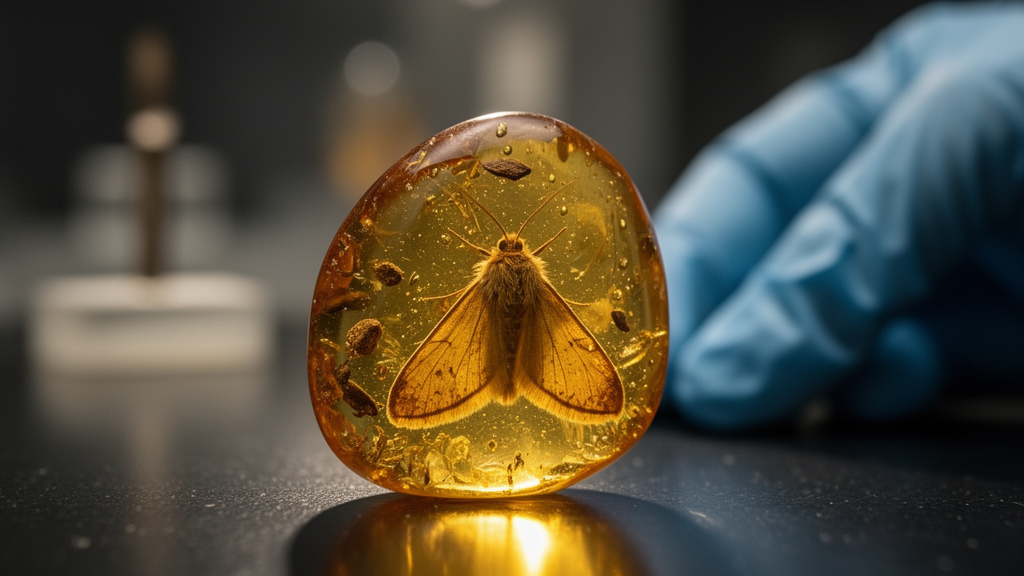
Deep in a lump of golden resin that hardened some 38 million years ago on the floor of a subtropical Baltic forest, a tiny male moth came to rest and was sealed away for eternity. Now, described for the first time, that specimen is rewriting a small corner of the story of how moths evolved. The fossil, named Glaesopterix jonasdamzeni, belongs to the family Micropterigidae, the most primitive living family of Lepidoptera, and it displays a combination of anatomical traits never before seen in any known member of the group. The finding, published in the journal Zitteliana, is based on a single, extraordinarily well-preserved male imago and offers a rare glimpse into the diversity of basal moths that fluttered through the Eocene forests of northern Europe.
The amber inclusion was recovered from the Jantarny amber mine in the Kaliningrad area of Russia, from strata dated to the Priabonian stage of the Eocene epoch. It is one of roughly 2,000 Lepidoptera specimens recovered from Baltic, Rovno and Bitterfeld ambers, and one of only 30 Micropterigidae in the collection of the author who studied it. That rarity alone makes the specimen remarkable, but it is the moth’s anatomy that has captured scientific attention. The body measures just 3.03 millimetres from head to tip of abdomen, and the head, without eyes, is only 520 micrometres broad. The forewings stretch 4 millimetres in length and the hindwings 3.4 millimetres, making this one of the smallest moths ever described from Baltic amber.
What sets Glaesopterix apart is a suite of characters that, individually, are found scattered across different lineages of Micropterigidae, but together form a combination unknown in any other genus. The labial palpi are probably reduced to fewer than three segments, a trait shared with some southern hemisphere genera. The apical crossvein Sc-R is absent in the forewing, a character otherwise seen mainly in Australian genera. The crossvein R-M is very short, partly found in northern hemisphere genera and in the genus Micropterix. The cell in the hindwing is open, as in northern hemisphere genera. Sternum V glands are absent, like in Micropterix. And the male abdominal sternite VIII is completely absent, a condition found in several lineages but never in this particular combination.
The genus name Glaesopterix derives from the Latin glaesum, referring to the Germanic word for amber, and the ancient Greek ptéryx, meaning wing. The species name honours Jonas Damzen of Vilnius, Lithuania, who generously gifted the specimen for scientific study and also provided the photographs. The holotype, a male imago, is currently kept in a sealed plastic bag inside a metal box to exclude access of air and light, and will be transferred to the Bavarian State Collection of Natural History upon publication. The authenticity of the specimen was ensured by obtaining it from a trusted amber dealer known to the researcher through a long-term relationship, and the amber contains Quercus-type trichomes typical for Baltic amber, confirming its provenance.
Micropterigidae are considered the most basal extant family of Lepidoptera, meaning they diverged earliest from the main moth and butterfly lineage. They possess mandibulate mouthparts rather than the coiled proboscis of more derived moths, and their wing venation is homoneurous, with forewings and hindwings sharing a similar pattern. Extant non-glossatan families also include Agathiphagidae and Heterobathmiidae, each sometimes given suborder status. Molecular genetic studies consistently support the early diverging status of these families, placing them at the very root of the lepidopteran tree. The fossil record of Lepidoptera comes from four main sources: fine-laminated sediments preserving wing venation, amber inclusions preserving all external structures, larval leaf mines in fossil leaves, and isolated scales from sediments. Amber is by far the best preservational medium, and this new specimen is a prime example.
The description of Glaesopterix is based on meticulous analysis of its wing venation, which is homoneurous and complete. The forewing shows Sc1 and Sc2 with a basal fork at half length, R1 and R2 with a basal fork at half of their length, Rs1 and Rs2 on a common stem, and a crossvein Rs2-Rs3 that closes the cell. The hindwing shows Sc and R separate, R and Rs forked at approximately one-sixth of wing length, and Rs1 and Rs2 as well as Rs3 and Rs4 forked at half of wing length each. Crucially, the crossvein Rs2-Rs3 is absent in the hindwing, meaning the accessory cell is open. No pterostigma or nygmata are visible. The antennae are submoniliform, about two-thirds the length of the forewings, with 33 to 34 barrel-shaped flagellomeres. Distinct ascoid sensillae, a very characteristic apomorphy of Micropterigidae, could not be identified, though tufts of long scales on each flagellomere may represent their precursors.
The body of the moth shows further diagnostic features. The abdomen is 460 micrometres broad and slender, with the ventral side narrower than the dorsal side. Sternum VIII is completely absent and tergum IX is strongly reduced. The uncus is short and broadly rounded, while the valves are broad and prominently sickle-shaped in ventral view, with bristles pointing inwards at their tips. The legs show a protibia with a well-developed epiphysis, a midtibia without spurs, and a hindtibia with two pairs of spurs, giving a spur formula of 0-0-4. The tarsi have five tarsomers, with the proximal one more than twice the length of the second. Patchy, iridescent colour patterns are preserved in the forewings, reminiscent of the purple-violet ground colour with golden markings seen in the extant genus Micropterix.
To place Glaesopterix in context, the researcher compared it with other lineages of Amphiesmenoptera, including the fossil order Tarachoptera, the caddisflies (Trichoptera), and basal Lepidoptera. Its assignment to Micropterigidae is beyond any doubt, supported by four recognisable apomorphies of the family: a swollen pedicel, reduced labial palpi, a spur formula of 0-0-4, and loss of the crossvein M-Cu in the hindwing. However, the puzzle deepens when the specimen is compared with the five lineages currently recognised within Micropterigidae, based on a 2004 molecular study of 16S rRNA. No comprehensive study has yet been performed to identify external characters as autapomorphies of each of these lineages, making it difficult to correlate fossil morphology with molecular phylogeny.
The analysis attempted to identify simple external apomorphies and correlate them with characters found in Glaesopterix, including Agathiphagidae as an outgroup and the two genera recently transferred to Heterobathmiidae, Palaeosabatinca and Parasabatinca. The results show that Glaesopterix shares some characters with the Australian lineage, such as the absence of the apical crossvein Sc-R in the forewing, but lacks others, like the absence of the humeral vein. It shares the reduced labial palpi with the southern sabatincoid lineage, but lacks the fusion of Sc-R in the hindwing. It shares the open hindwing cell and absent male abdominal sternite VIII with Sabatinca s.str., but lacks the median indentation of the scapus. The strongest correlations appear with the northern hemisphere genera and the Micropterix lineage, which share the reduced labial palpi, the very short crossvein R-M, and the absent male abdominal sternite VIII. However, Glaesopterix lacks the unforked R in the forewing found in both of those lineages, and it retains the basal crossvein M-CuP, which is absent in the Micropterix lineage.
The conclusion drawn from this analysis is that Glaesopterix does not belong to any of the five currently recognised lineages of Micropterigidae. Rather, it represents a separate lineage, closer to the northern hemisphere genera and the Micropterix lineage than to the southern ones, and perhaps occupying a somewhat intermediate and therefore possibly basal state between these two. The genus itself shows no autapomorphies of its own, because all its apomorphic characters are shared with at least one other lineage. This makes Glaesopterix a fascinating window into the early evolution of moths, suggesting that the diversity of basal Lepidoptera in the Eocene forests of Europe was greater than previously appreciated, and that lineages now extinct may have persisted alongside the ancestors of today’s mandibulate moths. As more amber inclusions are studied, the picture of how the most primitive moths evolved will only grow richer.
Subject of Research: A new genus and species of basal mandibulate moth, Glaesopterix jonasdamzeni, is described from a single male imago preserved in Eocene Baltic amber, exhibiting a unique combination of primitive and derived traits that places it outside the five known lineages of Micropterigidae.
Article Title: A new micropterigid genus from Eocene Baltic amber ( Lepidoptera , Micropterigidae )
Article References: A new micropterigid genus from Eocene Baltic amber ( Lepidoptera , Micropterigidae ). (n.d.). https://doi.org/10.3897/zitteliana.100.198183
Image Credits: AI Generated
DOI: 10.3897/zitteliana.100.198183
Keywords: Baltic amber, Eocene, Micropterigidae, Lepidoptera, Glaesopterix jonasdamzeni, mandibulate moths, fossil insect, amber inclusion, wing venation, primitive moths, palaeontology, Zitteliana
Cite Scienmag News
Gavin Prescott. (October 15, 2026). Tiny moth in Eocene Baltic amber reveals a lost branch of primitive Lepidoptera. Scienmag. https://scienmag.com/tiny-moth-in-eocene-baltic-amber-reveals-a-lost-branch-of-primitive-lepidoptera/
Gavin Prescott. "Tiny moth in Eocene Baltic amber reveals a lost branch of primitive Lepidoptera." Scienmag, 15 October 2026, https://scienmag.com/tiny-moth-in-eocene-baltic-amber-reveals-a-lost-branch-of-primitive-lepidoptera/. Accessed 15 October 2026.
Gavin Prescott. "Tiny moth in Eocene Baltic amber reveals a lost branch of primitive Lepidoptera." Scienmag. October 15, 2026. https://scienmag.com/tiny-moth-in-eocene-baltic-amber-reveals-a-lost-branch-of-primitive-lepidoptera/


