


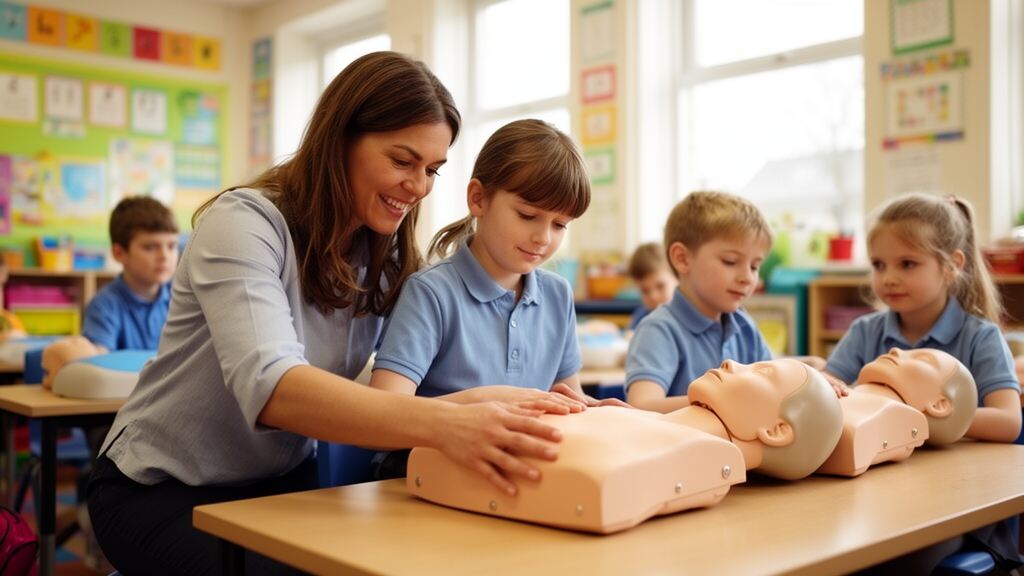
When someone collapses in cardiac arrest, the first minutes are everything. Survival hinges on bystanders who recognize the emergency, call for help, and start chest compressions before professional responders arrive. That is why the European Resuscitation Council has pushed for years to make basic life support training a universal part of school education, most prominently through the Kids Save Lives initiative. A new study from Granada, Spain, now offers a detailed look at whether very young children can actually absorb and retain these lifesaving skills when the teaching is broken into short, game-like bursts rather than traditional lectures.
The research, published in BMC Medical Education as part of the CORE-LIFE research project, was carried out by a team of clinicians and educators affiliated with the Hospital Universitario Virgen de las Nieves, the Hospital Universitario Clínico San Cecilio, and the University of Granada. Their prospective observational study enrolled 416 primary school students across all six grades of a single school, the Cristo de la Yedra school in Granada, and tested a cardiopulmonary resuscitation curriculum built around two fashionable ideas in modern pedagogy: microlearning and gamification. Microlearning means delivering content in small, focused units that fit a child’s attention span, while gamification wraps the material in game mechanics such as challenges and rewards to sustain motivation.
The intervention itself was deliberately compact. Rather than a full-day workshop, the children received a short, practical, and sequential didactic unit aligned with the European Resuscitation Council’s recommendations for basic life support. The sequence that every resuscitation trainee must master is demanding for a child: check for danger and response, call for help, position the victim, and deliver effective chest compressions. Each of these steps was broken down into digestible segments, and the researchers then waited four months before testing how much the children still remembered and could perform.
That delayed assessment is one of the most interesting technical features of the study. Most educational research measures skill immediately after training, when performance is at its peak and retention has not yet been tested by time. By evaluating the children four months later, the Granada team probed what psychologists call long-term procedural memory, the durable motor and cognitive patterns that would actually matter in a real emergency. The results showed significant differences between school grades in the correct execution of the overall CPR sequence, with a p-value below 0.001, indicating that the probability of observing such differences by chance alone was extremely small. Older children, as one might expect, generally handled the sequence better than their younger schoolmates, but students across the grades demonstrated varying levels of performance on the individual procedural components when retested months after the intervention.
Perhaps the most striking finding came from outside the classroom. The researchers distributed family questionnaires and, of the 259 that were returned, 95.0 percent reported positively on the transmission of CPR-related content into the family environment. In other words, children were apparently going home and talking about chest compressions, emergency calls, and the chain of survival with their parents and siblings. This ripple effect has long been one of the theoretical arguments for teaching resuscitation in schools: each trained child becomes a small vector of knowledge into a household, potentially multiplying the number of prepared bystanders far beyond the classroom roster.
The authors are careful, however, to flag the limits of that family data. The questionnaires were exploratory and self-reported, meaning they capture a perception of dissemination within families but do not provide evidence that parents actually learned CPR or acquired any practical skill. A parent who remembers their child enthusiastically demonstrating compressions on a stuffed animal is not the same as a parent who could perform them. This distinction matters for anyone designing public health policy based on the study, because the true multiplier effect of school-based training remains an open question that would require direct assessment of family members.
On the question of feasibility, the study delivers encouraging but carefully qualified results. The intervention was successfully implemented across all six primary school grades, and a high proportion of non-excluded participants completed the four-month assessment, suggesting that the format was workable within a real school environment and acceptable to children, teachers, and families. Yet the researchers explicitly note that no pre-specified feasibility criteria were established before the study began, so the findings should be read as descriptive indicators of implementation rather than proof that formal feasibility thresholds were met. This is an honest methodological caveat that distinguishes the paper from more promotional accounts of educational innovation.
There is a second, equally important limitation: the absence of a comparison group. Because every participating child received the microlearning and gamification programme, and no control group received a different format or no training at all, the study cannot attribute the observed outcomes to either instructional strategy. The children learned, and much of the learning persisted for four months, but whether the game-based microformat outperforms conventional teaching of the same content is unknown. This is a common trade-off in school-based research, where ethical and logistical constraints often make randomized designs difficult, but it means the study establishes feasibility rather than superiority.
The study was approved by the Research Ethics Committee of the University of Granada under registration 1244/CEIH/2020 and conducted according to the principles of the Declaration of Helsinki. Written informed consent was obtained from the parents or legal guardians of all participating children, and the schoolchildren themselves received age-appropriate information about the study before taking part, with their willingness to participate respected throughout. All data were collected and analysed in anonymised form, and the authors declare no competing interests. The research received no dedicated funding, and the team thanked the school’s management for its cooperation.
What the Granada study ultimately contributes is a proof of concept with unusually honest boundaries. It shows that a short, game-infused, microlearning-based CPR curriculum can be delivered across an entire primary school, that children as young as those in the earliest grades can engage with the material, and that measurable procedural knowledge survives a four-month interval, with older grades performing the full sequence more reliably. It also hints at a powerful halo effect into families, even if that effect remains unquantified. For advocates of the Kids Save Lives vision, in which every schoolchild in Europe would graduate with basic life support competence, the study adds a practical data point: the youngest learners are not too young, and the format need not consume whole school days. The next step, which the authors’ own limitations point toward, is a controlled comparison against standard instruction, ideally across multiple schools, to determine whether gamified microlearning is merely a feasible way to teach children to save lives or genuinely a better one.
Subject of Research: School-based CPR education using microlearning and gamification in primary school children
Article Title: Feasibility of a school-based cardiopulmonary resuscitation educational programme incorporating microlearning and gamification in primary school children: a prospective observational study
Article References: Carrasco-Cáliz, A., Parrilla-Ruiz, F. M., Gómez-Moreno, G., Pérez-Villares, J. M., Padilla-Serrano, A., & Cárdenas-Cruz, A. (2026). Feasibility of a school-based cardiopulmonary resuscitation educational programme incorporating microlearning and gamification in primary school children: a prospective observational study. BMC Medical Education. https://doi.org/10.1186/s12909-026-10616-w
Image Credits: AI Generated
DOI: 10.1186/s12909-026-10616-w
Keywords: cardiopulmonary resuscitation, basic life support, microlearning, gamification, primary school children, health education, Kids Save Lives, chain of survival, school-based intervention, skill retention, medical education, public health
Cite Scienmag News
Courtney Benton. (October 15, 2026). Microlearning and Games Could Teach Primary School Children Lifesaving CPR. Scienmag. https://scienmag.com/microlearning-and-games-could-teach-primary-school-children-lifesaving-cpr/
Courtney Benton. "Microlearning and Games Could Teach Primary School Children Lifesaving CPR." Scienmag, 15 October 2026, https://scienmag.com/microlearning-and-games-could-teach-primary-school-children-lifesaving-cpr/. Accessed 15 October 2026.
Courtney Benton. "Microlearning and Games Could Teach Primary School Children Lifesaving CPR." Scienmag. October 15, 2026. https://scienmag.com/microlearning-and-games-could-teach-primary-school-children-lifesaving-cpr/


