


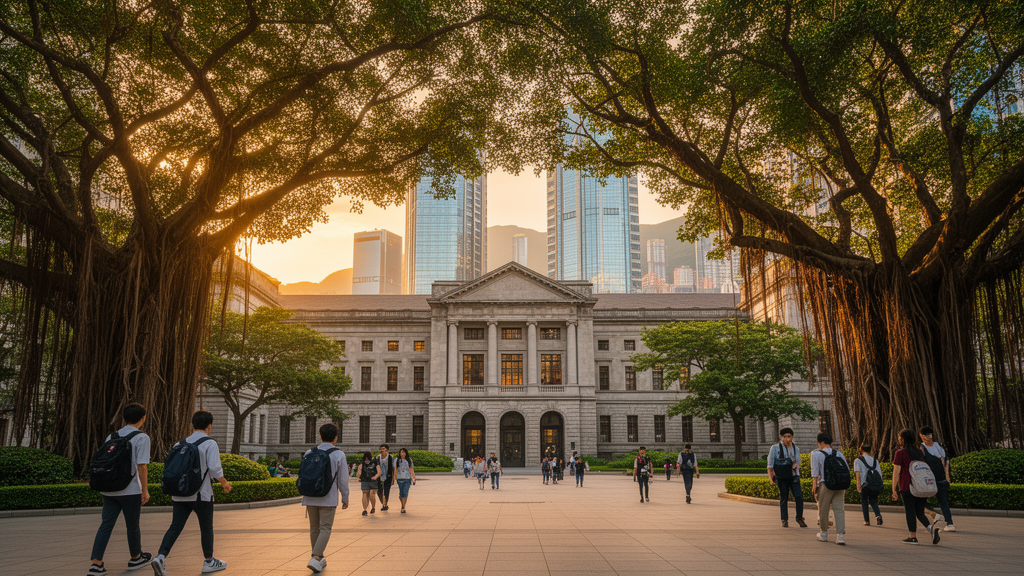
The University of Hong Kong has once again secured its position among the world’s leading institutions of higher education, placing 33rd globally in the 2027 Times Higher Education World University Rankings. The result confirms HKU’s status as the highest-ranked university in Hong Kong, a position it has defended through years of intensifying international competition among research-intensive universities. In an era when global league tables are scrutinized by governments, funding bodies, prospective students, and academic recruiters alike, the university’s continued presence in the upper tier of the rankings carries significance well beyond institutional prestige, touching on research funding, faculty recruitment, and the city’s broader ambition to serve as an international hub for education and innovation.
One of the most notable developments in this year’s assessment was a rise in HKU’s academic reputation score, a component of the rankings that reflects how scholars around the world perceive the quality of a university’s research and teaching. Academic reputation is among the most closely watched indicators in the THE methodology because it captures something that bibliometric measures alone cannot: the informed judgment of tens of thousands of experienced academics who respond to the annual invitation to name the institutions they consider strongest in their own fields. A gain in this measure suggests that HKU’s scholarly output and intellectual influence are being recognized at an accelerating pace by peers across disciplines and continents, reinforcing the university’s standing as a serious global research power.
The Times Higher Education World University Rankings evaluate universities using a framework built around five broad pillars: teaching, research environment, research quality, international outlook, and industry engagement, sometimes described as knowledge transfer. Each pillar is constructed from a combination of institutional data, bibliometric analysis, and survey results. Teaching performance is assessed through indicators such as the doctorate-to-bachelor’s ratio, the ratio of academic staff to students, and institutional income. Research environment draws on measures of research income and productivity, while research quality relies heavily on citation analysis, including field- and year-normalized citation impact, and on indicators of research excellence and influence. International outlook considers the proportion of international students and staff as well as international collaboration, and industry engagement tracks income from commercial sources and patents. HKU’s sustained high placement indicates consistent strength across this multidimensional spectrum rather than excellence in a single narrow category.
For HKU, the 2027 result underscores what university leadership describes as sustained strength in teaching, pioneering research, and global engagement. The ability to attract world-class faculty and students is central to that performance. Elite universities operate in a fiercely competitive global market for talent, and ranking positions both reflect and reinforce that market position: high rankings make an institution more attractive to leading researchers and ambitious students, and the presence of those researchers and students in turn strengthens the research output, citation impact, and reputation scores that determine future rankings. HKU’s continued top-tier placement suggests that this virtuous cycle remains firmly in operation on the university’s campus overlooking the southern slopes of Hong Kong Island.
Professor Xiang Zhang, President and Vice-Chancellor of HKU, framed the university’s mission in forward-looking terms in response to the results. “The true value of a university lies in its capacity to shape the future,” he said. “At HKU, our focus is on pioneering new frontiers of knowledge and nurturing the visionary thinkers who will solve tomorrow’s global challenges. We will continue to advance our mission as a leading global institution, driving progress through world-class teaching and research innovation to strengthen our contributions to the betterment of Hong Kong, the nation, and the world.” The statement positions the university not merely as a custodian of accumulated knowledge but as an active engine of discovery, with an explicit commitment to serving the city, the nation, and the international community simultaneously.
Zhang’s remarks reflect a broader philosophy increasingly common among research universities: that the measure of institutional success is not the ranking itself but the downstream impact of research and education on society. In practical terms, that impact flows through several channels. Basic research conducted at universities like HKU feeds the pipeline of scientific discovery that ultimately yields new technologies, medical treatments, and materials. Graduates trained in a research-intensive environment carry analytical skills and technical expertise into industries, hospitals, schools, and public institutions. International collaboration, which the THE framework explicitly rewards, accelerates the pace of science by connecting researchers to complementary expertise, unique facilities, and diverse datasets across borders. A university that performs well across all of these dimensions multiplies its contribution far beyond its own campus.
Hong Kong’s higher education landscape makes HKU’s leading position particularly consequential. The city hosts a cluster of publicly funded universities that have risen rapidly in global standings over the past two decades, supported by substantial government investment in research and a strategic orientation toward internationalization. English-language instruction, strong ties to global academic networks, and proximity to the research and manufacturing ecosystems of the Greater Bay Area give Hong Kong institutions distinctive advantages. Within this competitive local ecosystem, the highest-ranked institution serves as an anchor: it attracts international partnerships, hosts major research facilities, and sets a benchmark that peers across the city strive to match. HKU’s 33rd-place finish in 2027 therefore resonates across the entire territory’s academic sector.
The rise in academic reputation deserves particular attention from a technical standpoint. Reputation surveys are methodologically demanding instruments, typically gathering responses from tens of thousands of published academics worldwide who are asked to identify the best institutions in their own broad field and discipline. Because respondents can only name universities they know well, reputation scores tend to favor institutions with visible, high-impact research and extensive international networks. Gains in this indicator are therefore difficult to engineer directly; they generally follow from years of sustained investment in faculty quality, research infrastructure, and scholarly visibility. That HKU’s reputation measure improved in the 2027 cycle suggests that the university’s recent scholarly output is being read, cited, and valued by an expanding community of international peers, a signal that often precedes further gains in citation-based and collaboration-based metrics in subsequent years.
The 2027 rankings arrive at a moment of rapid change in global higher education. Universities worldwide are navigating shifting patterns of international student mobility, evolving research funding priorities, the disruptive and enabling influence of artificial intelligence on both scholarship and teaching, and growing expectations that academic institutions demonstrate tangible societal and economic value. Ranking frameworks have evolved in parallel, with THE and other organizations refining their methodologies to capture research quality more precisely, to reward open science practices, and to weigh engagement with industry and community alongside traditional academic measures. Navigating this shifting landscape while maintaining a stable position among the world’s top forty institutions requires a combination of strategic clarity, financial resilience, and consistent research performance, qualities that the 2027 result indicates HKU continues to possess.
Looking ahead, the university’s leadership has signaled that the pursuit of excellence will remain inseparable from its commitment to public purpose. The combination of a stable top-tier global ranking, an improving reputation among international scholars, and continued leadership within Hong Kong provides HKU with a strong platform from which to pursue its stated ambitions in teaching and research innovation. For students weighing where to study, researchers considering where to build their careers, and partners seeking academic collaborators in Asia, the 2027 Times Higher Education World University Rankings offer a data-driven affirmation that the University of Hong Kong remains among the institutions where the frontiers of knowledge are being actively pushed outward, and where the next generation of thinkers is being prepared to confront the global challenges of the decades ahead.
Subject of Research: The University of Hong Kong's performance in the 2027 Times Higher Education World University Rankings
Article Title: HKU continues to lead in 2027 THE World University Rankings
Article References: HKU continues to lead in 2027 THE World University Rankings. (n.d.). Original publication
Image Credits: AI Generated
DOI: Not provided
Keywords: University of Hong Kong, THE World University Rankings, higher education, global university rankings, academic reputation, research quality, Professor Xiang Zhang, Hong Kong, university rankings methodology, international outlook, teaching excellence, research funding
Cite Scienmag News
Courtney Benton. (October 15, 2026). HKU Holds 33rd Place Worldwide in 2027 THE Rankings as Hong Kong’s Top University. Scienmag. https://scienmag.com/hku-holds-33rd-place-worldwide-in-2027-the-rankings-as-hong-kongs-top-university/
Courtney Benton. "HKU Holds 33rd Place Worldwide in 2027 THE Rankings as Hong Kong’s Top University." Scienmag, 15 October 2026, https://scienmag.com/hku-holds-33rd-place-worldwide-in-2027-the-rankings-as-hong-kongs-top-university/. Accessed 15 October 2026.
Courtney Benton. "HKU Holds 33rd Place Worldwide in 2027 THE Rankings as Hong Kong’s Top University." Scienmag. October 15, 2026. https://scienmag.com/hku-holds-33rd-place-worldwide-in-2027-the-rankings-as-hong-kongs-top-university/


