


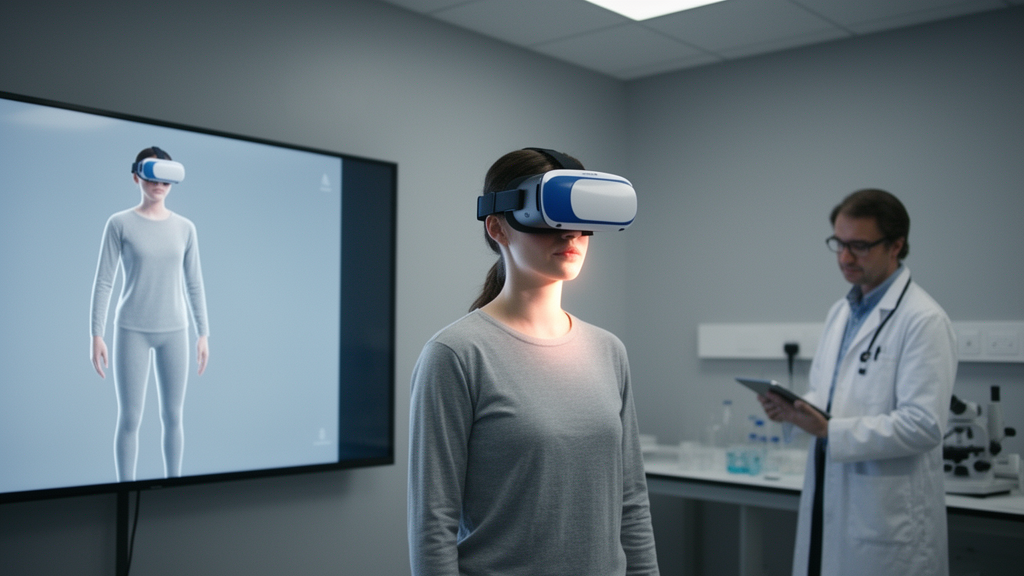
Imagine trying to work out what a friend sitting across a round table can see—whether a digit on a card looks upright to them or upside down to you. For most people, this mental juggling act, known as Level-2 visual perspective taking, happens almost effortlessly. For individuals with schizophrenia, a new study suggests, it is markedly harder—and, perhaps surprisingly, putting a virtual avatar in the other person’s shoes does not seem to help.
The research, published in BMC Psychiatry by Pei Xie, ChaoZheng Huang, Li Lu, HanBin Sang and AiBao Zhou, set out to answer two questions at once. First, do people with schizophrenia show impairments in Level-2 visual perspective taking, the cognitively demanding ability to compute how a scene actually appears from another person’s viewpoint? Second, could a simple manipulation—identifying with a self-represented avatar—reduce those deficits? The answers, drawn from two experiments involving more than 120 participants, are a clear yes to the first question and a firm no to the second.
Visual perspective taking is typically divided into two levels. Level-1 perspective taking is the simpler of the two: it involves understanding whether another person can or cannot see an object, a judgment that depends mainly on line of sight. Level-2 perspective taking goes further, requiring an observer to work out how an object or scene looks from someone else’s position—whether a number appears rotated, whether an object sits to the left or right from the other person’s vantage point. This richer computation is thought to draw on mental rotation processes, either imagining the self rotating into the other’s position or rotating the object itself, and it is closely tied to everyday social cognition, from interpreting a companion’s view of a shared scene to navigating conversation and cooperation.
Because social cognition is frequently disrupted in schizophrenia, researchers have long suspected that perspective-taking difficulties might contribute to the interpersonal challenges characteristic of the condition. Yet the picture has been complicated by the fact that perspective-taking performance can be measured in different ways—some tasks emphasize the appearance of objects, others their spatial location—and it has remained unclear whether deficits generalize across these domains. The new study was designed to test exactly that, using two distinct paradigms in parallel.
Experiment 1 recruited 63 participants and used a digit inversion task to probe Level-2 perspective taking based on object appearance. In this kind of task, participants must judge how a digit, such as a 6 or a 9, appears to another person seated at a different orientation; when the other person’s view is incongruent with one’s own, the correct answer requires suppressing one’s immediate egocentric impression and mentally transforming the stimulus. Experiment 2, with 62 participants, used a round-table task to assess perspective taking based on spatial location, requiring participants to determine how objects are arranged from another seat at the table. Crucially, both experiments included participants with schizophrenia and healthy controls, and both groups completed the tasks under two conditions: one in which the other person was represented by a self-avatar, an avatar identified as representing the self, and one in which an other-avatar was used.
The results were consistent across both task domains. Individuals with schizophrenia demonstrated significant impairments in Level-2 visual perspective taking compared with healthy controls, showing lower accuracy and a stronger egocentric bias—the tendency for one’s own viewpoint to interfere with judgments about another person’s perspective. The deficit was particularly pronounced in perspective-incongruent conditions, the trials that place the greatest demand on the ability to set aside one’s own view and adopt another’s. This pattern held whether the task involved the appearance of digits or the spatial layout of a table, suggesting that the impairment is not an artifact of any single experimental paradigm but a pervasive feature of how perspective taking breaks down in schizophrenia.
The more provocative finding concerns the avatars. The researchers had hypothesized that a self-avatar—an avatar that participants identified as representing themselves—might act as a kind of cognitive anchor, making it easier to simulate another person’s viewpoint and thereby mitigating the perspective-taking deficit. In healthy individuals, self-related cues are known to enjoy processing advantages, and embodied or avatar-based manipulations have shown promise in other areas of social cognition research. But in this study, the self-avatar identity did not produce a selective performance benefit in the schizophrenia group. Whatever advantage the self-avatar manipulation offered, it did not translate into improved Level-2 perspective taking for the participants whose deficits it was meant to address.
The authors are careful about what this null result means. The absence of a schizophrenia-specific self-avatar benefit suggests that an instruction-based self-avatar manipulation alone may be insufficient to selectively improve Level-2 visual perspective-taking performance in schizophrenia. In other words, simply telling participants that an avatar represents themselves, without the deeper immersive or embodied engagement that full avatar-based interventions can provide, may not be enough to recruit the self-related cognitive processes that could, in principle, support perspective taking. The cognitive mechanisms underlying the observed pattern of deficits—and the failure of the self-avatar to alter them—remain to be established, and the study’s conclusions explicitly flag this as an open question for future research.
Why might self-avatar cues fail in schizophrenia? The study does not settle the question, but the result fits within a broader research landscape in which self-processing abnormalities have been repeatedly implicated in the disorder. If the sense of self, or the way self-related information is integrated with perception and action, is itself altered in schizophrenia, then interventions that rely on self-identification to boost social cognition may need to be redesigned—perhaps by incorporating more immersive embodiment, or by targeting the underlying egocentric bias directly rather than assuming that a self-cue will automatically reorient attention toward another’s viewpoint. The finding also serves as a caution for the growing field of virtual reality-based mental health interventions, which often assume that avatar manipulations will transfer smoothly across clinical populations.
For clinicians and researchers, the study’s confirmation of pervasive Level-2 perspective-taking deficits across both object-based and spatial tasks strengthens the case that these difficulties are a genuine and general feature of schizophrenia, not a byproduct of task choice. That matters because perspective taking underpins everyday social interaction, and understanding precisely where the computation fails—whether in suppressing the egocentric view, in mentally rotating the self or the object into another’s frame, or in integrating the two—could guide the development of targeted cognitive training. The study, which received informed written consent from all participants under a protocol approved by the Ethics Board of Northwest Normal University and was supported by funding including the Sichuan Science and Technology Program and the National Natural Science Foundation of China, leaves the therapeutic door open: the deficits are real and measurable, but the tools for closing the gap have not yet been found. What the avatars could not do, future research will have to.
Subject of Research: Level-2 visual perspective taking and self-avatar effects in schizophrenia
Article Title: The effect of avatar identity on level-2 visual perspective taking in individuals with schizophrenia
Article References: Xie, P., Huang, C., Lu, L., Sang, H., & Zhou, A. (2026). The effect of avatar identity on level-2 visual perspective taking in individuals with schizophrenia. BMC Psychiatry, 26(1), Article 719. https://doi.org/10.1186/s12888-026-08614-9
Image Credits: AI Generated
DOI: 10.1186/s12888-026-08614-9
Keywords: schizophrenia, visual perspective taking, Level-2 VPT, self-avatar, egocentric bias, social cognition, mental rotation, psychosis, virtual avatars, cognitive impairment, BMC Psychiatry, embodiment
Cite Scienmag News
Glenn Wilkins. (October 15, 2026). Schizophrenia Study Finds Self-Avatars Fail to Fix Perspective-Taking Deficits. Scienmag. https://scienmag.com/schizophrenia-study-finds-self-avatars-fail-to-fix-perspective-taking-deficits/
Glenn Wilkins. "Schizophrenia Study Finds Self-Avatars Fail to Fix Perspective-Taking Deficits." Scienmag, 15 October 2026, https://scienmag.com/schizophrenia-study-finds-self-avatars-fail-to-fix-perspective-taking-deficits/. Accessed 15 October 2026.
Glenn Wilkins. "Schizophrenia Study Finds Self-Avatars Fail to Fix Perspective-Taking Deficits." Scienmag. October 15, 2026. https://scienmag.com/schizophrenia-study-finds-self-avatars-fail-to-fix-perspective-taking-deficits/


