


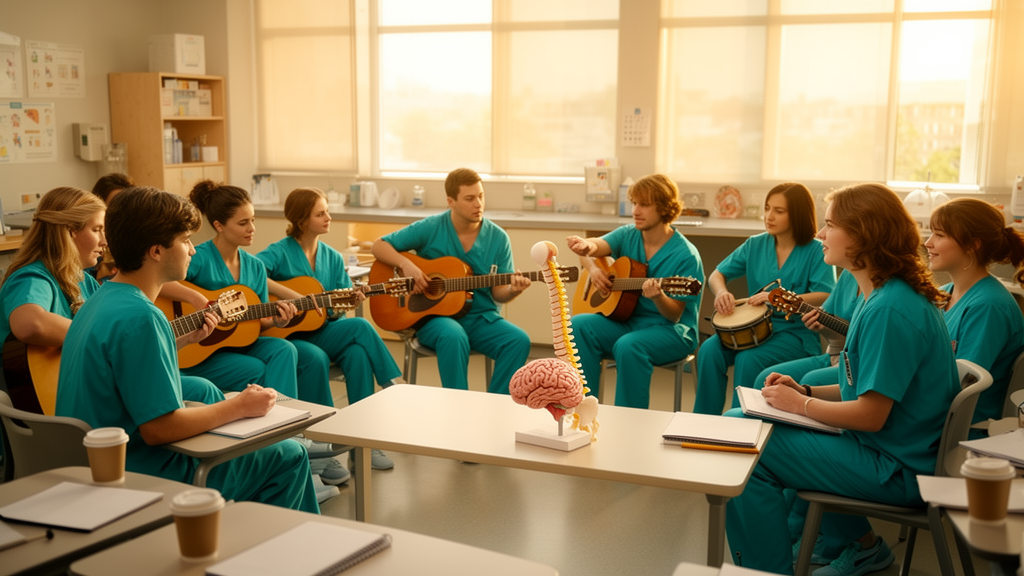
Every nursing student eventually confronts the twelve cranial nerves, a daunting roster of anatomical structures that must be memorized not only by name but also by function and classification as sensory, motor, or mixed nerves. The material is abstract, sequentially organized, and unforgiving of gaps in recall, which is why it has long been taught through lectures supported by slides and diagrams. A new quasi-experimental study from Bali, Indonesia, tested whether a very different vehicle—original educational songs written in blues, rock, and acoustic styles—could help students master this content more effectively than conventional instruction. The results, published in Discover Education, are intriguing but come with important statistical caveats that the authors themselves take pains to emphasize.
The research team, led by Sri Sundari of Universitas Muhammadiyah Yogyakarta together with Made Yos Kresnayana and Dwijoko Purbohadi, recruited 65 second-semester nursing students from a private health college in Bali. Because the researchers worked with two pre-existing, intact classes rather than randomly assigning individuals, the study followed a non-equivalent control group design. One class of 33 students became the experimental group and learned cranial nerve content through a music-based instructional package, while the other class of 32 students received conventional lecture-based teaching. The same instructor delivered all sessions in both conditions, over three weeks, with identical learning objectives, session lengths of 60 minutes, and comparable classroom environments, so that the instructional approach itself remained the primary difference between the groups.
The musical intervention was carefully engineered rather than casually assembled. Three original compositions of roughly three minutes each were written specifically for the study, with lyrics embedding the names, functions, and classifications of the cranial nerves. Each session covered a different subset of nerves in a different genre: the first session covered cranial nerves I to IV in a blues style, the second covered nerves V to VIII in rock, and the third covered nerves IX to XII acoustically. Tempos were held between approximately 90 and 120 beats per minute, a moderate range chosen so that the anatomical lyrics could be heard and followed clearly. Each session followed a consistent routine: an introduction to the topic, a brief pretest, the music-based learning activity, a discussion of the lyrics and the underlying anatomy, and a short posttest. The control group covered exactly the same material through PowerPoint-supported lectures, guided discussion, and written exercises with feedback, with the content reviewed by two external experts in neuroanatomy and nursing education to guarantee equivalence.
Learning outcomes were measured with a 20-item multiple-choice test that had been reviewed by three experts for content validity, achieving a Content Validity Index of 0.92, and showed good internal consistency with a Cronbach alpha of 0.83. Student engagement was assessed with a 10-item Likert-scale questionnaire with a reliability coefficient of 0.86, and an observation checklist with two independent observers confirmed that the planned instructional procedures were implemented consistently across sessions. Statistical analysis was performed in SPSS version 25, with Shapiro-Wilk and Levene’s tests verifying that the assumptions for parametric analysis were reasonably met before proceeding.
The most consequential finding of the study was actually a problem with the design: the two groups differed substantially in prior knowledge before instruction even began. The experimental group’s pretest means ranged from about 72 points while the control group’s hovered near 54, a gap of roughly 18 to 28 points depending on the session, and independent samples t-tests confirmed these baseline differences were highly significant across all three sessions. This imbalance is an inherent feature of using intact classes, and the researchers addressed it analytically by including pretest scores as a covariate in analyses of covariance. However, they repeatedly caution that statistical adjustment cannot fully compensate for such a large pre-existing difference between non-equivalent groups, a limitation that colors every downstream comparison in the study.
After adjustment, the music-based group showed significantly higher posttest scores in two of the three sessions. For Session I–IV, the ANCOVA yielded F(1,62) = 11.49, p = 0.001, with a partial eta-squared of 0.16 and an adjusted difference of 6.82 points; for Session V–VIII, F(1,62) = 13.15, p = 0.001, partial eta-squared of 0.18, and an adjusted difference of 6.29 points. The corresponding effect sizes were Cohen’s d of 1.14 and 1.07, values the authors describe as moderate-to-large but insist should be interpreted with caution given the baseline imbalance. In the third session, covering nerves IX to XII, the adjusted difference shrank to 2.87 points and was not statistically significant (p = 0.105), a result the authors partly attribute to a possible ceiling effect, since the experimental group’s posttest scores approached the upper range of the scale.
Perhaps the most sobering statistic in the paper concerns raw learning gains. When posttest minus pretest scores were compared directly, the two groups were statistically indistinguishable: the control group gained between 12.90 and 15.32 points across sessions, the experimental group between 11.64 and 15.00 points, and an independent samples t-test on overall gains found no significant difference (t(63) = 0.47, p = 0.64). In other words, both instructional approaches produced comparable magnitudes of improvement from pretest to posttest, and the apparent adjusted advantage of the music group reflects statistical comparison at the posttest endpoint rather than genuinely different learning trajectories. The authors are explicit that the findings indicate an association observed after adjustment, not evidence that music-based instruction caused the advantage.
Why might songs help at all? The authors frame their interpretation through two established theoretical lenses. Dual Coding Theory holds that verbal information becomes more retrievable when paired with a complementary auditory or visual channel, because dual representations create a richer associative network and more routes back to the material during recall. Cognitive Load Theory adds a complementary account: working memory has limited capacity, and content lacking clear structure forces learners to spend that capacity on organizing the material rather than understanding it. A predictable rhythmic pattern imposes structure from the outset, potentially freeing cognitive resources for the functional relationships among the nerves. Research in music cognition supports the idea that repeated melodic patterns facilitate efficient encoding of sequential material, and neuroscience work links musical engagement to attention, emotional processing, and memory formation, including activation of reward-related regions such as the mesolimbic dopaminergic system. Students in the experimental group reported higher engagement, describing the sessions as enjoyable and noting that the rhythm helped them remember the order and functions of the nerves, although a few commented that faster tempos occasionally made concentration harder.
The study’s limitations are considerable and honestly catalogued. Beyond the non-equivalent groups, the intervention bundled multiple active ingredients—music, repetition, singing, guided discussion, and active participation—so the specific contribution of the musical component cannot be isolated. Musical genre was completely confounded with instructional sequence and content, meaning no conclusions can be drawn about whether blues, rock, or acoustic styles differ in effectiveness. Participants knew they were receiving a novel intervention, opening the door to expectancy, novelty, and Hawthorne effects. All assessments were administered immediately after instruction, so nothing is known about medium- or long-term retention, which is precisely the outcome music-based methods are usually claimed to enhance. The single institution, small sample, and specific cultural and linguistic context of Bali further limit generalizability, and the proposed cognitive mechanisms remain interpretive rather than directly measured.
Even with these caveats, the study offers practical takeaways for health science education. The music-based sessions fit within standard 60-minute class periods, requiring no additional classroom time, and the approach could plausibly extend to other terminology-intensive subjects such as pharmacology, physiology, microbiology, and pathology, where students must recall ordered lists and classifications. Digital platforms could distribute educational songs so students can revisit content repeatedly outside class. The authors’ bottom line is measured: both conventional lectures and music-based instruction effectively supported learning of cranial nerve content, and the adjusted superiority of the musical package depended substantially on statistical correction rather than clearly different growth. Whether songs genuinely give students a durable memory advantage over slides and lectures remains an open question, one that will require randomized assignment, larger and more diverse samples, delayed posttests, and component-dismantling designs to answer definitively.
Subject of Research: Music-based instruction for cranial nerve anatomy learning in nursing education
Article Title: A quasi-experimental study of music-based instruction for cranial nerve learning in nursing students
Article References: Sundari, S., Kresnayana, M. Y., & Purbohadi, D. (2026). A quasi-experimental study of music-based instruction for cranial nerve learning in nursing students. Discover Education, 5(1), Article 964. https://doi.org/10.1007/s44217-026-02184-4
Image Credits: AI Generated
DOI: 10.1007/s44217-026-02184-4
Keywords: music-based instruction, cranial nerves, nursing education, neuroanatomy, quasi-experimental study, Dual Coding Theory, Cognitive Load Theory, ANCOVA, student engagement, educational songs, memory retention, health science education
Cite Scienmag News
Courtney Benton. (October 15, 2026). Nursing Students Learn Cranial Nerves Through Blues, Rock and Acoustic Songs. Scienmag. https://scienmag.com/nursing-students-learn-cranial-nerves-through-blues-rock-and-acoustic-songs/
Courtney Benton. "Nursing Students Learn Cranial Nerves Through Blues, Rock and Acoustic Songs." Scienmag, 15 October 2026, https://scienmag.com/nursing-students-learn-cranial-nerves-through-blues-rock-and-acoustic-songs/. Accessed 15 October 2026.
Courtney Benton. "Nursing Students Learn Cranial Nerves Through Blues, Rock and Acoustic Songs." Scienmag. October 15, 2026. https://scienmag.com/nursing-students-learn-cranial-nerves-through-blues-rock-and-acoustic-songs/


