


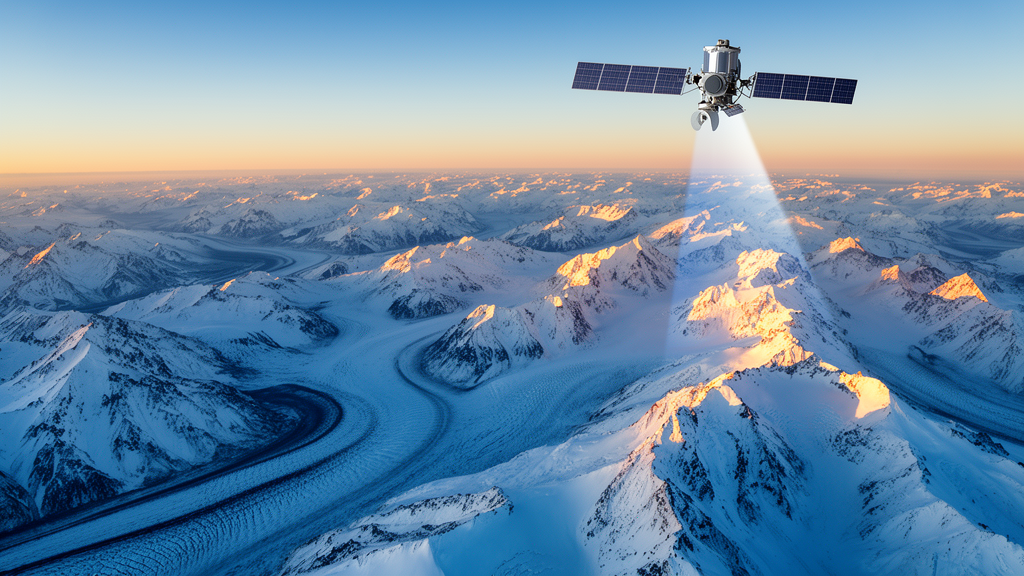
High in the Wrangell and St. Elias Mountains, on the border of Alaska and southwest Yukon, the snow that blankets the glaciers is quietly changing state. A new ten-year satellite study shows that seasonal melting now reaches nearly every elevation in the range, and that liquid water lingers inside the mountain snowpack weeks to months after air temperatures have plunged back below freezing. Only a sliver of the glacierized high country remains truly dry, a finding with sweeping implications for glacier hydrology, downstream rivers, and even the climate archives preserved in ice cores.
The research, published in The Cryosphere, was led by Ingalise Kindstedt of the University of Maine’s Climate Change Institute together with colleagues from institutions across the United States and Canada. The team exploited the European Sentinel-1 radar satellites, which have been imaging Earth’s surface since 2014, to map two critical dates for every point on the glaciers: the day melt first appears each spring, and the day the snow and firn refreeze each fall. Firn is the intermediate stage between fresh snow and glacial ice, snow that has survived at least one melt season, and its health is essential to how a glacier stores and releases water.
The technique relies on a simple but powerful physical principle. C-band synthetic aperture radar, the active microwave instrument aboard Sentinel-1, transmits radar pulses and measures the energy scattered back from the surface. Dry snow reflects radar strongly, but the introduction of even a small amount of liquid water dramatically changes the dielectric properties of the snowpack, attenuating the radar signal. When a pixel’s backscatter drops more than 3 decibels below its wintertime dry-snow average, the team classifies it as melting. Because the radar operates at night and through cloud cover, it delivers an unambiguous melt signal regardless of the darkness and storms that frequently shroud these mountains.
Sentinel-1’s specifications make it unusually well suited to this task. The mission revisits the study area every six days during years when both Sentinel-1a and Sentinel-1b were operational, at a spatial resolution of 20 meters across a 250-kilometer-wide swath. The radar wavelength, centered at 5.56 centimeters, is roughly two orders of magnitude larger than typical snow grain sizes of 0.1 to 0.3 millimeters, so grain size effects are negligible in the data. The team used co-polarization measurements, which are more sensitive to surface conditions, and processed images through the Alaska Satellite Facility with radiometric terrain correction to remove distortions from the rugged topography.
The results are striking. From 2018 to 2021, melt onset across much of the range occurred between roughly May 5 and June 25, and it closely tracked the seasonal rise of the 0 degree Celsius isotherm up to about 3000 meters elevation, validating the radar-based detection against in situ air temperature measurements from five ground-truth stations spanning 1192 to 5640 meters. But above 3000 meters, something unexpected happens: melt onset occurs at similar dates even as elevation increases, because the isotherm no longer rises systematically. Surface melting can be driven by incoming solar radiation even when air temperatures remain below freezing year-round, a conclusion the team supported with surface energy balance modeling showing that net shortwave radiation is the dominant positive contribution at the highest site, Prospector-Russell Col at 5640 meters.
The freeze-up story is even more revealing. Below about 1400 meters, the snowpack returns to winter conditions before air temperatures drop below freezing, reflecting melt down to bare ice at low elevations. But between roughly 2400 and 2900 meters, refreezing lags more than 100 days behind the arrival of subfreezing air temperatures. That delay, the team argues, is the signature of widespread meltwater retention: liquid water percolating into the porous firn and refreezing progressively downward, releasing latent heat that further warms the snowpack and reduces the efficiency of wintertime cooling. Terrain features such as elevation, distance from the ocean, slope angle, and aspect explain 61 percent of the variability in melt onset but only 25 percent of the variability in freeze-up, underscoring that refreezing is governed by subsurface processes rather than surface conditions alone.
By combining freeze-up delays with air temperatures and elevation, the team mapped firn hydrologic zones across the 45,470-square-kilometer study domain, of which 51 percent is ice-covered. The verdict: dry firn covers only 3 percent of the glacierized area, about 702 square kilometers, while hydrologic transition zones, regions caught between dry and wet firn regimes, cover 9 percent, about 2142 square kilometers. The remaining vast majority of the glacierized landscape is already wet firn. The transition zones occur anywhere from 1925 to 4225 meters, concentrated on the continental side of the range and on the flanks of high peaks, with those farther from the coast tending to sit at higher elevations. The lower bounds of these zones align with in situ observations of a perennial firn aquifer near the Kaskawulsh/Hubbard Divide at approximately 2640 meters, first documented in 2021.
The team interprets these transition zones as both spatial and temporal phenomena. Sites within them appear to be actively evolving from dry to increasingly wet firn states, a process supported by firn pack modeling and observations at Eclipse Icefield, where the firn is warming and can now support persistent liquid water into fall and winter. If wetting continues to the point of saturation, firn aquifers could develop more widely. Even without aquifer formation, continued wetting will alter firn structure and the timing of seasonal water release. The authors caution that a delayed backscatter rebound does not necessarily imply an aquifer, since percolation and delayed refreezing produce a similar radar response, but the direction of change is unambiguous.
The consequences ripple outward in several directions. Porous firn acts as a buffer on glacier runoff, delaying the transfer of meltwater to downstream systems by years to decades in some regions, and the Wrangell/St. Elias glaciers feed two of the largest watersheds draining into the Gulf of Alaska, the Copper and Alsek Rivers. Refreezing meltwater into near-surface ice layers can also reduce firn permeability and increase runoff, a fundamental change to firn structure documented in Greenland. Meanwhile, the near-disappearance of dry firn has direct implications for paleoclimate science: meltwater percolation and refreezing disrupt the stratigraphy of firn and ice, precluding ice core drilling, and opportunities to recover regional ice core records in Wrangell/St. Elias are already limited and likely to diminish with ongoing warming.
What the study cannot yet resolve is melt intensity, total melt production, or the partitioning of meltwater between storage and runoff, quantities needed to fully assess glacier mass balance and downstream hydrology. Variability in freeze-up delays between 3000 and 3400 meters suggests variation in melt season intensity without a corresponding shift in melt onset, showing that onset alone is an insufficient descriptor of seasonal melt dynamics. Nevertheless, in a region defined by pronounced seasonality, melt onset remains a valuable temporal anchor. As the authors conclude, the approach provides a temperature-independent baseline for evaluating ongoing changes in glacier surface melt, alpine firn evolution, and downstream hydrological impacts, and demonstrates the power of satellite radar for monitoring melt in complex, data-sparse mountain regions where weather stations are few and far between.
Subject of Research: Cryosphere
Article Title: Seasonal surface melt onset and firn freeze-up across the central Wrangell and St. Elias Mountains
Article References: Seasonal surface melt onset and firn freeze-up across the central Wrangell and St. Elias Mountains. (n.d.). https://doi.org/10.5194/tc-20-5941-2026
Image Credits: AI Generated
Keywords: glaciology, firn, Sentinel-1 SAR, Wrangell St. Elias, melt onset, freeze-up, firn aquifer, climate change, Alaska, Yukon, Seasonal, surface
Cite Scienmag News
Sloane Callahan. (October 15, 2026). Satellite Radar Reveals Widespread Hidden Meltwater in Alaska’s Wrangell and St. Elias Mountain Snowpacks. Scienmag. https://scienmag.com/satellite-radar-reveals-widespread-hidden-meltwater-in-alaskas-wrangell-and-st-elias-mountain-snowpacks/
Sloane Callahan. "Satellite Radar Reveals Widespread Hidden Meltwater in Alaska’s Wrangell and St. Elias Mountain Snowpacks." Scienmag, 15 October 2026, https://scienmag.com/satellite-radar-reveals-widespread-hidden-meltwater-in-alaskas-wrangell-and-st-elias-mountain-snowpacks/. Accessed 15 October 2026.
Sloane Callahan. "Satellite Radar Reveals Widespread Hidden Meltwater in Alaska’s Wrangell and St. Elias Mountain Snowpacks." Scienmag. October 15, 2026. https://scienmag.com/satellite-radar-reveals-widespread-hidden-meltwater-in-alaskas-wrangell-and-st-elias-mountain-snowpacks/


