


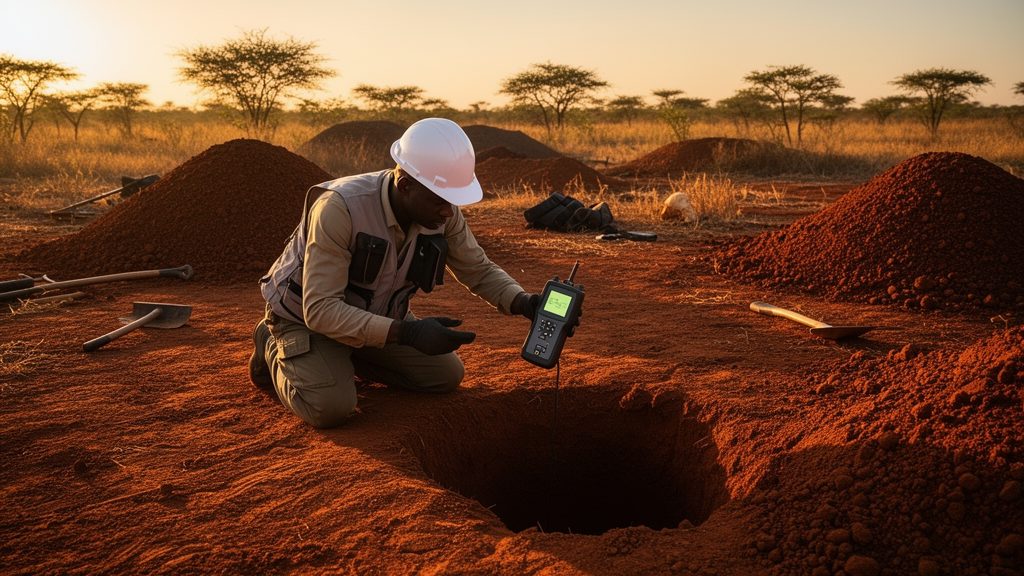
In the gold-rich soils of Niger State, in north-central Nigeria, an invisible hazard is being measured with new precision. A study published in Environmental Monitoring and Assessment has quantified the excess lifetime cancer risk posed by naturally occurring radioactive materials in soil from three artisanal mining and resident agricultural regions, where informal gold digging has become an economic lifeline for thousands of people. The research, conducted by Abdullahi Muhammad of Eastern Mediterranean University and Ibrahim Badamasi Babangida University and Akbar Abbasi of the University of Kyrenia, combined field gamma-ray spectrometry with a widely used environmental risk model to translate soil radioactivity into concrete estimates of long-term cancer risk for the miners and farmers who live and work on this land.
Naturally occurring radioactive materials, often abbreviated as NORM, are present in virtually all soils and rocks on Earth. The three radionuclides at the center of this investigation are potassium-40, a primordial isotope that makes up a tiny fraction of all natural potassium; radium-226, a member of the uranium-238 decay chain; and thorium-232, the head of its own long decay series. These isotopes are generally harmless at the low concentrations found in most agricultural land, but mining activities can concentrate them. When excavators and hand diggers bring deep material to the surface, process ore, and leave tailings exposed to wind and water, the normal geochemical balance is disturbed, and the radiation environment of a community can change in ways that are impossible to sense without instruments.
To measure those concentrations, the team collected soil samples from the three study regions and analyzed them using a sodium iodide detector doped with thallium, a workhorse instrument of gamma-ray spectroscopy. The NaI(Tl) detector registers the characteristic gamma photons emitted by each radionuclide and its decay products, allowing researchers to convert counts into activity concentrations expressed in becquerels per kilogram of soil. The results placed the average activity concentrations at 18.79 plus or minus 0.91 Bq/kg for radium-226, 7.87 plus or minus 1.23 Bq/kg for thorium-232, and 346.39 plus or minus 10.35 Bq/kg for potassium-40. These figures provide the essential input for any dose assessment, because the intensity of exposure in a contaminated landscape is governed first and foremost by how much radioactive material is actually present.
Measuring concentrations, however, is only the first step. The central question for radiation protection is what those numbers mean for human health over decades of exposure. To answer it, the researchers turned to the RESRAD code, short for residual radioactivity, a simulation package developed originally to support the cleanup of contaminated sites and now a standard tool for translating soil radioactivity into dose and risk estimates. RESRAD models the full web of exposure pathways that connect buried or surface-deposited radionuclides to human beings: direct external gamma irradiation from the soil itself, inhalation of dust particles carrying radioactive atoms, ingestion of soil, and the transfer of radionuclides through water, crops, and animal products into the food chain. By parameterizing the model with site-specific conditions and running it across a one-hundred-year horizon, the team could project how risk accumulates for two distinct populations, artisanal miners who spend long hours in intimate contact with disturbed soil, and resident farmers whose exposure comes through tilling, planting, and living on the same land.
The simulation results are striking for their clarity. Across the entire evaluated time period, from one to one hundred years, the excess lifetime cancer risk ranged from 2.33 times ten to the minus six to 5.40 times ten to the minus six. The minimum value was associated with thorium-232, while the maximum was driven by radium-226. In other words, of the three radionuclides studied, radium-226 emerged as the dominant contributor to long-term cancer risk in the mining soils, followed by thorium-232, with potassium-40 playing a comparatively smaller role despite its higher activity concentration. This inversion is scientifically meaningful: activity concentration alone does not determine risk, because each radionuclide carries its own decay energy, its own decay chain behavior, and its own dose coefficients that describe how effectively a given intake or external exposure translates into absorbed energy in human tissue.
The pathway analysis added another layer of insight. According to the simulation, the dominant exposure routes were direct radiation from the soil, both the direct gamma shine from the ground surface and the airborne component, together with inhalation. This finding matters enormously for practical protection. If inhalation and direct external exposure dominate, then the most effective interventions are those that reduce dust generation and limit time spent on freshly disturbed, unshielded soil. Simple measures such as wetting down working areas, wearing respiratory protection, and restricting the processing of ore in enclosed or poorly ventilated spaces can disproportionately reduce dose when inhalation is a leading pathway. Conversely, if food-chain transfer had dominated, the response would have focused instead on soil remediation and crop selection, a very different and more expensive set of actions.
The excess lifetime cancer risk metric itself deserves explanation, because it is the number that ultimately connects environmental measurement to human fate. The ELCR represents the probability, over and above the baseline cancer rate in any population, that a person will develop fatal cancer as a result of a lifetime of exposure to a given radiation source. Values on the order of ten to the minus six, as found in this study, correspond to roughly one additional cancer case per million exposed individuals, a magnitude that international guidance often treats as a threshold of concern for prolonged public exposure. The fact that the modeled risks in the Niger State mining regions fall within this low range is reassuring at first glance, but the authors emphasize that the findings are intended to inform radiation protection decisions, and the cumulative burden across large populations of miners and farmers, combined with other hazards of artisanal mining, is precisely the kind of information regulators need before risks grow.
The context of artisanal gold mining in Nigeria gives the study its urgency. Artisanal and small-scale mining provides livelihoods across parts of West Africa but operates largely outside formal regulatory frameworks, with minimal environmental monitoring and little occupational health oversight. Previous research in the same region has documented serious chemical hazards, including mercury contamination in soil at artisanal gold mine sites in Niger State, where the metal is used to amalgamate gold. The new radiological assessment adds a third dimension to this picture of cumulative environmental burden, showing that the same soils that carry toxic metals also carry measurable quantities of primordial and decay-chain radionuclides. For communities where mining and agriculture coexist on the same land, the combined evidence paints a portrait of chronic, low-level exposure that is easy to ignore precisely because no single measurement triggers alarm.
Methodologically, the study demonstrates the value of pairing direct spectroscopic measurement with process-based simulation. The NaI(Tl) measurements anchor the model in reality, capturing the actual gamma-emitting inventory of the soil, while RESRAD extends that snapshot across time and across exposure scenarios that would be impossible to observe directly. The one-hundred-year simulation window is particularly important for radionuclides like radium-226 and thorium-232, whose long half-lives mean that contamination does not simply decay away within a human generation. The authors note that the RESRAD-OFFSITE software used for the simulations is publicly available and that the model inputs are described in the article, an openness that allows other researchers to replicate the analysis in other mining regions where NORM data are scarce.
The broader significance of the work lies in its contribution to a growing global dataset on natural radioactivity in mining environments. Comparable assessments have been carried out around gold mines in Ghana, coal mining areas in Brazil, granite quarries in Iran, and iron beneficiation plants in China, each adding pieces to a picture of how extractive industries redistribute the Earth’s natural radioactivity into human contact. The Niger State study stands out for its explicit comparison of two vulnerable populations, miners and farmers, and for its pathway-resolved risk estimates that point directly toward mitigation. As demand for gold and other minerals continues to drive informal mining deeper into rural landscapes, studies of this kind provide the evidence base for radiation protection policies that can be implemented before, rather than after, health effects emerge. For the farming and mining communities of north-central Nigeria, the message of the numbers is measured but clear: the risk today is small, the dominant pathways are known, and the window for inexpensive prevention is open.
Subject of Research: Assessment of radiation dose and excess lifetime cancer risk from naturally occurring radionuclides in soil at artisanal gold mining sites in Nigeria using the RESRAD code
Article Title: Assessment of effective dose and radiation risk due to 226Ra, 40K, and 232Th exposure within the soil of artisanal gold mine using the RESRAD code
Article References: Muhammad, A., & Abbasi, A. (2026). Assessment of effective dose and radiation risk due to 226Ra, 40K, and 232Th exposure within the soil of artisanal gold mine using the RESRAD code. Environmental Monitoring and Assessment, 198(10), Article 1039. https://doi.org/10.1007/s10661-026-15887-w
Image Credits: AI Generated
DOI: 10.1007/s10661-026-15887-w
Keywords: natural radioactivity, radium-226, thorium-232, potassium-40, RESRAD, artisanal gold mining, excess lifetime cancer risk, Nigeria, gamma-ray spectrometry, radiation protection, NORM, exposure pathways
Cite Scienmag News
Nathaniel Bowman. (October 15, 2026). Hidden Radiation in Gold Mine Soil: RESRAD Model Maps Cancer Risk in Nigeria. Scienmag. https://scienmag.com/hidden-radiation-in-gold-mine-soil-resrad-model-maps-cancer-risk-in-nigeria/
Nathaniel Bowman. "Hidden Radiation in Gold Mine Soil: RESRAD Model Maps Cancer Risk in Nigeria." Scienmag, 15 October 2026, https://scienmag.com/hidden-radiation-in-gold-mine-soil-resrad-model-maps-cancer-risk-in-nigeria/. Accessed 15 October 2026.
Nathaniel Bowman. "Hidden Radiation in Gold Mine Soil: RESRAD Model Maps Cancer Risk in Nigeria." Scienmag. October 15, 2026. https://scienmag.com/hidden-radiation-in-gold-mine-soil-resrad-model-maps-cancer-risk-in-nigeria/


