


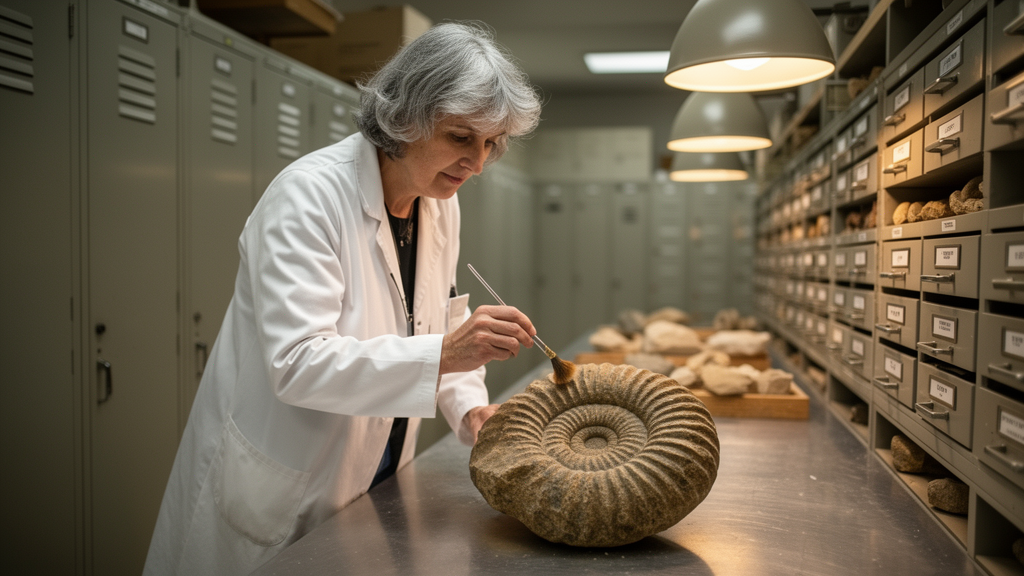
When Roger Portell first walked into the Florida Museum of Natural History as a newly hired laboratory technician, the invertebrate paleontology collection he would one day direct held roughly 12,000 specimens. When he retired this month after 42 years of service, that same collection contained more than seven million fossils, making it one of the largest repositories of invertebrate fossils in North America. The scale of that transformation, achieved specimen by specimen and expedition by expedition, is the clearest possible measure of a career devoted to the careful, unglamorous, absolutely essential work of building and safeguarding the physical evidence on which the entire discipline of paleontology depends. Museums around the world hold collections of this kind, but few have grown so dramatically under a single steward, and fewer still have done so while simultaneously opening their contents to the global research community through systematic digitization.
Portell’s retirement has not passed quietly. Members of the Paleontological Society organized a day-long session in his honor at their annual conference, held this year in Denver from October 11 through 14, filling a program with presentations that traced the influence of his work and mentorship across the field. His colleagues also nominated him for the society’s Pojeta Award, which recognizes exceptional professional and public service in paleontology, and he received the honor during a banquet on Sunday, October 11. The award’s emphasis on service rather than a single discovery captures what distinguishes Portell’s career. Jonathan Hendricks, curator of paleontology at the Milwaukee Public Museum and one of his nominators, put it plainly: he could not think of an individual who had done more in service of the discipline than Roger Portell.
The path that led Portell to the museum was anything but linear. He began his working life in restaurant management and banking, careers that left an unmet yearning he filled by hunting for fossils on weekends. The turning point came when he discovered a partial skeleton of an archaeocete, an extinct cetacean related to modern whales, and began assembling it in the dining room of his cramped apartment. His girlfriend, soon to become his wife, delivered the practical verdict that he would need a job at a museum if he intended to keep collecting at that pace. He took the advice seriously. Despite already holding a bachelor’s degree in business administration from Auburn University, he enrolled as an undergraduate at the University of Florida to study geology, graduating a second time before joining the museum’s invertebrate paleontology collection as a laboratory technician.
His rise through the institution was steady and deliberate. Three years after arriving as a technician, he was appointed full-time manager of the collection, and in 2008 he was promoted to director, the position he held until his retirement. Under his stewardship the collection’s growth from 12,000 specimens to more than seven million was driven in large part by the same impulse that had once filled his apartment dining room with whale bones: a deep passion for fieldwork. Portell participated in fossil collecting trips across large parts of North and South America and the Caribbean Islands, with a particular focus on fossils preserved during the Miocene in Panama and Chile, the Pleistocene in the Bahamas, the Eocene through Pleistocene in Florida, and various time periods in Cuba and Jamaica. These intervals and localities together span tens of millions of years of Earth history and some of the most biologically rich marine faunas ever preserved.
What makes those expeditions remarkable is that Portell rarely went alone. He indulged a second lifelong passion, sharing the wonders of the natural world, by organizing and leading trips that brought together professional paleontologists, avocational experts, high school teachers and college students from across the country. The educational payoff of that approach is difficult to overstate. Hendricks, who has known Portell since meeting him in a Florida shell aggregate pit in 1998, was one of the students whose trajectory was redirected by the experience. As an undergraduate at the University of Wisconsin, he joined a geology class spring break field trip to Florida, and Portell got the group into a quarry. Hendricks had planned to study dinosaurs and other vertebrates, but a single day among piles upon piles of shells, representing perhaps more than 1,000 species and an almost incalculable number of specimens, changed everything. He described the experience as intoxicating, and he went on to study invertebrates and to collaborate with Portell on numerous projects.
His case is far from isolated. Many of the people who nominated Portell for the Pojeta Award and helped organize the special conference session were individuals he had similarly helped along the way. Mark Patzkowsky, professor emeritus of geosciences at Pennsylvania State University, observed in his nomination that many collection managers put all of their efforts into the specimens themselves, with little interest in the wider profession or public, and that Portell did the opposite. Through his mentoring, Patzkowsky wrote, Portell inspired countless students to pursue paleontology, and many of those students are now outstanding scientists making their own contributions to the field. In a discipline where collections are often maintained behind closed doors, Portell treated every quarry visit and every visiting student as an opportunity to recruit the next generation of researchers.
Portell’s influence extends equally into the digital infrastructure of modern paleontology. Beyond expanding the collection’s sheer size, he led a sustained digitization effort that involved photographing specimens and entering all of the associated information into an online, freely accessible database that paleontologists around the world can use in their own research. Hendricks argued that it is really the digitization that sets the Florida Museum’s collection apart from many peer institutions, the result of Portell and his team chipping away at the work a little bit every day for so many years. Michal Kowalewski, a curator of invertebrate paleontology at the museum who worked closely with Portell for more than a decade, echoed the sentiment, noting that Roger perfected strategies for organizing and managing museum collections and established a gold standard that is renowned within the museum community and often emulated.
The scientific output that accompanied this curatorial work is substantial. Working with colleagues, Portell helped secure more than $2.8 million in grant funding from multiple sources to pay for improvements to the collection and for research, in which he remained actively engaged throughout his career. As of this year he is the single or co-author of more than 160 peer-reviewed scientific publications, with more currently in development, and he has published nearly 300 scientific abstracts, most of them in conference proceedings where he or a colleague gave public presentations. Characteristically, Portell often preferred poster presentations to lecture hall talks, because posters involve more one-on-one interaction. As Hendricks observed, Roger does not seek the limelight, has rarely if ever given a formal talk, and simply likes talking to people. His research focus remained, in almost every case, invertebrate paleontology, and working solo and with colleagues he discovered and named more than 100 species based on fossil material.
The recognition flows both ways. Six species have been named after Portell, including a type of sea cow that walked on legs, an extinct sirenian relative whose limb anatomy documents a remarkable stage in the transition of these marine mammals from terrestrial ancestors to fully aquatic life. Having species bear your name is one of the traditional honors of taxonomy, and receiving six of them reflects the esteem in which colleagues across the field hold his contributions to describing and interpreting fossil invertebrate diversity. Combined with the Pojeta Award and the dedicated conference session in Denver, these tributes sketch a portrait of a scientist whose legacy lies less in any single spectacular find than in the accumulated infrastructure, publications and people he leaves behind.
Portell intends to take a well-deserved break to spend time with family in the near future, but the unfinished projects will not stay unfinished for long. At some point, colleagues expect, he will turn his single-minded attention and meticulous work ethic back to the few remaining research efforts he has left in development. Kowalewski perhaps summed it up best in his tribute, writing that to call Roger an overachiever is a gross understatement, that his dedication, professionalism and profound knowledge of geology and paleontology set him apart, and that he can do anything and everything well. For a field that depends on the patient accumulation of specimens, data and trained successors, four decades of exactly that kind of work is a legacy few careers can match.
Subject of Research: Career and legacy of invertebrate paleontology collections director Roger Portell at the Florida Museum of Natural History
Article Title: Roger Portell, director of invertebrate paleontology, retires after 42 years, receives society award and conference session in his honor
Article References: Roger Portell, director of invertebrate paleontology, retires after 42 years, receives society award and conference session in his honor. (n.d.). Original publication
Image Credits: AI Generated
DOI: Not provided
Keywords: Roger Portell, invertebrate paleontology, Florida Museum of Natural History, Pojeta Award, Paleontological Society, museum collections, digitization, fossil fieldwork, Miocene, Pleistocene, taxonomy, mentorship
Cite Scienmag News
Violet Maxwell. (October 14, 2026). After 42 Years and Seven Million Fossils, a Museum Career Built One Specimen at a Time. Scienmag. https://scienmag.com/after-42-years-and-seven-million-fossils-a-museum-career-built-one-specimen-at-a-time/
Violet Maxwell. "After 42 Years and Seven Million Fossils, a Museum Career Built One Specimen at a Time." Scienmag, 14 October 2026, https://scienmag.com/after-42-years-and-seven-million-fossils-a-museum-career-built-one-specimen-at-a-time/. Accessed 14 October 2026.
Violet Maxwell. "After 42 Years and Seven Million Fossils, a Museum Career Built One Specimen at a Time." Scienmag. October 14, 2026. https://scienmag.com/after-42-years-and-seven-million-fossils-a-museum-career-built-one-specimen-at-a-time/


