


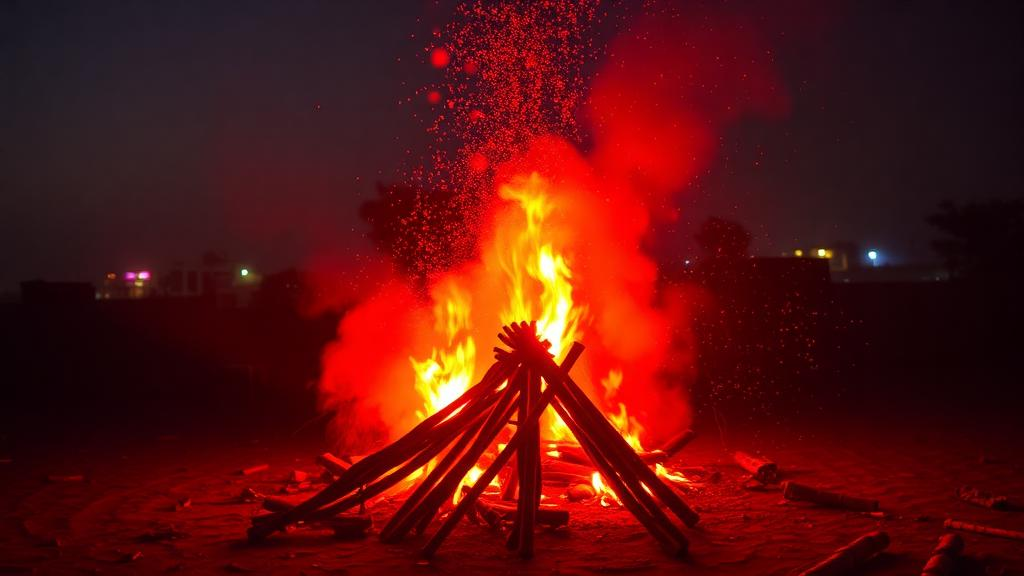
On the night before Holi, one of India’s most vibrant festivals, communities across the country light enormous bonfires known as Holika Dahan, burning wood, dung cakes, and an assortment of waste materials in a ritual that symbolizes the victory of good over evil. The spectacle is ancient and deeply cherished, but it also releases a dense plume of smoke into urban air that is already among the most polluted in the world. A new study from Lucknow, in the northern Indian state of Uttar Pradesh, has now measured exactly what those fires do to the city’s air, tracing fine particulate matter through three consecutive nights and calculating the health risks that follow. The results show a sharp, measurable spike in pollution that doubles fine particle concentrations in some neighborhoods and pushes cancer risk estimates beyond safety thresholds set by the United States Environmental Protection Agency.
The research, led by Sreekanth Bojjagani of the CSIR-Indian Institute of Toxicology Research together with colleagues S. S. Kalikinkar Mahanta and Hari Om Prasad, was published in the journal Environmental Monitoring and Assessment. The team focused on fine particulate matter, or PM2.5, particles no wider than 2.5 micrometers that are small enough to slip past the body’s natural defenses in the nose and throat and lodge deep in the lungs. Because these particles can carry toxic metals and organic compounds on their surfaces, they are considered among the most dangerous forms of air pollution, linked in large epidemiological studies to cardiovascular disease, respiratory illness, and premature death.
To capture the festival’s fingerprint, the researchers sampled air at two contrasting urban sites in Lucknow, one residential and one commercial, across three sequential nights: before Holika Dahan, the night of the bonfires themselves, and the night after. This before-during-after design allowed them to isolate the festival’s contribution from the city’s usual background of traffic, industry, and cooking smoke. The comparison was striking. On the night of the bonfires, PM2.5 concentrations rose to twice the pre-festival level at the residential site and 1.4 times the pre-festival level at the commercial site, a rapid degradation of air quality within a single evening.
But the team went beyond simply measuring how much particulate matter was in the air; they wanted to know what it was made of and where it came from. Using sophisticated chemical analysis, they identified tracer signatures characteristic of biomass combustion, the mixed fuel of wood, agricultural residue, and waste that feeds the Holika Dahan fires. These tracers were elevated by factors ranging from 1.2 to 2.7 on the festival night compared with the night before, providing a chemical receipt of what had been burned. The researchers also employed attenuated total reflectance Fourier transform infrared spectroscopy, or ATR-FTIR, a technique that probes the molecular functional groups on the surface of collected particles. The spectra revealed peaks in markers associated with biomass burning, confirming at the molecular level that the bonfires had left a measurable imprint on the local aerosol chemistry.
To pin down the source definitively, the team applied two statistical tools commonly used in air quality forensics: principal component analysis and hierarchical cluster analysis. Both methods group chemical species that behave together, allowing researchers to infer which emission sources dominate a given air sample. In this case, the statistics converged on a single conclusion: biomass burning from Holika Dahan was the predominant source of PM2.5 at both study sites on the festival night, outweighing the usual urban contributors during those hours. It is a rare example of a single cultural event overwhelming the everyday pollution profile of a city of millions.
Where did all that smoke go? To answer this, the researchers turned to two complementary modeling tools. The HYSPLIT trajectory model, developed by the National Oceanic and Atmospheric Administration, simulates the paths that air parcels travel, and its simulations showed the festival emissions drifting primarily eastward and southeastward away from the burning sites. Meanwhile, the AERMOD dispersion model, a regulatory standard for estimating how pollutants spread from their sources, generated hotspot maps showing that the bonfire emissions remained locally concentrated, propagating up to about 1.2 kilometers from the residential area and 1.5 kilometers from the commercial area. In other words, the smoke did not simply vanish into the regional haze; it settled over nearby streets and homes, exposing residents who lived closest to the fires.
The final step was translating these concentrations into health risk. Using the framework of the United States Environmental Protection Agency, the team calculated two distinct metrics. The first, the hazard index, estimates the risk of non-cancerous health effects such as respiratory irritation from inhaling the particle-bound toxic substances. Encouragingly, the hazard index values remained below the EPA’s permissible limit at both sites, even on the festival night when pollution peaked, suggesting that a single night of exposure does not pose an acute non-carcinogenic threat. The second metric, the cancer risk estimate, tells a more sobering story. At both sites, the calculated cancer risk exceeded the EPA’s safe limits due to the festival’s impact, with the peak occurring on the night of Holika Dahan itself. While a single night’s exposure is brief, the finding points to a cumulative concern: festivals like this recur annually, and their emissions add to a lifetime burden of inhaling carcinogenic compounds carried on fine particles.
The study’s findings sit within a broader and growing body of research on festival pollution in India. Previous work has documented aerosol spikes during Holi color play, Diwali fireworks, and crop residue burning episodes across the Indo-Gangetic Plain, the heavily populated corridor in which Lucknow lies. Earlier studies have shown that Holi colors themselves contain inhalable coarse particles capable of triggering inflammatory responses, and that bonfires during the Holika festival alter the optical and radiative properties of the atmosphere. What distinguishes the new research is its comprehensive approach: rather than measuring a single pollutant, the team combined chemical speciation, spectroscopic fingerprinting, statistical source apportionment, trajectory modeling, dispersion modeling, and formal health risk assessment into one integrated picture of a single night’s air quality crisis.
The implications extend beyond Lucknow. Millions of bonfires are lit across India on the same night, meaning the aggregate emissions from Holika Dahan represent a substantial, recurring pulse of fine particulate matter into an atmosphere that already exceeds national air quality standards for much of the year. The researchers emphasize that their findings highlight both short-term air quality degradation and potential long-term health concerns tied specifically to Holi festival-related combustion. Because the pollution hotspots are localized within a kilometer or so of the fires, residents living near large community bonfires bear a disproportionate share of the exposure, raising questions about where such fires should be lit in dense urban neighborhoods and what cleaner alternatives might exist.
There is no suggestion in the study that the tradition itself should end, and the authors frame their work as evidence for informed management rather than prohibition. Understanding precisely how much pollution the fires generate, which chemical tracers identify them, how far the smoke travels, and what health risks it carries gives city planners and public health officials the tools to mitigate harm, whether through better siting of bonfires, restrictions on burning plastic and other hazardous waste within the fuel mix, or advance public advisories for vulnerable populations such as children, the elderly, and those with respiratory conditions. As India grapples with some of the world’s most severe urban air pollution, even a single night of celebration, the study makes clear, is a night that leaves a measurable mark on the lungs of the city.
Subject of Research: Air quality and health impacts of Holika Dahan bonfire emissions on PM2.5 in Lucknow, India
Article Title: Impact of Holika Dahan on ambient PM2.5 and associated health risks in an urban environment of Lucknow, India
Article References: Impact of Holika Dahan on ambient PM2.5 and associated health risks in an urban environment of Lucknow, India. (n.d.). https://doi.org/10.1007/s10661-026-16041-2
Image Credits: AI Generated
DOI: 10.1007/s10661-026-16041-2
Keywords: Holika Dahan, PM2.5, air pollution, biomass burning, Lucknow, Holi festival, health risk assessment, HYSPLIT, AERMOD, cancer risk, source apportionment, Environmental Monitoring and Assessment
Cite Scienmag News
Russell Cooper. (October 14, 2026). Bonfire Night for Holi Doubles Fine Particle Pollution in Lucknow’s Air. Scienmag. https://scienmag.com/bonfire-night-for-holi-doubles-fine-particle-pollution-in-lucknows-air/
Russell Cooper. "Bonfire Night for Holi Doubles Fine Particle Pollution in Lucknow’s Air." Scienmag, 14 October 2026, https://scienmag.com/bonfire-night-for-holi-doubles-fine-particle-pollution-in-lucknows-air/. Accessed 14 October 2026.
Russell Cooper. "Bonfire Night for Holi Doubles Fine Particle Pollution in Lucknow’s Air." Scienmag. October 14, 2026. https://scienmag.com/bonfire-night-for-holi-doubles-fine-particle-pollution-in-lucknows-air/


