


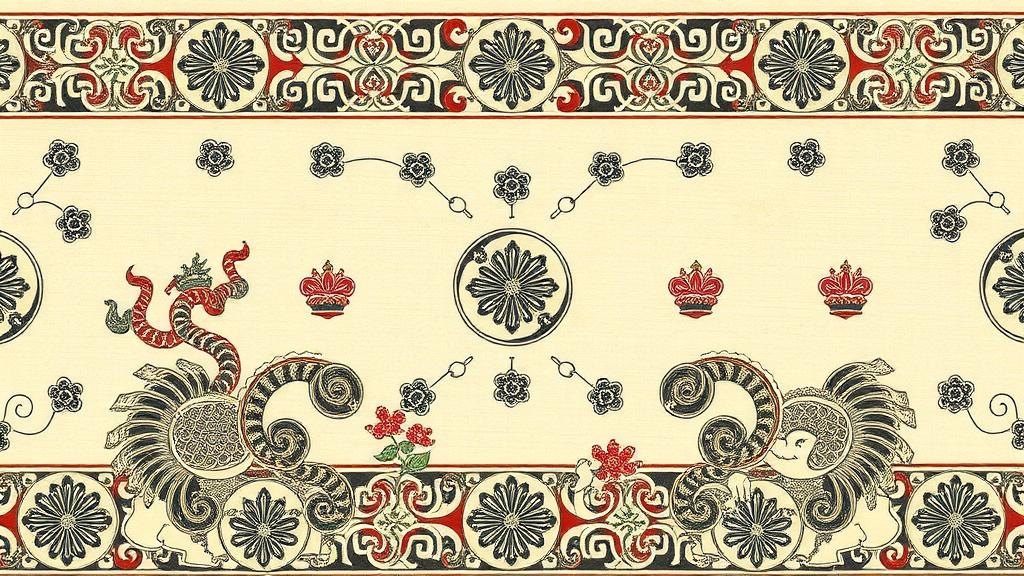
A team of researchers in China has built a generative artificial intelligence system that can produce black-and-white traditional Chinese motifs while respecting the historical period each pattern belongs to. The work, published in npj Heritage Science, addresses a stubborn problem in digital heritage: the image collections that document these decorative patterns are small, sparsely annotated, and difficult for machine learning models to learn from. By teaching the model not only what the motifs look like but also when they appeared, the researchers show that even a dataset of just 300 images can support faithful, period-aware generation.
Chinese black-and-white traditional motifs are far more than ornament. They encode cultural symbolism, ritual expression, and the slow evolution of visual style across dynasties, making them valuable records for historians and conservators. Yet their stark, high-contrast line work poses a challenge for generative models, which tend to blur the crisp contours that give these patterns their graphic power. Small datasets make matters worse, because modern deep generative networks typically demand thousands or millions of examples to generalize well.
The research team, led by Liu Gang of the College of Textile Science and Engineering at Jiangnan University together with colleagues from Wuxi University, assembled a curated dataset of 300 traditional pattern images drawn from four historical periods. Rather than treating the motifs as an undifferentiated mass of images, the framework conditions generation on chronology, forcing the model to capture the features that distinguish patterns from one era from those of another. This temporal signal is handled by a long short-term memory network, a recurrent architecture well suited to modeling sequential structure.
The pipeline begins with feature extraction using ResNet18, a convolutional neural network that distills each motif image into a compact representation of its visual content. These features then pass through the LSTM-based temporal module, which learns how stylistic attributes shift across the four periods. The result is a chronology-aware embedding that steers the generative core of the system toward the conventions of a chosen era rather than producing an average of all periods mixed together.
At the heart of the framework sits an edge-aware self-attention variational autoencoder. Variational autoencoders learn to compress images into a probabilistic latent space and then reconstruct them, making them a natural choice for small datasets where generative adversarial networks can be unstable. The addition of self-attention allows the model to weigh long-range relationships within a pattern, so that a repeated spiral or border element remains consistent across the whole composition. The edge-aware component specifically targets the high-contrast contours that define black-and-white motifs.
To sharpen those contours further, the authors introduce a Sobel-based edge loss. The Sobel operator is a classic image-processing filter that highlights gradients, effectively outlining where edges lie in an image. By penalizing disagreement between the edges of generated motifs and those of the training patterns, the loss pushes the model to preserve structural fidelity rather than allowing line work to soften or dissolve. This matters for heritage applications, where a blurred pattern loses the very information a historian needs.
The team benchmarked their framework against four baselines: an edge-guided generative adversarial network, an edge-conditioned diffusion model, a standard variational autoencoder, and a conditional variational autoencoder. Evaluation relied on established image-quality metrics covering different aspects of fidelity. Kernel inception distance measures how closely the distribution of generated images matches real ones, learned perceptual image patch similarity gauges perceptual resemblance, edge structural similarity index compares contour structure, and structural similarity and peak signal-to-noise ratio assess overall reconstruction quality.
Across all of these metrics, the proposed model outperformed the baselines, improving KID, LPIPS, Edge-SSIM, SSIM, and PSNR in the same small-sample setting. The authors attribute the gains to two design choices working in tandem: conditioning the generator on chronological information, which gives the model meaningful structure to organize its latent space around, and making reconstruction sensitive to edges, which protects the contours that matter most in these graphic traditions. The results suggest that domain-informed architecture, rather than sheer data volume, can compensate for the constraints of heritage datasets.
The implications extend beyond pattern generation. Chronology-aware synthesis could support conservation research, museum display design, textile design, and the study of stylistic evolution, offering scholars a way to visualize how motifs changed over time or to fill gaps in incomplete historical records. Because the framework explicitly models temporal progression, it may also help researchers test hypotheses about influence and transmission between periods, provided generated imagery is clearly distinguished from authentic artifacts.
The study, received in March 2026 and accepted in September 2026, was published open access under a Creative Commons license and reflects a growing trend in heritage science: adapting compact, carefully designed generative models to the realities of small, precious collections. The authors declare no competing interests and note that the study received no targeted funding. As museums and archives worldwide digitize their holdings, approaches like this one point toward a future in which artificial intelligence does not just classify the past but can reconstruct its visual grammar, one carefully drawn contour at a time.
Subject of Research: Chronology-aware generative modeling of early Chinese black-and-white traditional motifs using an edge-aware self-attention variational autoencoder
Article Title: Chronology-aware generation of early Chinese black-and-white traditional motifs via an edge-aware self-attention variational autoencoder
Article References: Chronology-aware generation of early Chinese black-and-white traditional motifs via an edge-aware self-attention variational autoencoder. (n.d.). https://doi.org/10.1038/s40494-026-03014-4
Image Credits: AI Generated
DOI: 10.1038/s40494-026-03014-4
Keywords: Chinese traditional motifs, generative AI, variational autoencoder, digital heritage, self-attention, chronology-aware generation, edge loss, small-sample learning, heritage science, pattern design, Sobel edge detection, machine learning
Cite Scienmag News
Courtney Benton. (October 14, 2026). AI Learns Centuries of Chinese Pattern History to Redraw Ancient Motifs. Scienmag. https://scienmag.com/ai-learns-centuries-of-chinese-pattern-history-to-redraw-ancient-motifs/
Courtney Benton. "AI Learns Centuries of Chinese Pattern History to Redraw Ancient Motifs." Scienmag, 14 October 2026, https://scienmag.com/ai-learns-centuries-of-chinese-pattern-history-to-redraw-ancient-motifs/. Accessed 14 October 2026.
Courtney Benton. "AI Learns Centuries of Chinese Pattern History to Redraw Ancient Motifs." Scienmag. October 14, 2026. https://scienmag.com/ai-learns-centuries-of-chinese-pattern-history-to-redraw-ancient-motifs/


