Why do some travelers come home from an ancient village bursting with stories, posting photographs, and recommending the trip to everyone they know, while others leave with little more than a few snapshots and a fading memory? A new study published in npj Heritage Science offers a rigorous psychological answer, and it centers on a surprisingly intimate variable: well-being. Researchers led by Di Hu of the Academy of Art and Design at Anhui University of Technology, working with colleagues from Shanghai Jiao Tong University and Anhui University of Technology, traced the pathway that leads from a tourist’s perception of authenticity to the tendency to tell stories about the experience. Their conclusion is that well-being, in both its psychological and subjective forms, sits at the heart of that pathway, acting as the emotional engine that converts a genuine encounter with living heritage into narrative communication.
The study is grounded in the Cognition–Affect–Behavior framework, a classic model in environmental psychology that describes how people first perceive and interpret their surroundings, then experience emotional responses to those interpretations, and finally act. Applied to agricultural heritage tourism, the framework suggests that when visitors perceive a village, its landscapes, and its traditions as authentic, that cognitive judgment triggers affective consequences, chiefly an enhanced sense of well-being, which in turn motivates a behavioral outcome: the inclination to share the experience through storytelling. What makes the new research distinctive is that it does not treat authenticity or well-being as single, undifferentiated quantities. Instead, the team decomposed both constructs into measurable dimensions and tested which specific pathways carry statistical weight.
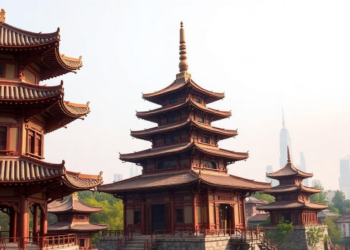
To do this, the researchers surveyed 402 visitors to three celebrated traditional villages in Anhui Province, China: Hongcun, Chengkan, and Xixinan. These settlements are outstanding examples of agricultural heritage tourism, places where centuries-old domestic architecture, working farmland, ritual life, and resident communities coexist and where tourism revenue supports the conservation of a living landscape rather than a frozen museum piece. Hongcun in particular is internationally known, but all three villages share the defining feature that makes them ideal laboratories for this kind of work: heritage is not staged for tourists but continues to function as part of daily village life. Visitors there encounter irrigation systems, ancestral halls, family compounds, and agricultural practices that are simultaneously attractions and lived realities.
The team analyzed the survey data using partial least squares structural equation modeling, or PLS-SEM, a statistical technique well suited to testing complex networks of hypothesized relationships among latent variables, which are constructs that cannot be observed directly and must be inferred from multiple questionnaire items. PLS-SEM allowed the researchers to estimate both the direct effects of perceived authenticity on storytelling tendency and the indirect effects that operate through well-being, while assessing how each dimension of authenticity contributed to the overall model. This dimensional approach is the study’s methodological backbone, and it is what enables the paper’s most interesting and nuanced findings.
First, the results confirm that tourist-perceived authenticity is not a monolith. The analysis identified five distinct components: ecological experience, cultural interaction, heritage reminiscence, personal reflection, and continuity of tradition. Ecological experience captures the visitor’s sense of the authenticity of the agricultural landscape and its natural setting. Cultural interaction reflects genuine engagement with residents and their customs. Heritage reminiscence involves the evocation of memory and nostalgia connected to rural and agrarian pasts. Personal reflection describes the inward turn, in which the authentic setting prompts visitors to contemplate their own identities and lives. Continuity of tradition, finally, is the perception that the practices on display are not performances but ongoing inheritances that persist across generations.
Second, and most importantly, the study demonstrates that both psychological well-being and subjective well-being mediate the relationship between perceived authenticity and storytelling tendency. Psychological well-being, in the tradition established by psychologist Carol Ryff, refers to deeper dimensions of functioning such as purpose in life, personal growth, autonomy, and positive relations with others. Subjective well-being, by contrast, is the more hedonic construct encompassing life satisfaction and the balance of positive over negative emotions. The finding that both forms of well-being carry the effect means that authentic heritage experiences do not merely make people feel pleasant in the moment; they appear to nourish something more durable, a sense that life is meaningful and going well, and it is this enriched state that travelers are moved to communicate to others.
Yet the mediation is not uniform across dimensions, and this is where the study becomes genuinely instructive for anyone concerned with heritage management. Cultural interaction, the dimension involving direct engagement with local people and their ways of life, showed a significant indirect effect on storytelling tendency only through psychological well-being, not through subjective well-being. In other words, meeting real farmers, watching real craftspeople, and conversing with real residents seems to elevate visitors’ sense of meaning and personal flourishing, and it is that elevation, rather than simple momentary pleasure, that drives them to tell stories. This suggests that the social fabric of a heritage village, the presence and openness of its community, is not a backdrop to the tourist experience but a central psychological ingredient in it.
Equally revealing are the pathways that failed. Personal reflection, the inward-looking dimension of authenticity, showed no significant indirect effect on storytelling tendency through either form of well-being. A visitor may stand in an ancient courtyard and be moved to deep introspection, but according to this data, that private contemplation does not reliably translate into the urge to narrate the experience to others. The implication is subtle: the most personally transformative aspects of heritage travel may also be the least communicable, or at least they do not travel through the well-being route that the study measured. For site managers, this cautions against assuming that encouraging solitary contemplative experiences will automatically generate the word-of-mouth advocacy on which heritage destinations increasingly depend.
The practical stakes of these findings are considerable. Agricultural heritage systems, from terraced rice landscapes to ancient irrigation networks, are recognized internationally as living heritage that must be conserved in use, not merely preserved as artifacts. Their survival depends on tourism economies that value them and on communities that see continuing benefit in maintaining traditional practices. If storytelling by satisfied visitors is a key channel through which heritage destinations build reputation and attract future support, then understanding what makes visitors into storytellers becomes a conservation strategy in its own right. The study suggests that managers should invest in the dimensions of authenticity that feed well-being, particularly opportunities for genuine cultural interaction with residents, and should treat community engagement not as an amenity but as infrastructure for both visitor psychology and heritage communication.
The research also contributes to a broader scientific conversation about why humans tell stories at all. Storytelling has long been understood as a fundamentally social behavior, a way of bonding, teaching, and transmitting culture, and a growing literature links narrative sharing to emotional arousal and self-relevant meaning. This study extends that literature into the heritage context, showing that the stories tourists tell are not simple advertisements for a destination but emotional byproducts of experiences that made them feel that life is richer and more meaningful. In that sense, every tale a traveler tells about a village like Hongcun is also a small act of heritage transmission, carrying the values of a living agricultural tradition into new audiences. The authors argue that their findings provide a theoretical basis for conserving living heritage and communicating heritage values in traditional villages, and the evidence they present makes a compelling case that the future of these landscapes may depend as much on the well-being of the people who walk through them as on the stones and fields themselves.
Subject of Research: The mediating role of tourist well-being in linking perceived authenticity to storytelling tendency in agricultural heritage tourism
Article Title: From tourist-perceived authenticity to storytelling tendency: the mediating role of well-being in agricultural heritage tourism
Article References: Hu, D., Guo, Y., Lu, Y., Song, Y., Shen, G., Xu, X., & Li, L. (2026). From tourist-perceived authenticity to storytelling tendency: the mediating role of well-being in agricultural heritage tourism. npj Heritage Science. https://doi.org/10.1038/s40494-026-03048-8
Image Credits: AI Generated
DOI: 10.1038/s40494-026-03048-8
Keywords: agricultural heritage tourism, perceived authenticity, well-being, storytelling tendency, PLS-SEM, Hongcun, Chengkan, Xixinan, traditional villages, heritage conservation, Cognition-Affect-Behavior framework, cultural interaction
Cite Scienmag News
Courtney Benton. (October 11, 2026). Feeling Real: How Well-Being Turns Authentic Heritage Encounters into Stories Worth Sharing. Scienmag. https://scienmag.com/feeling-real-how-well-being-turns-authentic-heritage-encounters-into-stories-worth-sharing/
Courtney Benton. "Feeling Real: How Well-Being Turns Authentic Heritage Encounters into Stories Worth Sharing." Scienmag, 11 October 2026, https://scienmag.com/feeling-real-how-well-being-turns-authentic-heritage-encounters-into-stories-worth-sharing/. Accessed 11 October 2026.
Courtney Benton. "Feeling Real: How Well-Being Turns Authentic Heritage Encounters into Stories Worth Sharing." Scienmag. October 11, 2026. https://scienmag.com/feeling-real-how-well-being-turns-authentic-heritage-encounters-into-stories-worth-sharing/