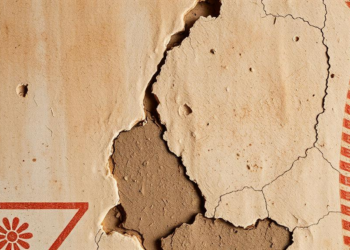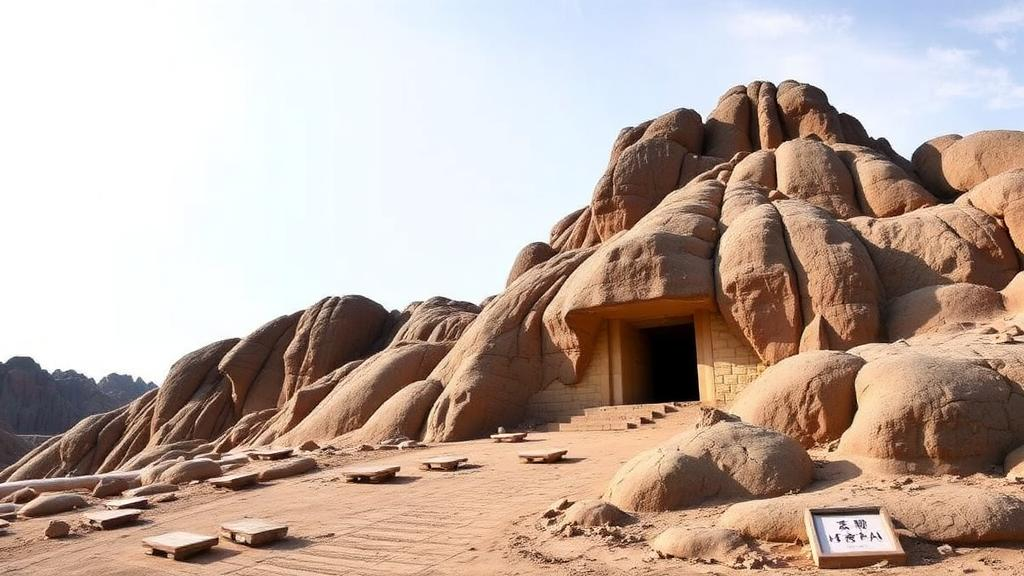
Deep in the arid hills of Ningxia, along the banks of the Yellow River, thousands of petroglyphs carved into dark rock faces record the lives of ancient peoples who lived millennia ago. The Damaidi Rock Art Conservation Area holds one of the richest concentrations of rock engravings in China, a vast open-air archive of hunting scenes, symbolic figures, and daily activities etched into stone. Yet like all exposed heritage, these carvings are under relentless assault from the environment. Among the most destructive threats is spalling, a disease of stone in which the rock surface flakes and peels away in layers, taking irreplaceable imagery with it. A new study published in npj Heritage Science offers one of the most systematic quantitative assessments of this deterioration ever attempted at the site, and its approach may reshape how conservators diagnose and treat rock art decay worldwide.
The research, led by Guopeng Wu, Ruiying Zhang, Zhijie Zhao, Guanghao Yu, Zhuohang Tian, Jiacheng Sui, and Kai Cui of the Silk Road Cultural Heritage Protection Research Institute and the Western Center of Disaster Mitigation in Civil Engineering at Lanzhou University of Technology, tackles a problem that has long frustrated heritage scientists. Spalling is not a uniform phenomenon. It manifests differently across a rock face depending on the local mineralogy, the density of microcracks, the strength of the surface, and the interplay of moisture, temperature swings, and salt weathering. Traditional condition surveys tend to rely on qualitative visual grading, which is inherently subjective and difficult to repeat or compare over time. The Damaidi team set out to replace that subjectivity with a reproducible numerical framework grounded in field measurement and laboratory testing.
The scale of the fieldwork alone is striking. The researchers conducted detailed surveys and laboratory analyses covering 144 individual instances of spalling distributed across eight densely carved zones of the conservation area. For each instance, they recorded a battery of physical and mechanical properties of the stone substrate, ultimately distilling the data into twelve indicators, labeled C1 through C12, that together characterize the vulnerability of the rock surface. These indicators span the mechanical integrity of the stone, its microstructural condition, and the geometry of the fracture networks that thread through it. By standardizing the description of each spalling instance through this common set of twelve variables, the team created a shared diagnostic language that can be applied consistently across the entire site and, in principle, at other rock art locations facing similar threats.
The analytical heart of the study is a hybrid method that combines cloud modeling with a game theory-based weighting scheme. Cloud modeling, a technique developed within the field of uncertainty artificial intelligence, is designed to handle the fuzzy boundary between qualitative descriptions and quantitative data. Rather than forcing each spalling instance into a rigid category, the cloud model represents concepts as clouds of numerical values defined by three parameters: expectation, entropy, and hyper-entropy. Expectation captures the central tendency of a grade, entropy describes its spread or fuzziness, and hyper-entropy quantifies the randomness of that spread. When a measured rock surface is evaluated, the model computes a membership degree describing how strongly it belongs to each severity grade, allowing borderline cases to be represented honestly rather than artificially forced into a single box.
The second ingredient, game theory-based weighting, addresses an equally stubborn problem in multi-indicator assessment: how much should each of the twelve indicators count toward the final severity score? Objective weighting methods derive weights from the statistical structure of the data itself, while subjective methods encode expert judgment about which factors matter most physically. Each approach has blind spots. The researchers treated the two families of weights as players in a cooperative game and solved for a combined weighting vector that minimizes the divergence between the combined result and each individual weighting scheme. The result is a set of composite weights that neither ignores the mathematics of the data nor the domain knowledge of conservators, producing a more defensible synthesis than either method alone could deliver.
With the hybrid model in place, the team classified spalling severity at Damaidi into four risk grades, each tied to a corresponding conservation strategy. This grading transforms the assessment from a static description into an actionable management tool. Zones and individual spalling instances falling into the highest risk grades can be prioritized for urgent intervention, such as consolidation or protective sheltering, while lower grades can be scheduled for routine monitoring. The researchers validated the framework, confirming both its accuracy and its rationality, which is a critical step for any quantitative method intended to inform real-world conservation budgets and interventions. Validation matters because a model that cannot be trusted to reproduce known conditions cannot be safely used to direct scarce preservation resources.
One of the most revealing components of the study is its correlation analysis. Using Pearson correlation, the team examined how strongly each of the twelve indicators related to the assessed severity of spalling. Four factors emerged as the most strongly correlated: rebound strength, designated C1, which reflects the hardness and integrity of the rock surface as measured by rebound testing; particle density, C6, which characterizes the compactness of the mineral grains forming the substrate; nearest fracture distance, C8, which measures how close the nearest crack lies to a given point on the surface; and fracture aperture, C10, which quantifies how wide those cracks are open. Together, these four indicators sketch a coherent physical picture of spalling as a process governed by surface mechanical weakness and the proximity of discontinuities through which moisture and stress can act.
That physical interpretation carries direct practical consequences. Rebound strength and particle density describe the intrinsic quality of the stone: a weak, loosely packed surface has little resistance to the cyclic stresses of daily heating and cooling, freeze-thaw action, and salt crystallization that drive flaking. Nearest fracture distance and fracture aperture, meanwhile, describe the pathways of attack: cracks act as conduits for water infiltration and as stress concentrators where failure initiates. A surface that is both mechanically weak and threaded with wide, closely spaced fractures is therefore the most likely candidate for severe spalling. For conservators, this suggests that monitoring programs should prioritize mapping fracture networks and tracking surface hardness over time, and that consolidation treatments aimed at strengthening the near-surface matrix and sealing microfractures may offer the greatest protective return.
Beyond its findings at a single site, the study’s authors frame the work as a preliminary scientific basis for the conservation of Damaidi and, importantly, as a potentially transferable model for analogous heritage sites. Rock art survives on every inhabited continent, from the painted caves of Europe to the engravings of the Australian outback and the deserts of the Americas, and spalling-type deterioration is a near-universal enemy of carved stone exposed to the elements. A framework built from twelve measurable indicators, processed through an uncertainty-aware model with transparent weighting, does not depend on the specific geology of Ningxia. Other research teams can adapt the indicator set to their local stone types, recalibrate the grade boundaries, and apply the same cloud-based evaluation pipeline, creating the possibility of genuinely comparable condition data across sites and continents.
The work also signals a broader shift in cultural heritage science, a field historically dominated by art historical judgment and artisanal intervention, toward the quantitative, data-driven methodologies familiar in engineering and the environmental sciences. The study was supported by the National Natural Science Foundation of China, the China Postdoctoral Science Foundation, the National Natural Science Foundation of Gansu, and programs at Lanzhou University of Technology, reflecting sustained institutional investment in heritage protection along the Silk Road corridor. For the petroglyphs of Damaidi, whose engraved panels have endured for thousands of years, the immediate benefit is a rigorous, repeatable diagnosis of where the stone is failing and why. For the discipline at large, the message is that the tools needed to save humanity’s oldest art may lie not only in the conservator’s kit but in the mathematics of uncertainty, provided researchers are willing to walk the rock faces and measure, instance by instance, exactly how the stone is letting go.
Subject of Research: Quantitative assessment of spalling deterioration in Damaidi petroglyphs using cloud modeling and game theory-based weighting
Article Title: A comprehensive evaluation of spalling disease in Damaidi petroglyphs using cloud modeling
Article References: Wu, G., Zhang, R., zhao, Z., Yu, G., Tian, Z., Sui, J., & Cui, K. (2026). A comprehensive evaluation of spalling disease in Damaidi petroglyphs using cloud modeling. npj Heritage Science. https://doi.org/10.1038/s40494-026-02972-z
Image Credits: AI Generated
DOI: 10.1038/s40494-026-02972-z
Keywords: Damaidi petroglyphs, rock art conservation, spalling disease, cloud model, game theory weighting, stone deterioration, cultural heritage science, fracture analysis, rebound strength, Pearson correlation, Ningxia, risk grading
Cite Scienmag News
Courtney Benton. (October 10, 2026). Cloud Model Brings Precision to the Fight Against Rock Art Decay in China. Scienmag. https://scienmag.com/cloud-model-brings-precision-to-the-fight-against-rock-art-decay-in-china/
Courtney Benton. "Cloud Model Brings Precision to the Fight Against Rock Art Decay in China." Scienmag, 10 October 2026, https://scienmag.com/cloud-model-brings-precision-to-the-fight-against-rock-art-decay-in-china/. Accessed 10 October 2026.
Courtney Benton. "Cloud Model Brings Precision to the Fight Against Rock Art Decay in China." Scienmag. October 10, 2026. https://scienmag.com/cloud-model-brings-precision-to-the-fight-against-rock-art-decay-in-china/