


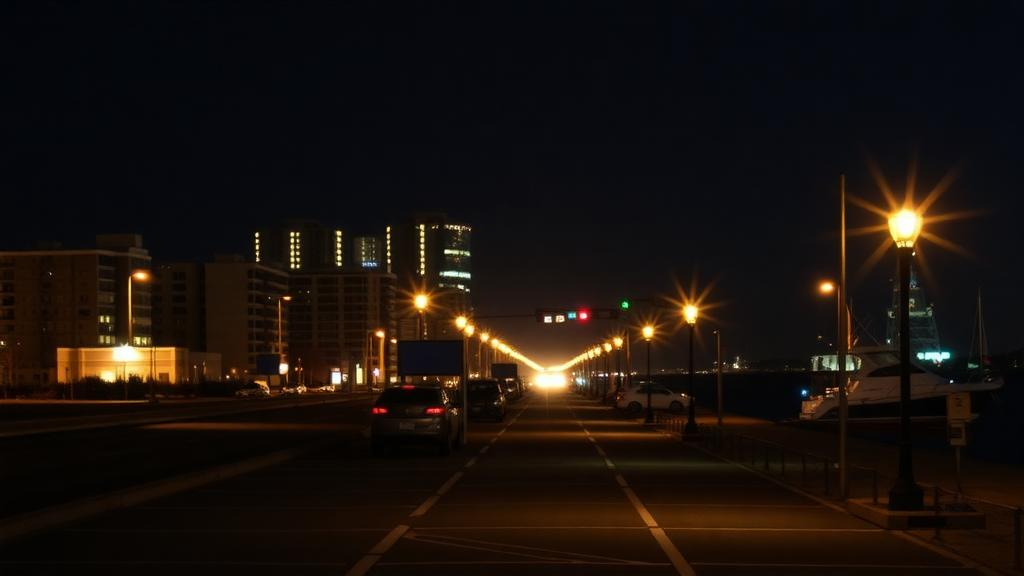
Artificial light at night has become one of the fastest-growing forms of pollution on the planet, glowing outward from cities, ports and highways until it touches nearly every shoreline on Earth. Yet while ecologists have documented its effects on everything from sea turtle hatchlings to oyster rhythms, surprisingly little is known about whether ordinary people actually want the lights turned down. A new study of two of Chile’s most light-polluted coastal cities reveals a striking answer: residents are willing to support mitigation, but only in ways that leave the benefits they cherish—safety, security and beautiful illuminated boulevards—firmly intact.
The research, published in the journal Ambio, surveyed 754 residents of Valparaíso and Viña del Mar, two adjacent port and resort cities in central Chile that rank second and fourth nationwide in artificial light at night. Both cities hold more than 300,000 residents and sit within a two-hour drive of Santiago, making them popular weekend destinations where bright waterfronts are part of the urban identity. The team, led by Olivia Raquel Rendon Thompson of Plymouth Marine Laboratory together with colleagues at Universidad Andrés Bello and other Chilean institutions, conducted in-person tablet surveys that began at the coastline—starting near intense light sources such as the port, a stadium and the famous Viña del Mar casino—and worked inland, sampling every tenth household where residents were available.
The survey’s design was deliberately comprehensive. It probed respondents’ connection to the sea, their awareness of the brightest light sources in their city, their views on the benefits and harms of nighttime lighting for people and marine life, their trust in and support for nine specific mitigation measures, and their sociodemographic characteristics. A pilot round of 100 surveys tested the questions before the final data collection, and the results were analysed in R using descriptive statistics alongside two multinomial logistic models—one explaining concern about light pollution’s impacts, the other predicting support for more or fewer mitigation measures. The authors note that the analytical framework can be replicated in other coastal cities worldwide, adjusted to local contexts.
What emerged first was a portrait of a population deeply engaged with the coast but largely blind to light as a pollutant. Sixty percent of respondents were female, the average age was 45, and nearly nine in ten reported non-economic marine activities such as enjoying the view, coastal recreation, wildlife watching or beach sports. Yet when asked an open-ended question about the top three threats to the marine environment, respondents overwhelmingly named solid waste, plastics and oil spills. Sewage, chemicals and noise barely registered, and just one percent of respondents spontaneously identified artificial light at night as a threat at all.
The asymmetry deepened when the researchers probed perceptions of lighting itself. Respondents identified public street lighting as the brightest source in their city, followed by advertising lights, and correctly noted that the most intensely illuminated zones sit on or beside the waterfront. When asked about benefits, personal security dominated—mentioned by 48 percent in the open-ended question and ranked as very important or important by the overwhelming majority in a follow-up list that also included safer transport, property security and increased scenic beauty. By contrast, 83 percent of respondents could name no negative impacts of nighttime lighting at all when asked directly. Even with prompting, only traffic accidents and loss of the starry sky crossed the 50 percent importance threshold, and every other harm was rated important by fewer than 30 percent of respondents.
Perhaps most tellingly, when presented with a list of eight potential negative impacts of artificial light on marine wildlife, more than 70 percent of respondents rated every single one as important or very important—with a suspiciously uniform response pattern across the board. The authors interpret this flat distribution cautiously: rather than reflecting deep domain knowledge, it suggests respondents were agreeing with plausible-sounding statements they had never considered before. The true public understanding of how artificial light penetrates the water column and disrupts the navigation, predation, reproduction and daily rhythms of marine organisms—from species that rely on lunar cues to sessile creatures that cannot move away—remains limited or unknown, the team concludes.
Support for mitigation followed a clear logic of preserving benefits while trimming waste. The measures winning more than 60 percent support were reducing brightness in protected areas, installing motion sensors on outdoor lights, and fitting directional panels that redirect light toward the ground. Measures perceived to touch everyday benefits—dimming urban streetlights, shortening operating hours, switching from white to yellow light—hovered around 50 percent, while lowering the height of light poles attracted support from only a third of respondents. Respondents were notably decisive, with fewer than three percent answering that they did not know. The regression analysis showed that supporters of stronger mitigation tended to have higher education, work in services or professions, perceive more negative impacts on humans and wildlife, and report high concern about lighting in their city.
Two demographic findings stood out. Women were significantly less likely to support mitigation measures—an inversion of the pattern seen in most environmental research, where women typically express greater ecological concern. The authors suggest this reflects differing priorities around the social functions of lighting, particularly perceptions of personal safety during nighttime movement through public spaces, rather than lower environmental commitment. Meanwhile, respondents from medium to high socioeconomic groups were also less supportive, and the highest and lowest socioeconomic classes were effectively absent from the sample due to refusals and safety-related exclusions in fieldwork. Responsibility, respondents agreed, lies overwhelmingly with government: 48 percent pointed to local authorities such as municipalities, 24 percent to central government, while only 17 percent named electricity companies and four percent private firms.
The study arrives at a politically opportune moment. Chile’s Decree No. 1/2022 established national emission limits for outdoor lighting, with explicit provisions for areas of special biodiversity protection, while the Convention on Biological Diversity has encouraged parties to manage light pollution’s impacts within national strategies. Yet no international treaty treats artificial light at night as a pollutant, and the Chilean research is the first social study of the issue to focus on coastal-marine impacts or to be conducted in a low-to-middle-income country—a significant gap given that roughly a quarter of the world’s shorelines and a quarter of its population are exposed to coastal light pollution.
The authors argue that the path forward runs through governance rather than engineering alone. Because acceptance hinges on protecting valued benefits, policies that pair ecological goals with safety assurances—shielded fixtures, motion-activated lighting, dark zones in protected areas—are most likely to succeed. Environmental education should target the specific ecological consequences for coastal and marine ecosystems, where awareness is weakest. And because residents see lighting as a public responsibility resting with municipalities, expanding that framing to include utilities, businesses and communities could unlock collaborative approaches. Framed as a social-ecological challenge rather than a technical lighting problem, the study suggests, dimming the night may yet win the public over—one well-aimed, motion-triggered lamp at a time.
Subject of Research: Public perceptions of and support for mitigating artificial light at night in coastal cities
Article Title: Public perceptions and (lack of) support for mitigation of artificial light at night in coastal cities
Article References: Public perceptions and (lack of) support for mitigation of artificial light at night in coastal cities. (n.d.). https://doi.org/10.1007/s13280-026-02478-9
Image Credits: AI Generated
DOI: 10.1007/s13280-026-02478-9
Keywords: artificial light at night, light pollution, coastal cities, marine ecosystems, Chile, public perceptions, environmental literacy, mitigation measures, urban lighting, environmental governance, biodiversity conservation, Valparaíso
Cite Scienmag News
Margaret Porter. (October 13, 2026). Coastal City Residents Back Dimming the Night—But Only If Safety Stays Lit. Scienmag. https://scienmag.com/coastal-city-residents-back-dimming-the-night-but-only-if-safety-stays-lit/
Margaret Porter. "Coastal City Residents Back Dimming the Night—But Only If Safety Stays Lit." Scienmag, 13 October 2026, https://scienmag.com/coastal-city-residents-back-dimming-the-night-but-only-if-safety-stays-lit/. Accessed 13 October 2026.
Margaret Porter. "Coastal City Residents Back Dimming the Night—But Only If Safety Stays Lit." Scienmag. October 13, 2026. https://scienmag.com/coastal-city-residents-back-dimming-the-night-but-only-if-safety-stays-lit/


