


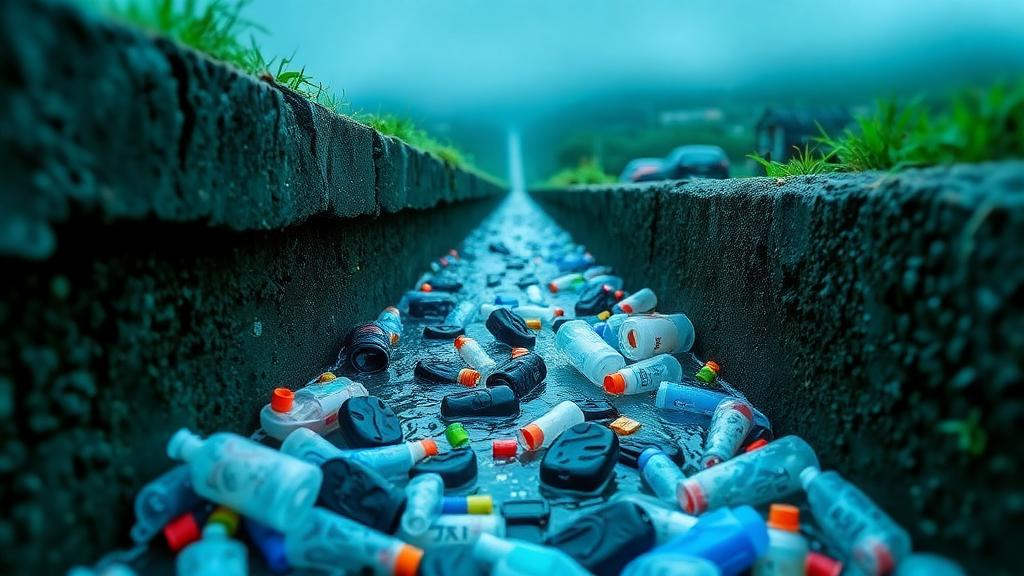
Every time rain falls on a city, it washes an invisible cargo of plastic fragments off rooftops, roads and pavements and into the drains beneath our feet. A new critical review published in Environmental Monitoring and Assessment argues that this hidden network of gutters, gullies, manholes and pipes is far more than a passive plumbing system: it behaves as a dynamic, reactive transport machine that collects, stores, resuspends and exports microplastics to receiving waters on a scale that has been seriously underestimated. The review, written by Jorge M. G. P. Isidoro of the University of Algarve in Portugal and R. B. Moruzzi of São Paulo State University in Brazil, synthesises the findings of roughly fifty core studies selected from more than a thousand screened records, and its conclusions should change how cities think about plastic pollution.
The most striking number in the review concerns how much plastic urban runoff actually carries. Conventional grab sampling, the practice of scooping a single water sample at a fixed moment, may dramatically understate the true load of microplastics moving through stormwater systems. In some cases, the authors report, stormwater microplastic loads exceed the loads discharged by treated wastewater effluent by up to six times. That comparison is remarkable because wastewater treatment plants have long been treated as the principal aquatic gateway for microplastics, subject to permits, monitoring and public scrutiny. Stormwater, by contrast, often flows to rivers and coastal waters with little or no treatment at all, meaning that one of the largest plastic pathways into the environment has been operating largely out of sight and out of regulation.
The review traces the journey of a microplastic particle from its source on the urban surface to the receiving water. Road surfaces, particularly in high-traffic areas, emerge as major reservoirs of plastic debris. Tyre wear particles, shed continuously as vehicles roll over asphalt, dominate this stock, alongside fragments from road markings, atmospheric deposition of synthetic fibres, and litter that breaks down in place. Studies of road dust in countries from Japan to Australia have confirmed the abundance of these particles, and plastic additives found in road dust can even serve as chemical fingerprints tracing particles back to their sources. When rainfall arrives, this accumulated reservoir is mobilised rapidly, with the first flush of runoff carrying a disproportionate share of the pollution load into the drainage network.
Once particles enter the pipes, the physics becomes genuinely complex, and this is where the review makes its most important conceptual contribution. Stormwater networks do not simply convey particles downstream. They act as reactive transport systems with temporary storage, in which mobilisation, sedimentation, resuspension and retention continually reshuffle the plastic cargo. Dense or biofouled particles settle into bed sediment during dry weather, only to be picked up again by the next storm surge. Manholes, the humble junction boxes of the drainage world, turn out to be significant sinks: laboratory experiments on surcharging and overflowing manholes showed that these structures can immobilise up to 17.3 percent of near-neutrally buoyant particles passing through them. Every manhole is therefore both a bottleneck and a buried plastic store, waiting for the right hydraulic conditions to release its contents.
Particle properties complicate the picture further. Buoyant polymers such as polyethylene would, in theory, ride the flow as wash-load and exit the system quickly. In practice, the review highlights that biofouling, the growth of microbial films and algae on particle surfaces, and aggregation with other suspended solids can shift buoyant polymers from wash-load to bedload. A plastic fragment that enters a sewer floating may end up buried in sediment, altering its residence time from hours to months or years. This transformation matters enormously for anyone trying to model or manage the pollution, because the effective behaviour of a particle depends not just on the polymer it was manufactured from but on the biological community it acquires inside the drain.
Modelling this behaviour is one of the field’s central challenges, and the review surveys the current toolkit with a critical eye. Physically informed approaches, including computational fluid dynamics simulations of microplastic transport through stormwater systems, can resolve the hydraulics of gullies, pipes and manholes in detail, while mass-balance and source-pathway-receptor frameworks help cities quantify plastic stocks and flows at the catchment scale. River and catchment fate models, originally developed for sediments and nanoparticles, have been adapted to simulate settling, resuspension and long-range export of plastics from land to sea. More recently, data-driven techniques such as graph neural networks have been applied to capture the influence of river hydrodynamics on transport processes, offering computational speed at the cost of interpretability. The authors caution that such machine-learning models, while promising, require validation in the many under-sampled regions where no calibration data exist.
The sampling problem underpins all of this uncertainty. Because microplastic concentrations in runoff vary wildly within a single storm, spiky first-flush pulses followed by declining concentrations, a grab sample taken at the wrong moment can miss the peak entirely. The review calls for standardised flow-proportional sampling, in which samplers collect water in proportion to the flow rate over the whole event, as the methodological foundation for comparable, defensible measurements. Without such standardisation, datasets from different cities and studies cannot be meaningfully compared, and models calibrated on biased data will produce biased predictions. Inter-event and intra-event monitoring of urban rivers during rainfall episodes has already shown how dramatically emissions fluctuate between and within storms, reinforcing the case for continuous, flow-weighted measurement.
On the mitigation side, the review offers both encouragement and a warning. Green and grey treatment measures, including permeable pavements, bioretention cells, constructed wetlands, retention ponds, sand filters and simple catch-basin inserts, can achieve high removal of coarse microplastic particles. Bioretention rain gardens studied over multiple years have accumulated substantial masses of microplastics along with associated metals, and treatment trains combining gross pollutant traps with bioretention have removed rubber, bitumen and other particles effectively. Retention ponds, meanwhile, bury a large fraction of incoming tyre wear particles in their sediments. But the performance of these systems declines sharply for fine particles below 100 micrometres, the fraction that is both hardest to measure and increasingly the focus of toxicological concern. The sub-100 micrometre fraction is the critical gap: it passes through filters designed for coarser debris and remains poorly quantified in most monitoring campaigns.
The review’s authors argue that effective control therefore requires treatment-train strategies that target both the surface sources and the in-network storage. Intercepting particles at the pavement, through permeable surfaces and source controls, reduces the load entering pipes; maintaining and cleaning drainage structures removes the buried reservoirs that would otherwise be flushed out in a future storm. Because manholes and pond sediments act as temporary sinks, a city that only treats the outfall misses the plastic that settles upstream and is exported later. The whole network, from road surface to receiving water, must be understood as one connected system.
The timing of this synthesis is significant. International negotiations under the United Nations Environment Assembly are working toward a legally binding instrument to end plastic pollution, and regulators increasingly need to know where the plastic actually comes from and how it moves. By showing that urban drainage networks are reactive transport systems whose loads can rival or exceed those of treated wastewater, the review reframes stormwater infrastructure as a first-order control point in the global plastic cycle. The authors’ prescriptions, flow-proportional sampling, physically informed modelling and treatment trains aimed at both sources and sinks, give engineers and policymakers a concrete agenda. The drains beneath our cities have been quietly shipping plastic to the sea for decades; the science now says we can finally map the superhighway, and start closing its on-ramps.
Subject of Research: Microplastic transport, modelling and mitigation in urban stormwater pavements and drainage networks
Article Title: Urban stormwater infrastructure as a microplastic superhighway: a critical review of transport dynamics, modelling, and mitigation across pavements and drainage networks
Article References: Isidoro, J. M. G. P., & Moruzzi, R. B. (2026). Urban stormwater infrastructure as a microplastic superhighway: a critical review of transport dynamics, modelling, and mitigation across pavements and drainage networks. Environmental Monitoring and Assessment, 198(10), Article 1050. https://doi.org/10.1007/s10661-026-15898-7
Image Credits: AI Generated
DOI: 10.1007/s10661-026-15898-7
Keywords: microplastics, stormwater, urban drainage, tyre wear particles, pavements, bioretention, permeable pavement, manholes, biofouling, flow-proportional sampling, treatment train, environmental monitoring
Cite Scienmag News
Violet Maxwell. (October 13, 2026). Stormwater Drains Revealed as a Microplastic Superhighway Straight to Rivers and Seas. Scienmag. https://scienmag.com/stormwater-drains-revealed-as-a-microplastic-superhighway-straight-to-rivers-and-seas/
Violet Maxwell. "Stormwater Drains Revealed as a Microplastic Superhighway Straight to Rivers and Seas." Scienmag, 13 October 2026, https://scienmag.com/stormwater-drains-revealed-as-a-microplastic-superhighway-straight-to-rivers-and-seas/. Accessed 13 October 2026.
Violet Maxwell. "Stormwater Drains Revealed as a Microplastic Superhighway Straight to Rivers and Seas." Scienmag. October 13, 2026. https://scienmag.com/stormwater-drains-revealed-as-a-microplastic-superhighway-straight-to-rivers-and-seas/


