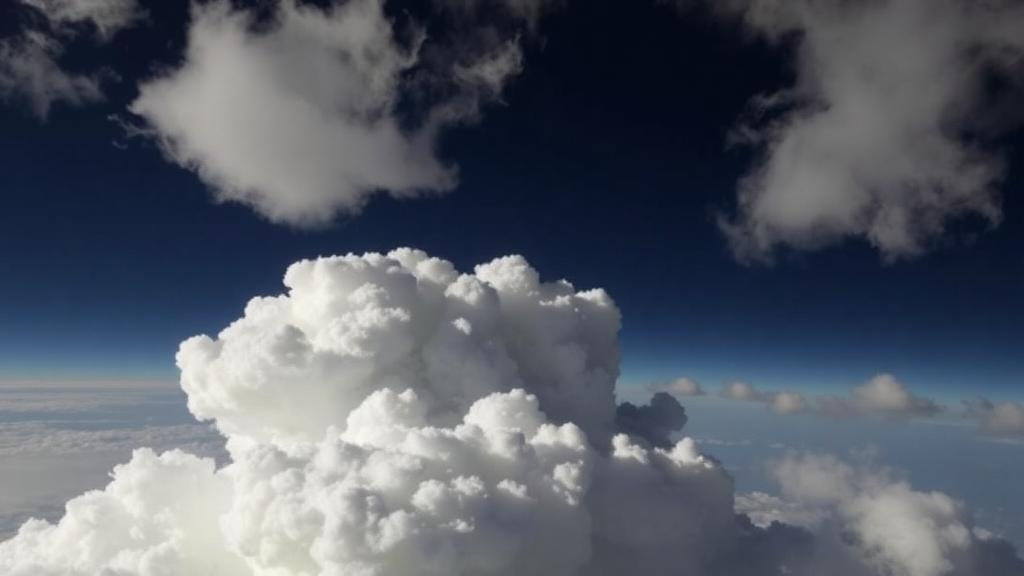
High above Antarctica and the Arctic, in a layer of the atmosphere so cold and so dry that it barely resembles the rest of the sky, clouds are quietly setting the stage for one of the most consequential chemical reactions on Earth. Polar stratospheric clouds, or PSCs, form only when winter temperatures in the stratosphere plunge below roughly 195 kelvin, and their icy and acidic particle surfaces act as chemical reactors that convert inert chlorine and bromine compounds into ozone-destroying forms. When sunlight returns in spring, those activated species shred ozone with astonishing efficiency, producing the Antarctic ozone hole each September and October. Now, a team of British, American, and German scientists has rebuilt the way one of the world’s leading Earth system models simulates these clouds, and the results, published in Geoscientific Model Development, show both striking progress and a stubborn remaining gap.
The study, led by Isabelle Sangha of the British Antarctic Survey and the University of Cambridge, together with Nathan Abraham, Andrew Orr, Hua Lu, NASA’s Michael Pitts and Lamont Poole, and Michael Weimer of the University of Bremen, targets the UK Earth System Model, UKESM1.1, running within version 13.9 of the Met Office Unified Model. The old PSC scheme in UKESM1.1 was, by the authors’ own assessment, too crude for the task. It assumed that nitric acid trihydrate, or NAT, the solid crystalline component of many PSCs, formed instantaneously in thermodynamic equilibrium whenever conditions allowed, and it fixed every NAT particle at a radius of one micrometre. Liquid supercooled ternary solution droplets, the STS particles that dominate much of the PSC volume, were not formed at all; their effect was approximated with a prescribed surface-area climatology. Ice particles came from the model’s cloud microphysics but were assigned a fixed ten-micrometre radius.
That simplicity mattered because real PSCs are anything but static. NAT particles grow over hours to days, drifting far from equilibrium and reaching sizes large enough to sediment out of the stratosphere, carrying nitric acid with them. This denitrification removes the very nitrogen species that would otherwise lock reactive chlorine back into harmless reservoirs, prolonging ozone destruction, a process especially consequential in the warmer Arctic where denitrification can tip marginal winters into severe ozone loss. Liquid STS droplets, meanwhile, are comparable to or even more effective than solid particles per unit surface area at activating chlorine. A model that cannot form STS, or that freezes NAT into an unrealistic equilibrium snapshot, will misrepresent both the chemistry and the timing of polar ozone depletion, undermining confidence in projections of future ozone recovery as the climate changes.
The fix imported a more sophisticated approach from the ICON-ART modelling framework developed in Germany. In the new scheme, NAT particles nucleate kinetically, beginning at a radius of just 0.1 micrometres when the partial pressure of nitric acid exceeds its saturation value over NAT with a three-kelvin supersaturation threshold, and then grow or shrink through a time-dependent diffusive growth equation that tracks the flux of nitric acid vapour to and from the particle surface. The particles are sorted into nine size bins spanning radii from 0.1 to 22.5 micrometres, with mass conserved as particles outgrow each bin and sedimentation velocities calculated interactively from Stokes’ law. STS droplets, for their part, now form thermodynamically through the uptake of nitric acid and water on aqueous sulphuric acid aerosols supplied by the model’s interactive GLOMAP aerosol microphysics, with the resulting droplet volume converted to surface area for heterogeneous chemistry.
To find out whether the upgrade actually works, the team turned to two of the most capable instruments ever flown for this purpose. The Cloud-Aerosol Lidar with Orthogonal Polarization, CALIOP, aboard the CALIPSO satellite, fired laser pulses into the stratosphere from 2006 to 2023 and used the polarization of the returning light to distinguish spherical liquid droplets from non-spherical solid particles, classifying PSCs into liquid-NAT mixtures, enhanced NAT mixtures, supercooled ternary solutions, ice, and wave ice. The Microwave Limb Sounder on NASA’s Aura satellite, flying in formation with CALIPSO in the A-Train, measured gas-phase nitric acid, water vapour, and ozone. Crucially, the team did not simply compare model output with satellite products; they computed the optical properties that CALIOP would have seen from the modelled particle populations, using Mie theory and T-matrix scattering calculations, and then ran the same classification algorithm on both datasets.
The comparison covered two contrasting winters: the extended 2008 Antarctic winter, when temperatures sat persistently below PSC formation thresholds, and the unusually cold 2009/2010 Arctic winter, which featured temperatures up to nine kelvin below climatology and a major sudden stratospheric warming in late January. The verdict was clear. The old scheme produced a narrow, essentially static distribution of cloud types, dominated by enhanced NAT mixtures, with almost no response to the changing conditions of the Arctic season and no ice-classified points at all. The new scheme broadened the simulated optical properties substantially, capturing the seasonal progression from NAT-dominated clouds in December through increasing STS and ice in January, and then the decline as the vortex warmed, in much closer agreement with CALIOP.
A sensitivity analysis across twelve simulations revealed which knobs mattered most. Increasing the maximum NAT number density shifted more cloud into the NAT mixture and ice categories, an effect most pronounced in the Arctic, where warmer temperatures limit ice formation. Increasing the prescribed ice number density, tested across values from 0.001 to 0.25 particles per cubic centimetre, pushed the optical signatures toward the ice and enhanced NAT regions, with the strongest effect over Antarctica. Yet even the best configurations fell short in one decisive respect: CALIOP observed substantial populations of ice clouds with scattering ratios between 5 and 20, while the simulations peaked around 6, and none of the runs produced the high-number-density wave ice that forms when mountain waves flash-freeze the stratosphere over mountainous terrain.
The gas-phase chemistry told a parallel story. The new scheme’s slower NAT growth and its partitioning of nitric acid between solid and liquid phases brought modelled gas-phase nitric acid closer to MLS observations, particularly within the polar vortex, where the satellite recorded a sharp June drop from eight to ten parts per billion down to roughly two as clouds sequestered the acid. But every simulation, old and new, started the season with a substantial nitric acid deficit, a known low reactive-nitrogen bias in UKESM1.1 that the authors caution may have been partly masked by the old scheme’s tendency to convert all available acid into NAT. Ozone, remarkably, was barely affected except near the edge of the polar vortex, where the new runs agreed better with MLS from August to October. The authors attribute this to saturation: deep inside the vortex, ozone depletion is already near-complete under persistently cold conditions, so changes in cloud microphysics matter most at the margins.
The remaining gaps point the way forward. The prescribed ice and NAT number densities constrain particles to a narrow range of surface areas, and the model lacks a scheme for the adiabatic cooling induced by mountain waves, which an earlier UKESM version had implemented and which can trigger the rapid, localised ice formation that seeds high-number-density NAT mother clouds downstream. Allowing number densities to vary with cooling rate, and reinstating the mountain-wave scheme, could close the gap with the most optically extreme clouds CALIOP observed. For now, the study stands as a careful, technically rigorous demonstration that how a model builds its clouds, particle by particle and bin by bin, determines how well it can be trusted to project the future of the ozone layer, a shield still recovering from a century of human chemistry and one whose fate is written, in part, in the coldest clouds on Earth.
Subject of Research: Updated polar stratospheric cloud parameterisation in the UK Earth System Model evaluated against CALIOP and MLS satellite observations
Article Title: Assessment of an updated polar stratospheric cloud parameterisation for the UK Earth System Model (UKESM1.1) within the UK Met Office Unified Model (v13.9) using CALIOP and MLS observations
Article References: Sangha, I., Abraham, N. L., Orr, A., Lu, H., Pitts, M. C., Poole, L. R., & Weimer, M. (2026). Assessment of an updated polar stratospheric cloud parameterisation for the UK Earth System Model (UKESM1.1) within the UK Met Office Unified Model (v13.9) using CALIOP and MLS observations. Geoscientific Model Development, 19(19), 9857-9877. https://doi.org/10.5194/gmd-19-9857-2026
Image Credits: AI Generated
Keywords: polar stratospheric clouds, ozone depletion, UKESM1.1, CALIOP, MLS, nitric acid trihydrate, supercooled ternary solution, stratospheric chemistry, Earth system modelling, Antarctic ozone hole, polar vortex, satellite observations
Cite Scienmag News
Bethany Barker. (October 13, 2026). Clouds That Destroy Ozone: A Sharper Model Closes In on the Polar Stratosphere’s Hidden Chemistry. Scienmag. https://scienmag.com/clouds-that-destroy-ozone-a-sharper-model-closes-in-on-the-polar-stratospheres-hidden-chemistry/
Bethany Barker. "Clouds That Destroy Ozone: A Sharper Model Closes In on the Polar Stratosphere’s Hidden Chemistry." Scienmag, 13 October 2026, https://scienmag.com/clouds-that-destroy-ozone-a-sharper-model-closes-in-on-the-polar-stratospheres-hidden-chemistry/. Accessed 13 October 2026.
Bethany Barker. "Clouds That Destroy Ozone: A Sharper Model Closes In on the Polar Stratosphere’s Hidden Chemistry." Scienmag. October 13, 2026. https://scienmag.com/clouds-that-destroy-ozone-a-sharper-model-closes-in-on-the-polar-stratospheres-hidden-chemistry/