


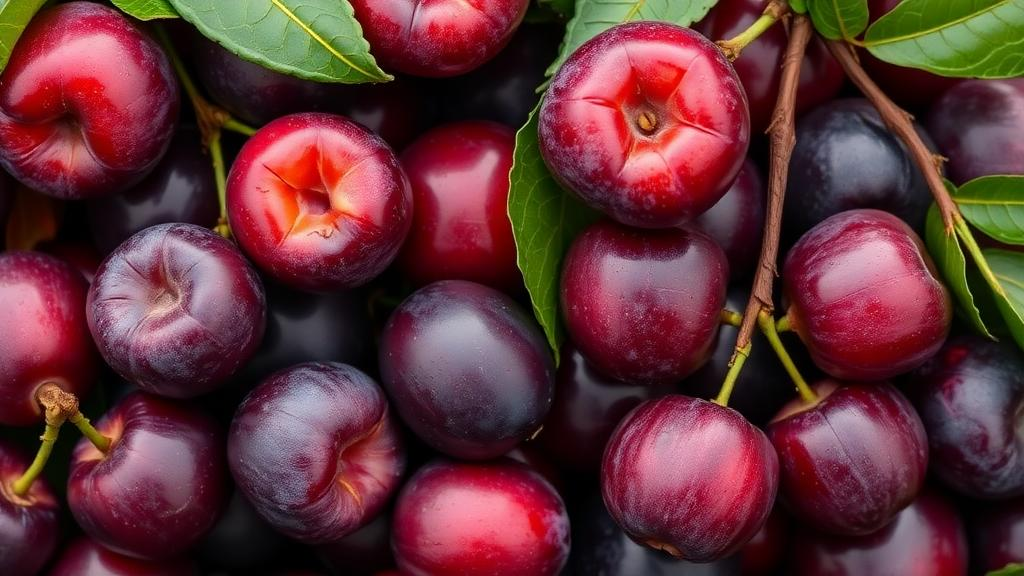
On the humid slopes of Türkiye’s Central and Eastern Black Sea coast, generations of farmers have tended European plum trees whose fruits range from tiny, intensely flavored morsels to substantial dessert-sized drupes. These local varieties of Prunus domestica L. have never been systematically cataloged with modern analytical tools, and their genetic value has remained largely anecdotal. A new study published in BMC Plant Biology by Erol Aydın of the Black Sea Agricultural Research Institute, Mehmet Ali Cengiz of Imam Mohammad Ibn Saud Islamic University, İdris Macit, and Hüsnü Demirsoy of Ondokuz Mayıs University set out to change that, combining classical fruit trait measurements, biochemical profiling, and machine learning to assess fifteen local plum varieties collected across two growing seasons.
The scale of the diversity the team documented is remarkable. Fruit weight among the fifteen accessions spanned from just 7.06 grams to 36.72 grams, a more than fivefold difference, while fruit width ranged from 20.67 to 36.54 millimeters. Such wide morphological variation within a modest collection of local germplasm underscores how much untapped diversity persists in traditional orchards and backyard plantings, even as commercial agriculture narrows the genetic base of many fruit crops. For breeders searching for new combinations of size, shape, and adaptation, these numbers represent a catalog of raw material.
The biochemical picture was equally striking. DPPH radical scavenging activity, a standard laboratory proxy for antioxidant capacity, reached a maximum of 83.20 percent in the collection. Total phenolic content varied dramatically, from 11.15 to 210.52 milligrams per gram of fresh weight, and vitamin C concentrations ranged from 5.29 to 82.03 parts per million. Phenolic compounds, which include flavonoids, anthocyanins, and phenolic acids, are central to the antioxidant behavior of stone fruits, and the nearly twentyfold spread in phenolic content suggests that some of these local plums could be genuinely valuable sources of nutritionally interesting chemistry.
Why does this matter beyond the orchard? Antioxidant activity in fruit is associated in the scientific literature with the neutralization of reactive oxygen species, and diets rich in antioxidant-containing fruits are widely studied for their potential health contributions. If breeders can reliably identify which fruit traits and biochemical components drive antioxidant capacity, they can select for enhanced nutritional quality alongside the agronomic traits that growers care about, such as yield, disease resistance, and fruit size. That is precisely the question the Turkish team posed: can the relationship between measurable fruit characteristics and antioxidant activity be captured computationally, in a way that makes selection faster and more targeted?
To explore that question, the researchers built machine learning models that attempted to predict antioxidant capacity from the morphological and biochemical parameters they had measured. They evaluated several algorithms, including Random Forest, which constructs ensembles of decision trees from bootstrapped samples of the data, and support vector regression with a radial basis function kernel, which maps inputs into high-dimensional feature spaces to capture nonlinear relationships. Crucially, they used leave-one-cultivar-out cross-validation, a demanding evaluation scheme in which the model is trained on all varieties except one and then asked to predict the held-out cultivar. This approach tests whether a model has learned generalizable biology or merely memorized the quirks of specific varieties.
The results were sobering, and the authors deserve credit for reporting them transparently. Random Forest delivered the best performance among the models tested, with an R² of negative 0.251 and a root mean square error of 33.91, while SVR-RBF achieved a lower mean absolute error of 25.24 compared with Random Forest’s 28.99. But a negative R² means the model’s predictions were worse than simply guessing the mean value of the training data for every unseen cultivar. In other words, none of the algorithms could meaningfully generalize to plum varieties it had never encountered. The team explicitly frames the machine learning component as exploratory rather than as evidence of robust prediction or causal relationships among the measured traits.
Feature-importance analysis did point to total phenolic content and vitamin C as the variables contributing most to model predictions, which aligns with biochemical expectations, since both classes of compounds are known to participate in radical scavenging reactions. However, the authors caution that these findings should be interpreted carefully given the limited number of independent cultivars in the dataset. Their SHAP-based interpretation, a technique that decomposes individual predictions into contributions from each feature, did not provide sufficient evidence to support positive or synergistic effects of total phenolic content and vitamin C on antioxidant activity. With only fifteen cultivars, statistical power is inherently constrained, and the models may be capturing noise as readily as signal.
This tension between an ambitious analytical toolkit and a small sample size is a familiar one in agricultural data science, and the study offers a useful lesson for the field. Machine learning excels when trained on large, diverse datasets, but germplasm characterization often proceeds accession by accession, with each variety requiring a full season of fruit collection and laboratory analysis. The negative cross-validation results here do not invalidate the approach; they quantify how far the field still is from models that can predict antioxidant performance in novel varieties. Larger multi-region collections, multi-year datasets, and standardized biochemical protocols would all strengthen future attempts to build genuinely predictive models of fruit quality.
Meanwhile, the core value of the study lies in what it says about the plums themselves. The substantial phenotypic and biochemical variation documented across the fifteen Black Sea varieties confirms that locally adapted European plum germplasm constitutes a meaningful reservoir of functional diversity. Some accessions combine desirable fruit characteristics with high phenolic content or elevated vitamin C, making them candidates for direct use in breeding programs aimed at enhancing nutritional quality. Others may carry adaptation to the cool, humid conditions of the Black Sea coast, traits that could become increasingly relevant as climate patterns shift and stone fruit production faces new environmental pressures.
The authors argue that incorporating these local varieties into conservation and breeding strategies could help develop plum cultivars that combine desirable agronomic traits with enhanced antioxidant potential and nutritional quality. That recommendation carries broader urgency. Landrace and local varieties worldwide are being lost as orchards are replanted with a handful of commercial cultivars, and each lost variety takes with it alleles that might someday underpin the next generation of resilient, nutritious fruit. Documenting collections like this one, even with exploratory modeling and honest caveats, is a first step toward ensuring that the genetic heritage embedded in traditional plum trees is characterized before it disappears, and that breeders can draw on it when the need arises.
Subject of Research: Morphological and biochemical characterization of local European plum germplasm from the Black Sea region using machine learning
Article Title: Integrating machine learning with fruit trait and biochemical profiling of local European plum (Prunus domestica L.) germplasm from the Black Sea region
Article References: Aydın, E., Cengiz, M. A., Macit, İ., & Demirsoy, H. (2026). Integrating machine learning with fruit trait and biochemical profiling of local European plum (Prunus domestica L.) germplasm from the Black Sea region. BMC Plant Biology. https://doi.org/10.1186/s12870-026-10152-1
Image Credits: AI Generated
DOI: 10.1186/s12870-026-10152-1
Keywords: Prunus domestica, European plum, genetic resources, antioxidant activity, total phenolic content, vitamin C, machine learning, Random Forest, SHAP analysis, cross-validation, Black Sea region, plant breeding
Cite Scienmag News
Alan Morgan. (October 13, 2026). Machine Learning Meets Heritage Plums: Black Sea Varieties Reveal Striking Antioxidant Diversity. Scienmag. https://scienmag.com/machine-learning-meets-heritage-plums-black-sea-varieties-reveal-striking-antioxidant-diversity/
Alan Morgan. "Machine Learning Meets Heritage Plums: Black Sea Varieties Reveal Striking Antioxidant Diversity." Scienmag, 13 October 2026, https://scienmag.com/machine-learning-meets-heritage-plums-black-sea-varieties-reveal-striking-antioxidant-diversity/. Accessed 13 October 2026.
Alan Morgan. "Machine Learning Meets Heritage Plums: Black Sea Varieties Reveal Striking Antioxidant Diversity." Scienmag. October 13, 2026. https://scienmag.com/machine-learning-meets-heritage-plums-black-sea-varieties-reveal-striking-antioxidant-diversity/


