


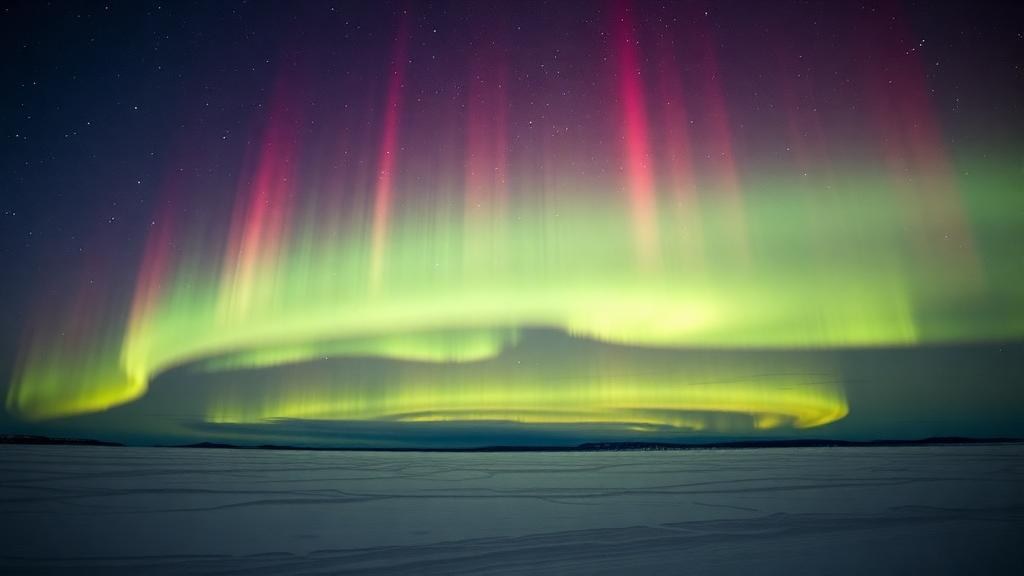
High above the Arctic, some auroras do more than glow and fade. Pulsating aurora, the patchy, diffuse form of the northern lights that brightens and dims in quasi-regular rhythms, has long been known to hide a second, faster rhythm inside its slower pulse. Now, for the first time, researchers have quantified this rapid flicker on a statistical scale, revealing that it is far from random: it intensifies toward the morning hours and is more common at lower magnetic latitudes. The findings, published in Annales Geophysicae by Sota Nanjo of the Swedish Institute of Space Physics and colleagues, transform a phenomenon previously studied case by case into a measurable diagnostic of how near-Earth space delivers energy into the upper atmosphere.
The rapid brightness changes, which the team calls internal modulation, occur at frequencies of a few hertz and are embedded within the main pulsations that last from several seconds to several tens of seconds. This hierarchical structure is not merely a curiosity of optics. It is widely understood as the ionospheric fingerprint of whistler-mode chorus waves in the inner magnetosphere, which scatter electrons into Earth’s atmosphere. Chorus bursts lasting seconds drive the main pulsations, while individual chorus elements on subsecond timescales drive the internal modulation. A model proposed by Yoshizumi Miyoshi and colleagues in 2015, later confirmed by conjugate observations between the Arase satellite and ground-based instruments, links each level of auroral variation to a corresponding level of wave activity.
Despite this physical understanding, internal modulation has been notoriously difficult to study systematically. Its amplitude is modest; a classic 1977 study by Royrvik and Davis reported that the 3 hertz modulation could reach roughly 20 percent of the relative intensity. Many standard auroral cameras capture images no faster than once per second, far too slow to resolve a few-hertz flicker, while high-time-resolution photometers sacrifice spatial coverage. Moreover, high-speed imaging trades sampling rate against signal-to-noise ratio, and the sheer volume of data produced by rapid cameras demands automated analysis. These constraints left the occurrence statistics of internal modulation, particularly its dependence on magnetic local time and latitude, largely unexplored.
The new study overcame these barriers with a combination of cutting-edge hardware and machine learning. The team deployed ORCA-Quest quantitative CMOS cameras, operated at 20 frames per second, which comfortably satisfies the Nyquist criterion for the targeted modulation frequencies. Equipped with a BG3 glass filter that suppresses the strong forbidden emission lines at 557.7 and 630.0 nanometers while retaining sensitivity to nitrogen band emissions, the cameras improved the signal-to-noise ratio for broadband auroral light. Identical systems operated at Kiruna, Sweden, at roughly 65.1 degrees adjusted geomagnetic latitude, and Skibotn, Norway, at about 66.7 degrees, two sites separated by approximately 170 kilometers at nearly the same longitude, with non-overlapping fields of view projected to 100 kilometers altitude.
The analytical pipeline was equally sophisticated. A pre-screening step based on the Tromsø AI deep-learning classifier, which achieves an average precision of 93.1 percent, filtered color all-sky images for likely auroral activity. For each qualifying minute, the team generated a keogram, a time-space plot built by stacking pixel intensities along a fixed north-south slice of the 20 hertz image sequence. A hierarchical two-stage classifier, built on a ResNet-18 backbone, then first determined whether the keogram contained pulsating aurora and, if so, whether internal modulation was present. The training labels came from 12,429 manually annotated Kiruna keograms spanning 98 nights, of which 8,163 were labeled as containing pulsating aurora and 2,608 as containing internal modulation within it.
Performance testing confirmed the approach was viable. The pulsating aurora classifier achieved a mean test F1 score of 0.9506 across ten training runs, indicating highly stable detection. The internal modulation classifier, inherently harder because the phenomenon is subtle and its definition involves boundary judgments, reached a mean F1 of 0.7472, with precision of 0.6630 and recall of 0.8630. Importantly, a weighted re-evaluation of all 241 misclassifications, in which clear errors counted fully but borderline and label-questionable cases counted less, raised the effective F1 to 0.8290. This error audit showed that many apparent failures were cases near the definitional boundary rather than genuine model mistakes, giving the team confidence to apply the classifier to tens of thousands of unseen keograms.
The statistical results were striking. Combining manual labels and model inference, the fraction of pulsating aurora accompanied by internal modulation increased toward the morning sector of magnetic local time at both sites. More remarkably, when compared at the same local time, the lower-latitude site, Kiruna, consistently showed a higher internal modulation fraction than Skibotn. The difference was most pronounced between 04:00 and 06:00 magnetic local time, where central differences of 0.293, 0.390, and 0.221 were measured at 04:00, 05:00, and 06:00 respectively, and the strict uncertainty ranges excluded zero at the two earlier hours. The authors argue that this latitudinal separation, though only about 1.6 degrees, is large enough for the two sites to sample different regimes of the auroral oval, and that observational biases cannot fully account for the gap.
A detailed single-night case study from Kiruna on 20 to 21 November 2025 illustrated how these statistics play out in real events. After an auroral breakup around 21:40 universal time, the probability of internal modulation did not rise monotonically. It first appeared as modulation embedded within clear main pulsations, then receded as the main pulsation dominated, and finally re-emerged in a state where the rapid component itself became dominant without a distinct slower envelope. A visual review of the test set reinforced this pattern: the fraction of internally modulated events in which the main pulsation was indistinct was 36 percent on the midnight sector but 69 percent in the 04:00 to 06:00 morning window, suggesting that the hierarchical time structure of the underlying chorus waves itself changes with local time.
These patterns carry deep physical implications. The morning-sector enhancement suggests that the excitation conditions and temporal structure of chorus waves depend on magnetic local time. According to nonlinear wave growth theory, the threshold amplitude for chorus excitation depends on the density and temperature anisotropy of energetic electrons; substorm injections lower this threshold, while later decay of the hot-electron population raises it, potentially shifting chorus toward a sparser temporal regime in which internal modulation becomes more prominent. Additionally, some morning-sector cases showed low overall brightness and internal modulation dominance, consistent with precipitation of relatively high-energy electrons with small velocity dispersion, a scenario linked to chorus waves propagating off the magnetic equator, possibly aided by duct propagation along field lines.
The connection may extend even to relativistic electron microbursts, sudden bursts of energetic electrons that represent a significant loss process for the outer radiation belt. Previous work has shown that microbursts favor the morning sector and the L-shell range of roughly 4.5 to 6.0, closely matching the region where the internal modulation fraction peaked in this study. If internal modulation is, in some cases, the optical signature of the high-energy tail of pulsating aurora precipitation, its statistical occurrence could provide ground-based constraints on when and where energetic electron loss is favored. While the authors caution that optical data alone cannot uniquely identify the underlying plasma mechanisms, coordinated observations with low-Earth-orbit particle detectors could soon test this link. What began as an elusive flicker within the northern lights has become a quantifiable window into the wave-particle interactions that shape Earth’s space environment.
Subject of Research: Statistical occurrence of rapid internal modulation in pulsating aurora and its link to chorus wave-driven electron precipitation
Article Title: Statistical properties of internal modulation in pulsating aurora
Article References: Nanjo, S., Taki, T., Hosokawa, K., Brändström, U., Miyoshi, Y., & Johnsen, M. G. (2026). Statistical properties of internal modulation in pulsating aurora. Annales Geophysicae, 44(2), 1023-1042. https://doi.org/10.5194/angeo-44-1023-2026
Image Credits: AI Generated
DOI: 10.5194/angeo-44-1023-2026
Keywords: pulsating aurora, internal modulation, chorus waves, machine learning, qCMOS camera, magnetosphere, electron precipitation, auroral oval, magnetic local time, space physics, whistler-mode waves, radiation belt
Cite Scienmag News
Violet Maxwell. (October 12, 2026). AI Reveals Hidden Flicker Patterns in Pulsating Auroras Across the Arctic Sky. Scienmag. https://scienmag.com/ai-reveals-hidden-flicker-patterns-in-pulsating-auroras-across-the-arctic-sky/
Violet Maxwell. "AI Reveals Hidden Flicker Patterns in Pulsating Auroras Across the Arctic Sky." Scienmag, 12 October 2026, https://scienmag.com/ai-reveals-hidden-flicker-patterns-in-pulsating-auroras-across-the-arctic-sky/. Accessed 12 October 2026.
Violet Maxwell. "AI Reveals Hidden Flicker Patterns in Pulsating Auroras Across the Arctic Sky." Scienmag. October 12, 2026. https://scienmag.com/ai-reveals-hidden-flicker-patterns-in-pulsating-auroras-across-the-arctic-sky/


