


In the rural landscapes of Japan, thatched roofs have sheltered families for centuries, their thick layers of Miscanthus and reed woven into an architectural tradition that is now recognized as culturally irreplaceable. But every roof eventually needs replacing, and the aged thatch stripped away during reroofing work poses a surprisingly modern dilemma. The material cannot simply be discarded without cost, its disposal threatens the preservation of traditional building heritage, and the volumes involved are far from trivial. A new study published in Discover Sustainability by Joseph Kotey Tawiah and colleagues at the University of Tsukuba suggests that this problematic residue could be reborn as a valuable agricultural resource, provided it undergoes one crucial transformation first: pyrolysis, the oxygen-free heating process that converts biomass into biochar.
The research team set out to answer a deceptively simple question within a circular economy framework. If old thatch is returned to the soil, does it help plants grow, or does it hold them back? To find out, the researchers ran controlled bioassays using lettuce, Lactuca sativa, a standard test species in ecotoxicology and plant science because it germinates quickly and responds sensitively to chemical stress. They compared two treatments derived from the same starting material: raw, aged thatch residues applied directly as a growth medium, and biochar produced from that same thatch through pyrolysis. Both were tested at multiple application rates, allowing the team to track how dose influenced germination, early seedling growth, and the dynamics of key nutrients.
The contrast between the two treatments could hardly have been starker. Untreated thatch residues suppressed lettuce performance in a clear dose-dependent pattern, with the highest application rate of two grams cutting germination by up to 32 percent. Seedlings exposed to the raw residues grew more slowly and less vigorously than controls, a result consistent with the presence of growth-inhibitory compounds and unfavorable physical chemistry in the aged material. For anyone hoping to simply spread decommissioned roof thatch onto farmland as mulch or soil conditioner, the message from the bioassay is a cautionary one: in its raw form, the residue can actively harm the very crops it is meant to support.
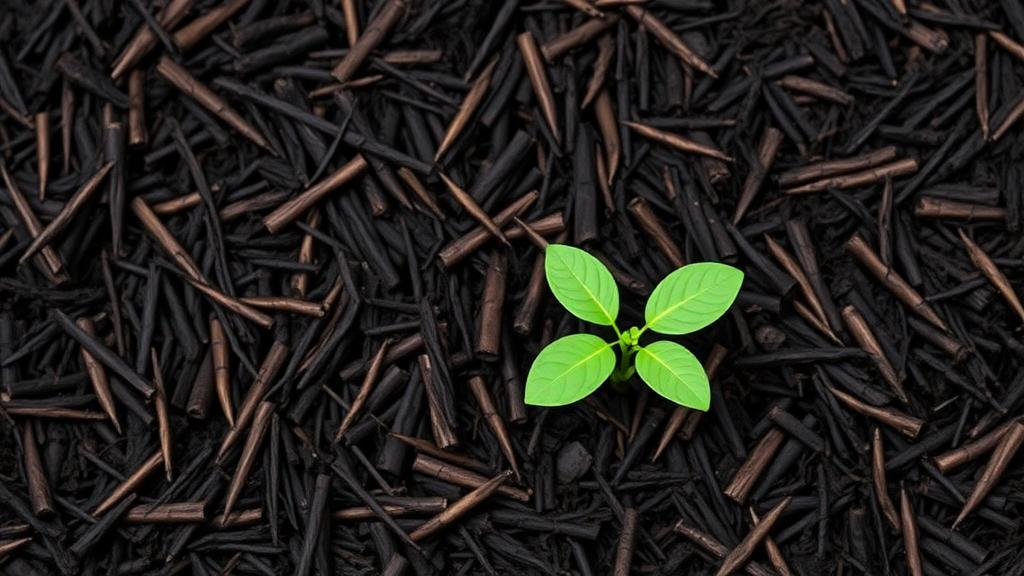
The biochar told an entirely different story. When the thatch was pyrolyzed, the resulting biochar consistently enhanced plant performance across the treatment range. The most striking result came from Miscanthus-derived biochar, which achieved 100 percent germination and the fastest mean germination time recorded in the experiment. Seedlings in biochar-amended media emerged quickly and uniformly, suggesting that the thermal treatment had eliminated or neutralized whatever compounds were holding back the raw residues. In effect, the same roof material that inhibited germination when applied directly became a growth-promoting medium after a stint in the pyrolysis reactor.
Physicochemical analysis explains why the two materials behave so differently. The aged thatch residues were acidic and rich in volatile, easily decomposable fractions, properties that favor rapid microbial breakdown and the swift release of nutrients in forms that can overwhelm young seedlings. Pyrolysis flipped this profile almost completely. The resulting biochar was alkaline rather than acidic, and its surface area was 50 to 70 times greater than that of the raw residues, a dramatic increase that transforms how the material interacts with water, nutrients, and soil microbes. High surface area is a hallmark of well-produced biochar and underpins its well-documented abilities to adsorb compounds, retain moisture, and provide habitat for beneficial microorganisms.
The nutrient dynamics data add a particularly important mechanistic layer. In the raw residues, nitrogen was released rapidly, and the authors point to the likely accumulation of mineral nitrogen as a key driver of the observed growth inhibition. Rapid nitrogen pulses can create osmotic stress, imbalances, and phytotoxic conditions in germination bioassays, where seedlings have no root systems capable of buffering sudden chemical swings. The biochar, by contrast, effectively mitigated this rapid nitrogen release. Its stable, carbon-rich structure holds nutrients in slower-exchange forms, smoothing out the availability curve so that emerging seedlings encounter a steadier, less hostile chemical environment. In other words, pyrolysis does not merely remove toxins; it fundamentally re-engineers the timing of nutrient supply.
These findings carry weight well beyond the laboratory. Japan’s thatched roofs, concentrated in historic villages and cultural landscapes, generate a recurring stream of aged material that has traditionally been recycled within local systems of use. As those systems fade, both the waste problem and the heritage problem intensify. The Tsukuba study reframes aged thatch not as refuse but as feedstock, a biomass resource whose value can be unlocked through a well-understood thermal process. Because biochar production can be scaled from small kilns to larger facilities, the approach could plausibly be adopted at the village level, keeping the material within the local circular economy that originally produced it and reinforcing the traditional knowledge systems that the research project explicitly set out to reevaluate.
The agricultural implications are equally significant. Biochar is already widely studied as a soil amendment with potential to improve fertility, sequester carbon, and reduce nutrient leaching, and this work adds a novel, culturally sourced feedstock to that portfolio. The demonstration that Miscanthus biochar from aged thatch can deliver complete, rapid germination suggests the material could compete with more conventional biochar sources. It also highlights a broader principle for waste-to-soil schemes: the chemical form of an organic residue matters as much as its nutrient content. A material can be rich in plant nutrients and still be phytotoxic if those nutrients arrive in a pulse that seedlings cannot tolerate. Converting that pulse into a slow-release reservoir is precisely what pyrolysis accomplishes.
Caveats remain, as they always do in bioassay work. Lettuce germination in a controlled medium is a sensitive but simplified proxy for performance in real field soils, where climate, microbial communities, existing soil chemistry, and application technique all modulate outcomes. The study tested specific application rates in a laboratory setting, and field-scale trials will be needed to confirm that the benefits translate to working farmland and to determine optimal dosing for different crops and soil types. The researchers also note that the material used came from actual reroofing work, obtained with the cooperation of a building firm and the Japanese Thatcher Association, which lends ecological realism to the feedstock but also means results may vary with the age, species composition, and history of any given batch of thatch.
Even with those qualifications, the study offers a rare, satisfying alignment of environmental science and cultural preservation. A residue that threatens heritage landscapes becomes, through a single well-chosen process, an amendment that supports sustainable agriculture, and the act of recycling it reinforces the very traditions that produced it. The authors conclude that pyrolysis plays a vital role in transforming aged thatch from a problematic cultural residue into a valuable soil amendment, a pathway that serves sustainable farming, circular economies, and the survival of traditional landscapes all at once. For the historic villages of Japan, and for any community wrestling with legacy organic waste streams, the lesson is elegant: sometimes the fastest route to preserving the past is to run it through the fire and put it back in the ground.
Subject of Research: Repurposing aged thatch residues and their biochar as soil amendments for sustainable agriculture
Article Title: Effects of aged thatch residues and their biochar on lettuce germination, early growth, and nutrient dynamics in a bioassay
Article References: Effects of aged thatch residues and their biochar on lettuce germination, early growth, and nutrient dynamics in a bioassay. (n.d.). https://doi.org/10.1007/s43621-026-03799-1
Image Credits: AI Generated
DOI: 10.1007/s43621-026-03799-1
Keywords: biochar, aged thatch, pyrolysis, lettuce germination, nutrient dynamics, circular economy, soil amendment, Miscanthus, reed, cultural heritage, sustainable agriculture, Japan
Cite Scienmag News
Violet Maxwell. (October 12, 2026). From Old Roofs to New Farms: Biochar Turns Aged Thatch Into a Plant Growth Booster. Scienmag. https://scienmag.com/from-old-roofs-to-new-farms-biochar-turns-aged-thatch-into-a-plant-growth-booster/
Violet Maxwell. "From Old Roofs to New Farms: Biochar Turns Aged Thatch Into a Plant Growth Booster." Scienmag, 12 October 2026, https://scienmag.com/from-old-roofs-to-new-farms-biochar-turns-aged-thatch-into-a-plant-growth-booster/. Accessed 12 October 2026.
Violet Maxwell. "From Old Roofs to New Farms: Biochar Turns Aged Thatch Into a Plant Growth Booster." Scienmag. October 12, 2026. https://scienmag.com/from-old-roofs-to-new-farms-biochar-turns-aged-thatch-into-a-plant-growth-booster/


