Some of the most powerful artificial intelligence systems on the planet can describe a photograph of a city street in remarkable detail, caption a painting, or answer questions about a medical scan. Yet when they are shown a microscopic image of plant tissue, many of them stumble badly. That is the central finding of a new benchmarking effort from the University of Queensland, where researchers have built a dataset designed to expose exactly where vision language models, the AI systems that combine image analysis with text understanding, fall short when they are asked to interpret the fine cellular details of plants and the diseases that attack them.
The project, known as PlantMicro, was developed by PhD student Tianqi Wei and collaborators at the university’s School of Electrical Engineering and Computer Science, working with the School of Agriculture and Food Sustainability and with partial support from the Grains Research and Development Corporation. The work was presented at the European Conference on Computer Vision 2026, one of the leading international venues for computer vision research, and the dataset has been released for free so that other researchers and AI developers can use it to measure and improve their models.
Vision language models have become widely adopted as research tools across many branches of microscopy. In fields ranging from materials science to medical pathology, these systems are increasingly used to help researchers sift through large volumes of imagery, flag features of interest, and answer questions about what a microscope is showing. But according to Wei, plant science has largely been left out of this trend, and for a good reason. Even the most advanced models, he explained, cannot be relied upon to accurately analyse cellular details in plant imagery, which makes them risky tools for research that demands precision.
That limitation matters more than it might first appear. Plant microscopy sits at the heart of some of the most consequential questions in modern science. Understanding how pathogens invade plant tissue, how cellular structures respond to stress, and how diseases spread through crops depends on researchers being able to interpret microscopic evidence correctly. If AI systems could be trusted to assist with that interpretation, they could accelerate discoveries in areas such as food security and environmental sustainability. As Wei put it, the current blind spots are preventing researchers from using these tools to make discoveries that would advance exactly those fields.
To understand why the models perform so poorly, the Queensland team first had to solve a measurement problem. Part of the reason an AI performance gap exists in plant microscopy, Wei noted, is that until now researchers have not been able to see precisely where vision language models are falling short, or how they might improve. Without a rigorous yardstick, developers have had no systematic way to diagnose the weaknesses of their systems or to track progress as they refine them. Benchmarking datasets have driven enormous gains in other areas of AI, from image classification to language understanding, but no equivalent resource existed for microscopic plant imagery.
PlantMicro fills that gap. The dataset integrates thousands of microscopic images of plants and plant diseases and pairs them with sophisticated training and evaluation mechanisms that test a model’s ability to identify, sort, and count minute details. Those three capabilities, recognition, categorisation, and quantification, are fundamental to how working plant scientists actually use microscopy. A researcher examining diseased tissue needs to know what organism is present, how it should be classified, and how abundant it is. A benchmark that tests all three therefore reflects the real demands of the discipline rather than an artificial laboratory task.
The results of the experiments were sobering. When Wei and his colleagues evaluated a range of vision language models on PlantMicro, both closed-source commercial systems and open-source alternatives performed poorly on plant host and disease identification, achieving average accuracies of only about 30 per cent. Wei pointed out that this is marginally above random guessing, a comparison that underscores just how far these systems remain from being dependable research assistants in this domain. The finding suggests, in his words, that vision language models still face considerable challenges in identifying host or pathogen types from microscopic evidence.
Why should systems that excel at so many visual tasks fail so dramatically here? The benchmark itself does not fully answer that question, but its design makes the diagnosis possible in a way that was not before. By breaking plant microscopy understanding into discrete, testable components, PlantMicro allows developers to see which specific skills their models lack. A model might perform adequately on one kind of task while collapsing on another, and that pattern of strengths and weaknesses is exactly the kind of feedback that guides targeted improvement. With PlantMicro, Wei said, researchers can clearly identify where major AI models are struggling.
The implications extend beyond the immediate technical community. Identifying these performance gaps is crucial feedback for AI developers seeking to improve their products for use in microscopic plant research, and the free availability of the dataset lowers the barrier for laboratories and companies around the world to act on that feedback. In the broader arc of AI development, benchmarks of this kind have repeatedly proven to be catalysts. When a weakness is measured publicly and precisely, progress tends to follow quickly, because researchers now have a concrete target to aim at rather than a vague sense that something is not working.
For plant science, the stakes are unusually high. Agriculture faces mounting pressures from climate change, emerging pathogens, and growing global demand for food, and microscopy remains a foundational method for understanding plant health at the cellular level. The fungus Lasiodiplodia exigua, one of the organisms featured in the project’s imagery, is known to cause plant diseases, illustrating the kind of pathogen that researchers routinely need to identify from microscopic evidence. If vision language models can eventually be made reliable in this setting, they could help researchers process imagery at a scale and speed that no human team could match, potentially speeding up the identification of diseases and the development of resistant crops. Wei and his collaborators hope their program will provide a better foundation for AI to be used in plant science for the benefit of everyone on the planet. For now, the message of PlantMicro is a candid one: the current generation of AI cannot yet be trusted with the microscopic details that plant research depends on, but for the first time, researchers know exactly where to look to fix that.
Subject of Research: Benchmarking vision language models for microscopic plant image understanding
Article Title: Unlocking AI as a research tool for plant microscopy
Article References: Unlocking AI as a research tool for plant microscopy. (n.d.). Original publication
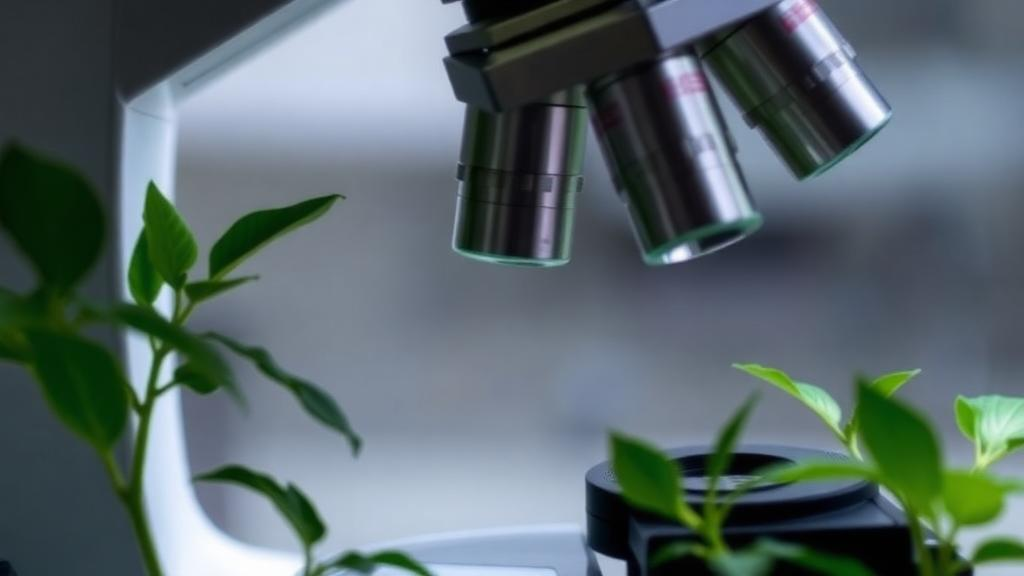
Image Credits: AI Generated
DOI: Not provided
Keywords: artificial intelligence, vision language models, plant microscopy, benchmarking dataset, plant pathology, University of Queensland, computer vision, food security, plant disease identification, European Conference on Computer Vision, agricultural science, machine learning
Cite Scienmag News
Blake Davidson. (October 12, 2026). AI Fails at Reading Plant Cells Under the Microscope, New Benchmark Reveals. Scienmag. https://scienmag.com/ai-fails-at-reading-plant-cells-under-the-microscope-new-benchmark-reveals/
Blake Davidson. "AI Fails at Reading Plant Cells Under the Microscope, New Benchmark Reveals." Scienmag, 12 October 2026, https://scienmag.com/ai-fails-at-reading-plant-cells-under-the-microscope-new-benchmark-reveals/. Accessed 12 October 2026.
Blake Davidson. "AI Fails at Reading Plant Cells Under the Microscope, New Benchmark Reveals." Scienmag. October 12, 2026. https://scienmag.com/ai-fails-at-reading-plant-cells-under-the-microscope-new-benchmark-reveals/