


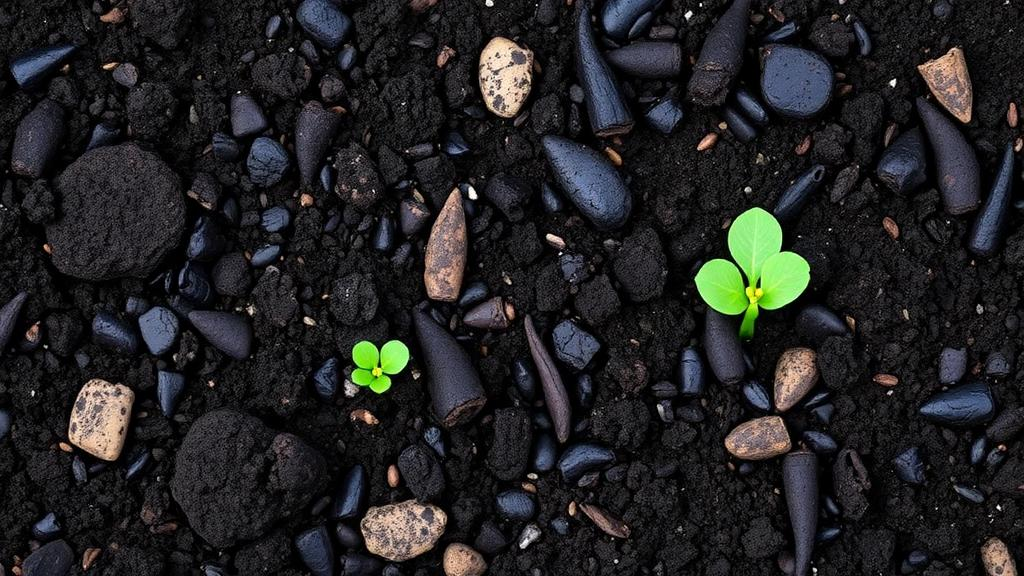
Two of the most talked-about tools in sustainable agriculture may accomplish far more together than either can alone. A new review published in the journal Microbial Ecology by Wojciech Stopa, Maria Strzelczyk and Jakub Dobrzyński of the Institute of Technology and Life Sciences–National Research Institute in Poland examines what happens when biochar—the charcoal-like material produced by heating organic matter in the absence of oxygen—is combined with Pseudomonas bacteria, a group of soil-dwelling microbes famous for their ability to promote plant growth and break down stubborn pollutants. The authors conclude that the pairing is genuinely synergistic in many settings, but they also deliver a sobering caveat: the outcome depends heavily on the type of biochar, the way the bacteria are attached to it, the soil in which the mixture is deployed, and the identity of the contaminants themselves.
Biochar has attracted enormous attention over the past two decades as a soil amendment that can lock away carbon for centuries while improving the physical and chemical properties of degraded land. Produced through pyrolysis, the thermal decomposition of biomass such as crop residues, wood chips or manure at temperatures typically ranging from roughly 300 to 900 degrees Celsius, biochar emerges as a highly porous, carbon-rich solid with an enormous internal surface area. That architecture gives it a remarkable capacity to adsorb water, nutrients and organic molecules, and it also creates a labyrinth of pores that, as the new review emphasizes, can serve as a protective microhabitat for bacteria. Pseudomonas species, meanwhile, are among the best-studied plant growth-promoting rhizobacteria, or PGPR. They colonize the root zone and stimulate plants through multiple mechanisms, including the production of phytohormones such as indole-3-acetic acid, the solubilization of mineral phosphates, the synthesis of siderophores that scavenge iron, and the suppression of soil-borne pathogens through antibiotic compounds and competitive colonization.
The central insight of the review is that these two components complement each other in ways that address each partner’s principal weakness. Free-living bacteria introduced into soil face a brutal environment: desiccation, ultraviolet radiation, grazing by protozoa, competition from native microbes, and fluctuating pH and salinity. Inoculants that perform spectacularly in greenhouse trials often fade within weeks in the field. Biochar changes that equation. Its pore network shelters bacterial cells from predators and drying, buffers moisture availability, and can supply adsorbed nutrients that sustain microbial metabolism during lean periods. The review reports that biochar can stimulate the production of extracellular polymeric substances, the sticky biofilm matrix that bacteria secrete to anchor themselves and resist environmental stress. It can also enhance catabolic enzyme activity, the enzymatic machinery that allows Pseudomonas strains to degrade organic contaminants. In effect, biochar functions as both a fortress and a pantry for the bacteria.
The authors identify four principal strategies for bringing the partners together, and the distinction matters for anyone designing a biochar-based product. Adsorption is the simplest: bacterial cells are mixed with biochar and allowed to attach passively to its surfaces through electrostatic interactions, hydrophobic effects and the gradual secretion of adhesive polymers. Embedding goes further, immobilizing cells within or on the biochar matrix under controlled conditions to create a carrier material that can be stored and transported. Co-inoculation introduces biochar and bacteria separately but simultaneously to the same soil, while co-application refers to the broader practice of applying both to a field as part of a single management scheme. Each approach trades off convenience, cost and performance. Immobilization on biochar tends to maximize cell survival and repeated use in bioremediation columns or bioreactors, whereas co-application is the most practical for farmers but offers the least control over where bacteria and biochar particles actually meet in the soil profile.
When the partnership works, the benefits ripple through the entire soil–plant system. The review describes how combined biochar–Pseudomonas treatments can significantly alter soil physicochemical properties, improving cation exchange capacity, water retention, aggregate stability and nutrient cycling. Pseudomonas strains living in biochar-amended soil contribute to nitrogen transformations, phosphorus solubilization and the decomposition of organic matter, feeding nutrients to plant roots in a slow, steady rhythm. Plants respond with measurable gains in germination, root architecture, shoot biomass and yield, along with enhanced tolerance to abiotic stresses such as drought and salinity. The mechanism is partly hormonal and partly nutritional, but there is also an indirect route: healthier, more diverse microbial communities in the rhizosphere outcompete pathogens and induce systemic resistance in the plant itself, priming its immune defenses before an attack occurs.
The second great promise of the pairing lies in biodegradation and detoxification of pollutants, an area where the review sees some of the most compelling evidence. Agricultural and industrial soils worldwide carry burdens of petroleum hydrocarbons, pesticides, polycyclic aromatic hydrocarbons and heavy metals. Pseudomonas species are celebrated biodegraders, possessing enzymatic pathways that can cleave aromatic rings and metabolize a wide range of xenobiotic compounds. Biochar assists on two fronts. For organic pollutants, it concentrates contaminant molecules onto its surfaces through adsorption, placing them in close proximity to the degrading bacteria and their extracellular enzymes, which can accelerate breakdown while reducing the acute toxicity and mobility of the compounds in soil water. For heavy metals, which cannot be destroyed, biochar’s alkaline pH, oxygen-containing functional groups and mineral ash content immobilize ions such as cadmium, lead and zinc through adsorption, precipitation and complexation, cutting their uptake by plants, while Pseudomonas can further reduce metal bioavailability through biosorption and the secretion of chelating agents.
Yet the review is emphatic that this is not a plug-and-play technology. The efficacy of biochar–Pseudomonas systems is highly variable, and three factors dominate the outcome. The first is feedstock: biochar made from woody biomass differs chemically and structurally from biochar made from manure, sludge or crop straw, and those differences cascade into pore size distributions, surface chemistry, nutrient content and, ultimately, bacterial compatibility. The second is pyrolysis temperature, which governs nearly everything about the final material. Low-temperature biochars retain more labile carbon and functional groups that feed microbes, while high-temperature biochars are more stable and adsorptive but can be less hospitable habitats. The third is soil type, since texture, pH, organic matter content and native microbial communities all modulate whether introduced Pseudomonas strains establish, persist and perform. A combination that transforms a sandy, contaminated soil in one trial may do little in a clay-rich soil with different chemistry.
The nature of the contaminant adds another layer of complexity. Highly adsorbed pollutants may be detoxified by immobilization but become less available for enzymatic attack, a phenomenon known in bioremediation as sequestration, and the balance between immobilization and degradation is delicate. Some contaminants can even inhibit bacterial growth at high concentrations, overwhelming the protective capacity of the biochar. The review stresses that environmental conditions—moisture, temperature, redox state and seasonal variation—shape the interaction continuously, which is precisely why results from controlled laboratory microcosms so often fail to translate cleanly into the field. The authors argue that this gap is the single biggest obstacle between promising bench science and practical implementation at the scale of real farms and contaminated sites.
To close that gap, the authors chart a clear research agenda. They call for long-term field experiments that track biochar–Pseudomonas systems across multiple growing seasons, capturing how bacterial populations establish, how biochar ages and oxidizes in soil, and whether the benefits to crop productivity and pollutant removal persist or decay over time. Equally important, they advocate multi-omics approaches—genomics, transcriptomics, proteomics and metabolomics applied together—to dissect the molecular conversation between biochar surfaces, Pseudomonas cells, the wider soil microbiome and plant roots. Such tools could reveal which bacterial genes are activated in the biochar microhabitat, which enzymes drive degradation in situ, and which signaling molecules mediate the partnership, turning an empirical practice into a designable one.
The significance of the review extends beyond agronomy. As governments seek nature-based solutions to soil degradation, food insecurity and industrial contamination, technologies that combine waste-derived materials with living microbes offer an appealing vision: converting agricultural residues into biochar, charging that biochar with beneficial bacteria, and deploying the mixture to grow crops while cleaning the ground beneath them. The Polish team’s synthesis makes clear that the vision is grounded in real mechanisms—habitat provision, stress buffering, enzyme stimulation and pollutant capture—but also that it must be engineered with precision rather than applied as a universal remedy. The synergy is real, the authors conclude, but it is conditional, and understanding those conditions is the next great task for soil microbiology.
Subject of Research: Synergistic interactions between biochar and Pseudomonas bacteria in plant growth promotion and pollutant biodegradation
Article Title: Synergistic Effects of Biochar and Pseudomonas spp. on Plant Growth Stimulation and Biodegradation of Pollutants
Article References: Synergistic Effects of Biochar and Pseudomonas spp. on Plant Growth Stimulation and Biodegradation of Pollutants. (n.d.). https://doi.org/10.1007/s00248-026-02911-2
Image Credits: AI Generated
DOI: 10.1007/s00248-026-02911-2
Keywords: biochar, Pseudomonas, plant growth-promoting rhizobacteria, bioremediation, soil microbiome, pyrolysis, heavy metals, organic pollutants, soil health, PGPR, biodegradation, sustainable agriculture
Cite Scienmag News
Alan Morgan. (October 12, 2026). Charred Soil, Living Allies: How Biochar and Pseudomonas Team Up to Grow Crops and Eat Pollution. Scienmag. https://scienmag.com/charred-soil-living-allies-how-biochar-and-pseudomonas-team-up-to-grow-crops-and-eat-pollution/
Alan Morgan. "Charred Soil, Living Allies: How Biochar and Pseudomonas Team Up to Grow Crops and Eat Pollution." Scienmag, 12 October 2026, https://scienmag.com/charred-soil-living-allies-how-biochar-and-pseudomonas-team-up-to-grow-crops-and-eat-pollution/. Accessed 12 October 2026.
Alan Morgan. "Charred Soil, Living Allies: How Biochar and Pseudomonas Team Up to Grow Crops and Eat Pollution." Scienmag. October 12, 2026. https://scienmag.com/charred-soil-living-allies-how-biochar-and-pseudomonas-team-up-to-grow-crops-and-eat-pollution/


