


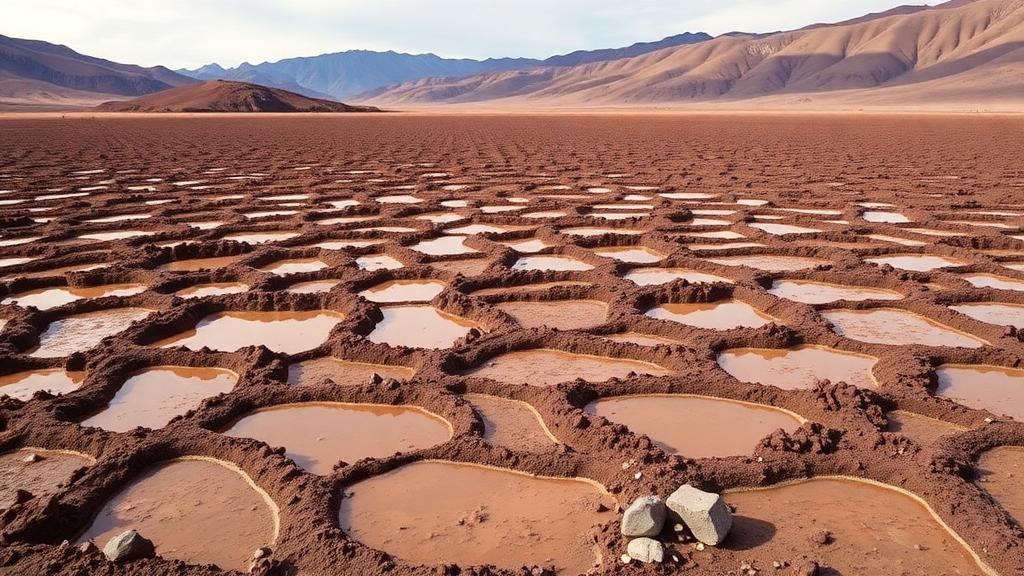
High on the Tibetan Plateau, where permafrost lurks beneath alpine meadows and glaciers feed the headwaters of Asia’s great rivers, a quiet accounting exercise is underway. Scientists have spent decades asking how much carbon the plateau’s vegetation pulls out of the atmosphere each year, but a new study argues that the answer depends less on air temperature alone and more on what is happening a few centimeters below ground: the temperature and moisture of the soil itself. In research published in the journal Plant and Soil, a team led by Qing Peng and Binghao Jia of the Institute of Atmospheric Physics at the Chinese Academy of Sciences quantified how these soil hydrothermal conditions govern both the raw productivity of plants and the efficiency with which they convert absorbed carbon into lasting biomass across four decades of rapid warming.
The study’s central quantities are two of the most important currencies in ecosystem science. The first is net primary productivity, or NPP, which measures the amount of carbon that vegetation fixes through photosynthesis minus the carbon plants respire for their own maintenance — in effect, the gross income of an ecosystem’s carbon economy. The second is carbon use efficiency, or CUE, the ratio of the carbon actually incorporated into plant tissue to the total carbon fixed. A high CUE means an ecosystem is a disciplined saver, converting its photosynthetic earnings into wood, roots, and leaves rather than burning them off as respiration. Together, these two metrics determine whether a landscape acts as a growing carbon sink or a leaky one, and both are exquisitely sensitive to the physical conditions of the root zone.
To track these variables across a region the size of a small continent, the researchers turned to the Community Land Model version 5.0, a state-of-the-art land surface model developed for Earth system simulation. CLM5.0 integrates soil thermal and hydrological processes, vegetation dynamics, and biogeochemical cycling, allowing the team to simulate NPP and CUE across the plateau from 1979 to 2020. The model was constrained and evaluated against an impressive array of observational data: long-term in situ soil temperature records archived at the National Tibetan Plateau Data Center, eddy-covariance measurements of net ecosystem productivity and heterotrophic respiration from the Haibei research station, satellite-derived MODIS net primary productivity products, and independent NPP estimates from the CASA and VPM remote sensing models. Soil property maps and plant functional type distributions provided the underlying substrate and vegetation structure.
The simulation revealed a striking hierarchy among the plateau’s ecosystems. Forests, concentrated in the warmer and wetter southeastern margins, were the most productive, with a median NPP of 963.52 grams of carbon per square meter per year. Shrublands, however, proved to be the most frugal, achieving the highest median carbon use efficiency at 0.53 — meaning more than half of the carbon they fixed was retained in biomass rather than lost to respiration. Grasslands, which blanket the vast majority of the plateau, showed the most dramatic long-term trajectories: their NPP climbed by 2.16 grams of carbon per square meter per year each year, while their CUE declined by 0.0009 per year. That combination — rising gross productivity but falling efficiency — hints at a subtle but consequential shift in how these alpine ecosystems are handling a warming climate.
The declining CUE of grasslands deserves particular attention. Carbon use efficiency tends to fall when respiration outpaces photosynthesis, and warming accelerates both plant and microbial metabolism. Previous work cited by the team, including multi-model analyses of the Qinghai-Tibet Plateau, has suggested that continued climate change will erode the carbon use efficiency of terrestrial ecosystems across the region. The new results add a mechanistic dimension to that picture: the decline is not simply a response to warmer air, but is tightly coupled to the state of the soil, where permafrost thaw, altered drainage, and shifting moisture regimes reshape the environment in which roots and microbes operate. An ecosystem that fixes more carbon but spends proportionally more of it on respiration may accumulate biomass more slowly than its rising NPP would suggest.
To disentangle the relative influence of soil temperature and soil moisture, the researchers employed a random forest machine learning approach, a method well suited to capturing nonlinear relationships and interactions among many predictors. The analysis produced a clear seasonal signature. In spring and autumn — the shoulder seasons when the plateau’s vegetation is waking from or settling into dormancy — soil temperature was the dominant driver of NPP variation. This makes physical sense: during these periods, plant growth is often limited by cold soils, and the timing of spring thaw regulates when roots can access water and nutrients and when photosynthesis can resume. Earlier and warmer soil thawing has been shown to regulate the onset of growth in tundra and alpine biomes, and the new findings confirm that this temperature control extends across the plateau’s diverse vegetation types.
Summer told a different story. Once soils had warmed sufficiently, temperature ceased to be the binding constraint, and soil moisture took over as the key driver of net primary productivity. The plateau’s summer monsoon delivers the bulk of annual precipitation, and interannual variability in that moisture supply strongly modulates how much carbon vegetation can fix during the peak growing season. This finding aligns with global evidence that soil moisture exerts a large influence on long-term terrestrial carbon uptake, and it carries a sobering implication: as warming intensifies evapotranspiration and potentially destabilizes monsoon patterns, summer drought stress could become an increasingly important brake on the plateau’s carbon sink, even as longer and warmer growing seasons push in the opposite direction.
The vegetation-type analysis added yet another layer of nuance. For carbon use efficiency, soil temperature contributed more in grasslands, whereas soil moisture was the primary driver in shrublands and forests. These differences likely reflect the distinct ecophysiological strategies of the plant types involved. Grasses, with shallow root systems and rapid tissue turnover, are highly responsive to the thermal environment of the upper soil layers. Shrubs and trees, with deeper roots and woody structure, depend more heavily on sustained water availability, making their carbon allocation decisions more sensitive to moisture fluctuations. For land managers and carbon accountants, this means that a single regional parameterization of soil controls would misrepresent at least some of the plateau’s ecosystems; the rules of the carbon economy change with the vegetation.
Why does all of this matter beyond the plateau itself? The Tibetan Plateau, often called the Third Pole, holds one of the largest reservoirs of permafrost soil carbon outside the Arctic. As permafrost degrades and glaciers retreat, the soil hydrothermal regime is being rewritten, with consequences that ripple through the global carbon cycle. The study’s findings suggest that the trajectory of the plateau’s carbon sink will hinge on the coupled evolution of soil temperature and moisture — not on warming alone. A warmer but wetter plateau could continue to expand its vegetation carbon uptake, as the team’s earlier work on soil warming and wetting indicated, whereas a warmer and drier one could see productivity gains offset by respiration losses and declining efficiency. Regional carbon sink management and climate adaptation strategies, the authors argue, need to account for this hydrothermal coupling explicitly.
The study also demonstrates the growing power of combining process-based Earth system models with machine learning attribution. By simulating four decades of coupled soil and vegetation dynamics with CLM5.0 and then using random forests to apportion variance among drivers, the researchers achieved something neither approach could accomplish alone: a physically consistent reconstruction of ecosystem carbon behavior, paired with a data-driven ranking of its controls across seasons and vegetation types. The work was supported by the National Natural Science Foundation of China, the National Key R&D Program, and the Chinese Academy of Sciences, with simulations conducted using the Earth System Numerical Simulation Facility. As permafrost thaw accelerates across the world’s cold regions, this kind of quantitative attribution — knowing precisely when warmth matters and when water matters, and for which plants — will be essential for forecasting whether high-altitude and high-latitude ecosystems remain allies in the fight against climate change or become its amplifiers.
Subject of Research: Effects of soil temperature and moisture on vegetation carbon sequestration under climate warming on the Tibetan Plateau
Article Title: Quantifying the effects of soil hydrothermal conditions on vegetation carbon sequestration capacity under climate warming on the Tibetan Plateau
Article References: Peng, Q., Jia, B., Wang, L., Wu, R., & Huang, Q. (2026). Quantifying the effects of soil hydrothermal conditions on vegetation carbon sequestration capacity under climate warming on the Tibetan Plateau. Plant and Soil. https://doi.org/10.1007/s11104-026-09026-0
Image Credits: AI Generated
DOI: 10.1007/s11104-026-09026-0
Keywords: Tibetan Plateau, net primary productivity, carbon use efficiency, soil temperature, soil moisture, permafrost degradation, climate warming, CLM5.0, random forest, grasslands, carbon sink, alpine ecosystems
Cite Scienmag News
Alan Morgan. (October 11, 2026). Soil Warmth and Water Hold the Key to Carbon Storage on the Tibetan Plateau. Scienmag. https://scienmag.com/soil-warmth-and-water-hold-the-key-to-carbon-storage-on-the-tibetan-plateau/
Alan Morgan. "Soil Warmth and Water Hold the Key to Carbon Storage on the Tibetan Plateau." Scienmag, 11 October 2026, https://scienmag.com/soil-warmth-and-water-hold-the-key-to-carbon-storage-on-the-tibetan-plateau/. Accessed 11 October 2026.
Alan Morgan. "Soil Warmth and Water Hold the Key to Carbon Storage on the Tibetan Plateau." Scienmag. October 11, 2026. https://scienmag.com/soil-warmth-and-water-hold-the-key-to-carbon-storage-on-the-tibetan-plateau/


