


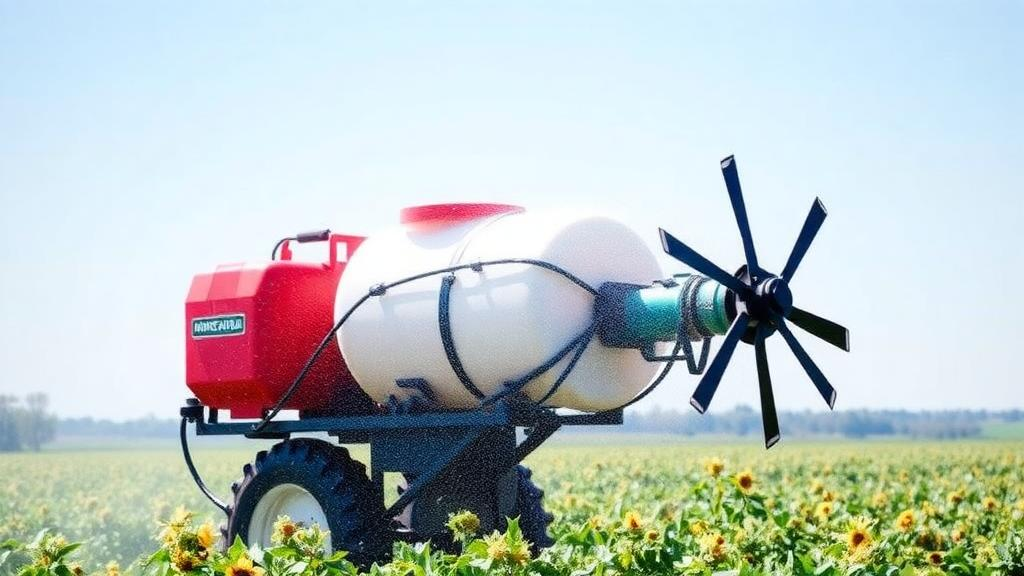
Every year, American farms lose an estimated 31.75 million kilograms of pesticide to airborne drift, a plume of wasted chemistry that drifts across fields, into schools, and over rural communities. Airborne drift has been linked to between 37 and 68 percent of pesticide-related illnesses among U.S. agricultural workers, and it has been implicated in roughly 31 percent of acute pesticide illness cases reported in American schools. Now, a team of agricultural engineers has taken a major step toward shutting down that invisible cloud, with a control model that lets a sprayer’s fan breathe with the wind, matching its airflow to the canopy in front of it and the weather around it.
The research, published in Smart Agricultural Technology, tackles a stubborn blind spot in precision agriculture. Sensor-guided sprayers have become remarkably good at adjusting how much liquid they release: ultrasonic sensors, LiDAR, and stereo vision systems can map a tree canopy in real time and pulse individual nozzles on and off through solenoid valves driven by pulse-width modulation signals. Variable-rate sprayers built around stereo vision have cut pesticide use by 72.6 to 80.5 percent and reduced ground losses by 57.6 percent compared with conventional constant-rate machines. But while the liquid side of spraying has grown intelligent, the air side has barely changed in decades.
Conventional orchard sprayers rely on axial fans that blast a constant, high-volume stream of air to carry droplets into dense foliage. That fixed airflow is a compromise at best. Directed at a sparse canopy, it blows droplets straight past the leaves and into the atmosphere; aimed at dense foliage, it lacks the momentum to push droplets into the interior where pests hide. Mechanical baffles and louvers have been tried to modulate the output, but they respond slowly, offer coarse control, consume large amounts of energy, cannot adapt to shifting winds, and can even damage crops with excessive airflow. Because canopy density changes over a season and wind conditions shift minute to minute, no fixed setting can consistently balance deposition against drift.
The new work builds on an electric air-assisted spraying system, or EAAS, developed earlier by Hongyoung Jeon and Heping Zhu. The system uses a tower design with vertically stacked electric fans that can swing air velocity from zero to 11.3 meters per second in roughly three seconds, delivering air horizontally and parallel to the ground rather than in the turbulent radial pattern of conventional fans. Earlier field tests showed how sensitive spray performance is to fan speed: low air assistance of 3.4 meters per second increased average canopy deposition on full-foliage apple trees by 24.6 percent over unassisted spraying, while maximum output of 11.3 meters per second cut deposition by 23.2 percent and inflated drift potential by up to 401.4 percent. The message was clear: more air is not better air.
To turn that insight into a working controller, the team led by Matthew J. Herkins ran a systematic campaign of wind tunnel experiments. Their test rig paired a 397-millimeter electric axial fan with a flat-fan spray nozzle, both governed by an Arduino microcontroller and a solid-state relay that adjusted fan speed in 5 percent duty-cycle increments, yielding outlet air speeds from 1.86 to 10.96 meters per second. Inside a low-speed wind tunnel capable of laminar airflow up to about 10 meters per second, they sprayed an artificial Ficus tree placed 2.05 meters downwind. Three foliage conditions, leafless, half-foliage, and full-foliage, corresponded to leaf area index values of 0.00, 1.39, and 2.77, spanning the range measured on apple trees across a growing season. Wind speeds from 0.7 to 4.3 meters per second and wind directions sweeping from directly favorable to directly adverse completed the test matrix.
Deposition was measured with a fluorescent tracer, Brilliant Sulfaflavine, collected on stainless steel meshes at three canopy heights, while water-sensitive papers recorded spray coverage and downwind samplers captured airborne drift. The results revealed a striking pattern: when wind blew with the spray direction at 270 degrees, deposition peaked at the lowest fan speed tested and fell as air speed rose, a consequence of leaf layering, in which high-velocity airstreams flatten foliage against itself and shield interior surfaces. As wind direction swung oblique, the optimum fan speed climbed steadily, reaching the maximum 10.96 meters per second at 305 degrees. Denser canopies demanded more air to overcome aerodynamic drag, but only when crosswinds deflected the plume. Statistical analysis confirmed the hierarchy: fan air speed alone explained 41.2 percent of deposition variance, and its interaction with wind direction accounted for another 38.3 percent, dwarfing every other factor.
From this dataset the researchers built empirical regression models that predict the optimal fan speed from wind speed, wind direction, and canopy density. For favorable wind directions, they developed five models corresponding to drift tolerance thresholds of 0, 2.5, 5, 10, and 15 percent, each defining how much deposition a grower will accept in exchange for less drift. The models used physics-informed features, including perpendicular and parallel wind efficiency terms that decompose the wind vector relative to the spray trajectory, and a saturating leaf area transformation. Cross-validation was rigorous: five-fold and ten-fold schemes, plus leave-one-angle-out and leave-one-wind-out tests. Under ten-fold validation, coefficients of determination ranged from 0.783 to 0.865, and the final refitted 0 percent tolerance model achieved an R-squared of 0.894 with a root mean square error of just 1.10 meters per second.
Adverse winds demanded a different strategy. When spraying into wind at 90 or 118 degrees, the optimum was near-maximum fan output in 14 of 15 measurable conditions, and at 4.3 meters per second under the oblique adverse direction, no deposition was recorded at any fan speed. The team fitted a single third-order polynomial that returns near-maximum air assistance throughout this envelope, keeping the controller logic continuous rather than predictive. The authors caution that the models are empirical and valid only within the experimental calibration domain; conditions outside it require recalibration, not extrapolation, and denser canopies beyond a leaf area index of 2.77 still need field validation.
The implications reach well beyond the wind tunnel. Because the models are simple enough to run on a sprayer’s onboard controller, they could be folded directly into the EAAS tower, where each vertically stacked fan module would apply the equations using wind and canopy inputs local to its own height. The researchers outline the road ahead: implementing the models on a field sprayer, adding travel speed to capture machine-generated turbulence, exploring machine-learning approaches to smooth abrupt fan transitions, and linking the system to local weather stations so the sprayer anticipates changing conditions rather than lagging behind them. Reliable real-time wind estimation from a moving platform remains a prerequisite for deployment.
If those steps succeed, the payoff could be substantial for specialty crops such as tree fruits, nuts, and vines, which are among the most intensive pesticide consumers per acre in U.S. agriculture. A sprayer that dials its fan down when the wind cooperates and the canopy is thin, and pushes it to maximum only when crosswinds demand it, would cut the chemical and energy waste baked into every fixed-airflow pass. In an era when agriculture faces mounting pressure to protect workers, rural communities, and waterways from pesticide exposure, teaching a sprayer to feel the wind may prove one of the most consequential upgrades precision farming has delivered in years.
Subject of Research: Automatic air assistance control for electric air-assisted agricultural spraying systems
Article Title: Development of an automatic air assistance control model for an electric air-assisted spraying system
Article References: Herkins, M. J., Jeon, H., Zhu, H., Zhao, L., You, K., Marzano, S.-Y., & Ozkan, E. (2026). Development of an automatic air assistance control model for an electric air-assisted spraying system. Smart Agricultural Technology, 15, Article 102619. https://doi.org/10.1016/j.atech.2026.102619
Image Credits: AI Generated
DOI: Not provided
Keywords: precision agriculture, pesticide drift, air-assisted sprayer, variable-rate application, leaf area index, wind tunnel, canopy deposition, spray coverage, regression model, orchard spraying, electric fan control, smart agricultural technology
Cite Scienmag News
Alan Morgan. (October 10, 2026). Smart Sprayer Model Tunes Fan Airflow in Real Time to Slash Pesticide Drift. Scienmag. https://scienmag.com/smart-sprayer-model-tunes-fan-airflow-in-real-time-to-slash-pesticide-drift/
Alan Morgan. "Smart Sprayer Model Tunes Fan Airflow in Real Time to Slash Pesticide Drift." Scienmag, 10 October 2026, https://scienmag.com/smart-sprayer-model-tunes-fan-airflow-in-real-time-to-slash-pesticide-drift/. Accessed 10 October 2026.
Alan Morgan. "Smart Sprayer Model Tunes Fan Airflow in Real Time to Slash Pesticide Drift." Scienmag. October 10, 2026. https://scienmag.com/smart-sprayer-model-tunes-fan-airflow-in-real-time-to-slash-pesticide-drift/


