


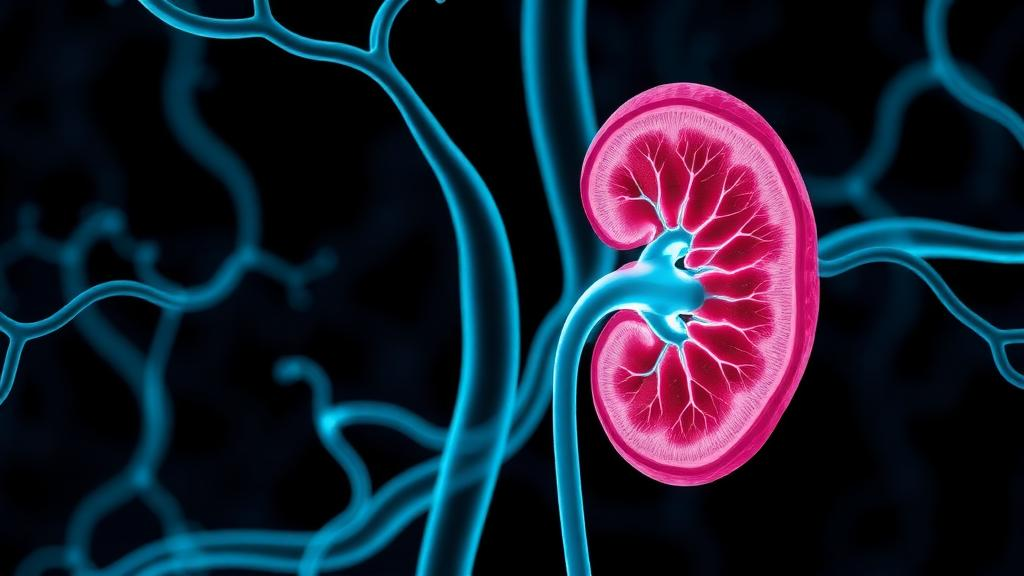
One of the most feared complications of diabetes is the slow, silent destruction of the kidneys’ microscopic filters. Now researchers report that they have traced this destruction to a surprisingly direct molecular handshake: a fat molecule latching onto a calcium channel that had never before been linked to kidney biology. The discovery, published in the Journal of Advanced Research, identifies a protein called Aebp1 as an upstream driver of the cascade and points to a simple urine test that could flag patients at high risk of losing kidney function.
Diabetic kidney disease is the leading cause of end-stage kidney disease worldwide, and even with modern therapies, many patients continue to progress toward dialysis. At the heart of the damage sit podocytes, specialized cells whose interlocking foot processes form the final barrier that stops proteins from leaking into the urine. When podocytes are injured and lost, proteinuria and glomerulosclerosis follow, and the process is largely irreversible. Two pathways have long been implicated: the toxic accumulation of the lipid ceramide in glomeruli, and the loss of calcium homeostasis that shatters the podocyte’s delicate cytoskeleton. What was missing was the physical link between the two, the precise molecular event that turns fat overload into a calcium catastrophe.
To find it, the team, led by Aiping Duan and Hao Bao of Jinling Hospital and Nanjing University, performed an integrated analysis of gene and protein expression data from diabetic glomeruli, drawing on public datasets including GSE142025, GSE236426 and GSE96804. Using elastic net regression, bootstrap resampling, cross-validation and permutation testing to separate genuine disease hubs from statistical noise, they ranked candidate genes and focused on Adipocyte Enhancer-Binding Protein 1, or Aebp1. Its expression rose steadily as kidney function declined, and immunofluorescence staining of human biopsy tissue confirmed that the protein accumulated prominently in injured podocytes, a pattern mirrored in a mouse model of diabetes induced by streptozotocin and a high-fat diet.
The researchers then asked whether Aebp1 was merely a bystander or an active culprit. Injecting an Aebp1-overexpressing adenovirus into the renal cortex of healthy mice was enough to trigger proteinuria, glomerulosclerosis and the characteristic flattening of podocyte foot processes seen under the electron microscope. Conversely, mice engineered to lack Aebp1 specifically in podocytes were substantially protected: after induction of diabetes, they showed less protein leakage, less scarring and better-preserved filtration architecture. The same protective effect appeared in a second model, adriamycin-induced nephropathy, suggesting that the pathway is not unique to diabetes but may operate across proteinuric kidney diseases, including focal segmental glomerulosclerosis.
The mechanistic trail began with lipidomics. When the team forced Aebp1 expression in cultured mouse podocytes, digital RNA sequencing showed more than three thousand genes changing, with the altered genes heavily enriched in cytoskeletal pathways. Untargeted lipidomics revealed 213 differentially abundant lipids, and among them ceramides and sphingomyelins topped the list. Treating podocytes with C16-ceramide alone reproduced the cytoskeletal collapse, while genetic knockout of Aebp1 in diabetic mice blunted ceramide accumulation in their podocytes. The lipid was not just a correlate; it was sufficient to cause the damage pattern.
How does Aebp1 raise ceramide in the first place? The answer ran through inflammation. Aebp1 overexpression degraded the inhibitory protein IkB-alpha and drove phosphorylated NF-kB p65 into the nucleus, and luciferase reporter assays confirmed that NF-kB binds directly to the promoter of Neu3, a gene encoding a sialidase enzyme central to the ceramide salvage pathway. Blocking NF-kB with the inhibitor BAY 11-7082 suppressed both the Neu3 surge and the ceramide buildup. The chain of command, from Aebp1 through NF-kB to Neu3 to ceramide, held up in diabetic mouse kidneys as well as in culture dishes.
The study’s boldest claim concerned what ceramide does next. Screening calcium channel genes, the researchers found that Trpc6 and Calhm2 both rose after ceramide treatment, but Calhm2, a channel previously studied in the brain and never implicated in kidney physiology, responded most dramatically. Overexpressing Calhm2 raised intracellular calcium and disrupted the cytoskeleton; silencing it blunted the response. Crucially, ceramide did more than increase the channel’s abundance. Within fifteen minutes, ceramide triggered a dose-dependent calcium surge in podocytes, amplified by Calhm2 overexpression and abolished by Calhm2 knockdown, indicating direct activation of the channel by the lipid.
Structural evidence sealed the argument. Molecular docking simulations using the cryo-EM structure of human Calhm2 predicted a hydrogen bond between ceramide and the glutamine residue at position 232 of the channel. Surface plasmon resonance then measured a binding affinity of 1.225 micromolar, a strength consistent with a genuine regulatory interaction. In effect, the researchers had caught a lipotoxic metabolite in the act of opening a gate: ceramide binds Calhm2, calcium floods in, and the podocyte’s actin scaffolding comes apart. This lipid-gated mechanism differs from the mechanical and receptor-mediated activation described for Trpc6 and Piezo1, broadening the framework of how calcium dysregulation injures the kidney filter.
The translational payoff came from urine. Analyzing samples from 55 patients with biopsy-proven diabetic kidney disease and 20 healthy controls, the team found that urinary Aebp1 mRNA levels clearly separated patients from controls, achieving an area under the receiver operating characteristic curve of 0.924, which held up under cross-validation at 0.850. More importantly, urinary Aebp1 correlated with 24-hour proteinuria and independently predicted the severity of glomerulosclerosis on biopsy: after adjusting for tubular fibrosis, age and gender, each unit increase in log-transformed expression corresponded to roughly a four-unit rise in the proportion of scarred glomeruli, explaining about 21 percent of the remaining variance.
The biomarker also looked forward. Over a follow-up extending to 55 months, patients with high baseline urinary Aebp1 faced a significantly higher cumulative incidence of the study’s renal endpoint, a 30 percent or greater decline in estimated glomerular filtration rate. Restricted mean survival time analysis showed high-expression patients losing about 7.4 months of event-free time over 42 months, and penalized multivariable logistic regression yielded an adjusted odds ratio of 4.31 for kidney function decline after accounting for baseline eGFR. The authors caution that the cohort is modest and that upstream triggers of Aebp1, the roles of other ceramide chain lengths, and definitive in vivo tests of Neu3 and Calhm2 remain open questions. But the core message is striking: a fat molecule, a previously obscure calcium channel, and a measurable urinary signal now form a single, testable pathway, one that repositions lipids as active signaling molecules and offers clinicians a noninvasive window into the health of the kidney’s most vulnerable cells.
Subject of Research: The role of Aebp1, ceramide and the Calhm2 calcium channel in podocyte injury in diabetic kidney disease
Article Title: Aebp1 drives a ceramide-gated Calhm2 calcium influx that injures podocytes in diabetic kidney disease
Article References: Duan, A., Jiang, Y., Wang, X., Chen, Z., Dong, P., Guo, Z., Qin, W., & Bao, H. (2026). Aebp1 drives a ceramide-gated Calhm2 calcium influx that injures podocytes in diabetic kidney disease. Journal of Advanced Research. https://doi.org/10.1016/j.jare.2026.10.017
Image Credits: AI Generated
DOI: Not provided
Keywords: diabetic kidney disease, podocytes, Aebp1, ceramide, Calhm2, calcium signaling, NF-kB, Neu3, glomerulosclerosis, urinary biomarker, lipotoxicity, focal segmental glomerulosclerosis
Cite Scienmag News
Jerry Hayes. (October 10, 2026). Scientists Discover a Lipid-Gated Calcium Channel That Drives Diabetic Kidney Damage. Scienmag. https://scienmag.com/scientists-discover-a-lipid-gated-calcium-channel-that-drives-diabetic-kidney-damage/
Jerry Hayes. "Scientists Discover a Lipid-Gated Calcium Channel That Drives Diabetic Kidney Damage." Scienmag, 10 October 2026, https://scienmag.com/scientists-discover-a-lipid-gated-calcium-channel-that-drives-diabetic-kidney-damage/. Accessed 10 October 2026.
Jerry Hayes. "Scientists Discover a Lipid-Gated Calcium Channel That Drives Diabetic Kidney Damage." Scienmag. October 10, 2026. https://scienmag.com/scientists-discover-a-lipid-gated-calcium-channel-that-drives-diabetic-kidney-damage/


