


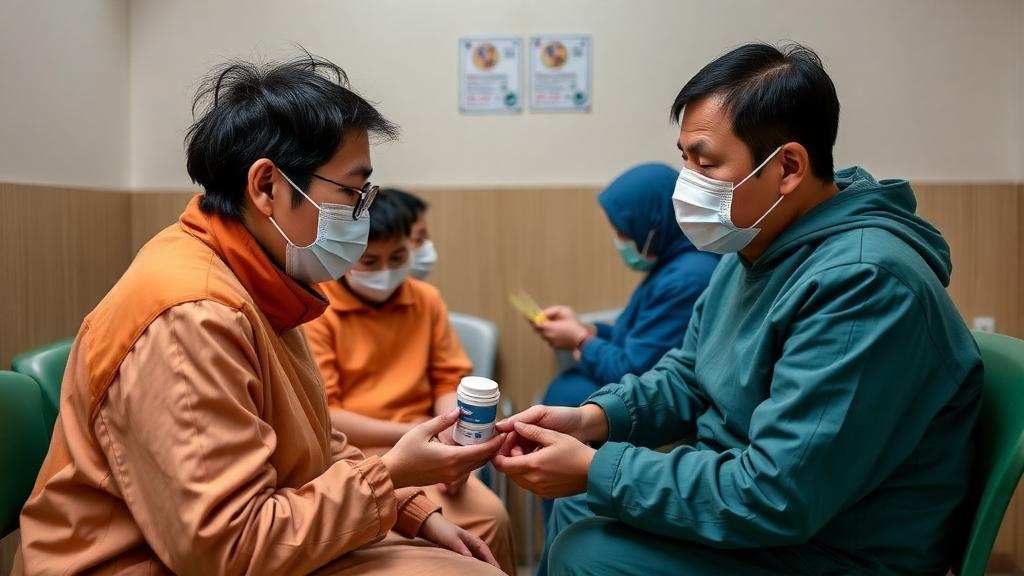
Brucellosis, a bacterial infection passed from livestock to humans through unpasteurized dairy or direct contact with infected animals, remains one of the most persistent zoonotic diseases in China. Although effective antibiotic regimens exist, the drugs must be taken for weeks at home, far from the direct supervision of clinicians. A new multi-center study published in PLOS Neglected Tropical Diseases has now quantified just how difficult that home stretch proves to be, finding that nearly half of patients fail to take their medication as prescribed and that adherence deteriorates the longer treatment continues.
The research team, led by Qiaoshan Lu and colleagues, enrolled 820 brucellosis patients across six prefectures spanning several provinces and autonomous regions, including Inner Mongolia, Xinjiang, and Shandong. Recruitment and follow-up ran from December 2019 to August 2021, a window that required the investigators to navigate the logistical disruptions of the COVID-19 pandemic while tracking patients through the early and middle phases of their antibiotic courses. Demographic details and clinical information were gathered through structured questionnaires and medical records, creating one of the most systematic datasets yet assembled on treatment behavior among Chinese brucellosis patients.
To measure adherence objectively, the team used the Chinese version of the Morisky eight-item Medication Adherence Scale, a validated questionnaire widely applied in chronic disease research. Patients completed the assessment at two critical time points: six weeks and twelve weeks into therapy. This design allowed the researchers to capture not just a snapshot of behavior but a trajectory, revealing whether patients sustained their regimen or drifted away from it as symptoms faded and the inconvenience of daily dosing accumulated.
The results were sobering. At the six-week follow-up, 801 patients remained in the study, with a mean age of about 49 years, and 53.18 percent achieved optimal adherence scores, with a median score of 8 on the eight-point scale. By twelve weeks, only 426 patients completed follow-up, and the proportion with optimal adherence had fallen to 41.31 percent, with the median score dropping to 7. The decline was statistically significant, indicating that adherence erodes measurably as treatment lengthens. In practical terms, this means that by the third month of therapy, fewer than half of the patients who stayed in care were taking their drugs exactly as directed.
The study also uncovered a striking geographic gradient. Compared with patients in Inner Mongolia, those in Xinjiang were more than twice as likely to be optimally adherent, with an odds ratio of 2.14, while patients in Shandong showed even stronger adherence, with an odds ratio of 2.94. These regional differences, significant at conventional thresholds, suggest that local health system capacity, cultural attitudes toward medication, livestock-keeping practices, and the organization of follow-up care all shape whether patients complete their courses. A one-size-fits-all national adherence strategy, the findings imply, would miss the mark in important ways.
Beyond geography, three individual-level determinants stood out in the multilevel logistic regression models. Social support emerged as a protective factor: each incremental increase on the support measure raised the odds of optimal adherence by roughly six percent. Patients embedded in supportive families and communities appear better equipped to sustain the discipline that weeks of daily dosing demand. Conversely, patients who had experienced a previous episode of brucellosis were significantly less likely to adhere well, with an odds ratio of 0.42, a counterintuitive finding that may reflect familiarity breeding complacency or frustration with repeated illness.
Perhaps the most clinically intriguing determinant involved concomitant use of hepatoprotective medications, drugs prescribed alongside antibiotics to shield the liver from drug toxicity. Patients taking these additional medications had markedly lower odds of optimal adherence, with an odds ratio of 0.39. The authors suggest this association may signal a broader pattern of polypharmacy burden: the more pills a regimen contains, the harder it becomes to sustain, and patients burdened by side effects or complex schedules may simplify their behavior by skipping doses. The finding underscores a tension in brucellosis management, where protective co-medication intended to improve tolerability may paradoxically undermine the core goal of completing the antibiotic course.
Quality of life added another dimension to the picture. Adherence scores correlated positively with quality of life measurements at both follow-up points, with correlation coefficients of 0.28 at six weeks and 0.21 at twelve weeks, both statistically significant. While the study design cannot fully disentangle whether feeling better drives patients to take their drugs or whether consistent dosing makes patients feel better, the bidirectional plausibility is strong. Patients burdened by fatigue, joint pain, and the other debilitating symptoms of chronic brucellosis may lack the energy and organization to maintain complex regimens, creating a vicious cycle in which poor adherence prolongs illness and prolonged illness further erodes adherence.
The public health stakes of these findings are considerable. Brucellosis is notorious for relapse and chronicity when treatment is incomplete, and China has faced recurring outbreaks linked to its large sheep, goat, and cattle industries, particularly in northern pastoral regions. Every patient who abandons therapy early represents a potential reservoir of persistent infection, prolonged suffering, and continued healthcare utilization. The study’s conclusion that tailored interventions are urgently needed is therefore not a routine academic caveat but a call grounded in the specific weaknesses the data reveal: adherence declines over time, varies sharply by region, and falters among patients with prior infections and heavy medication burdens.
The authors point to concrete strategies. Strengthening social support structures, whether through family engagement, community health workers, or peer networks, offers a low-cost lever with measurable effect. Patients with a history of previous brucellosis episodes should be prioritized for tailored education rather than assumed to know the ropes. And clinicians should scrutinize co-prescriptions, ensuring that hepatoprotective and other adjunctive drugs are used only when genuinely indicated, so that the essential antibiotic regimen remains as simple and sustainable as possible. As brucellosis continues to circulate in China’s livestock-human interface, this study provides one of the clearest roadmaps yet for closing the gap between effective drugs and effective treatment.
Subject of Research: Medication adherence and its determinants among brucellosis patients in China
Article Title: Medication adherence and its determinants among Brucellosis patients in China: A multi-center follow-up study
Article References: Lu, Q., Qin, H., Zhou, S., Li, S., Chen, J., Chen, Q., & Tang, X. (2026). Medication adherence and its determinants among Brucellosis patients in China: A multi-center follow-up study. PLOS Neglected Tropical Diseases, 20(10), e0014741. https://doi.org/10.1371/journal.pntd.0014741
Image Credits: AI Generated
DOI: 10.1371/journal.pntd.0014741
Keywords: brucellosis, medication adherence, China, zoonotic disease, antibiotic treatment, Morisky scale, social support, public health, patient follow-up, relapse prevention, multilevel regression, quality of life
Cite Scienmag News
Kristina Jarvis. (October 10, 2026). Half of Brucellosis Patients in China Struggle to Finish Their Antibiotics. Scienmag. https://scienmag.com/half-of-brucellosis-patients-in-china-struggle-to-finish-their-antibiotics/
Kristina Jarvis. "Half of Brucellosis Patients in China Struggle to Finish Their Antibiotics." Scienmag, 10 October 2026, https://scienmag.com/half-of-brucellosis-patients-in-china-struggle-to-finish-their-antibiotics/. Accessed 10 October 2026.
Kristina Jarvis. "Half of Brucellosis Patients in China Struggle to Finish Their Antibiotics." Scienmag. October 10, 2026. https://scienmag.com/half-of-brucellosis-patients-in-china-struggle-to-finish-their-antibiotics/


