


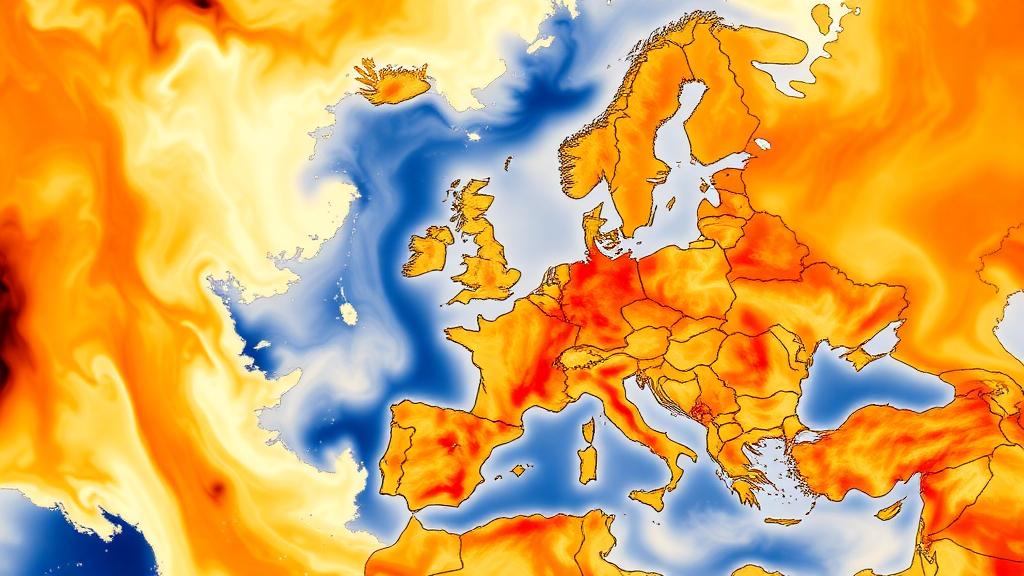
Heatwaves have become one of the defining hazards of a warming Europe, from the deadly 2003 summer that gripped the continent to the record-shattering events of recent years. Yet most studies still define these disasters using a single number: the surface temperature. A new study published in Earth System Dynamics takes a fundamentally different approach, applying an unsupervised machine learning model to decades of atmospheric data to reveal, in unprecedented detail, the full multivariate fingerprints of Western European heatwaves. The results suggest that the atmospheric anatomy of these events is not merely intensifying under global warming but structurally changing, in some seasons in ways that cannot be explained by rising temperatures alone.
The research, led by Aytaç Paçal of the German Aerospace Center (DLR) together with colleagues at the University of Bremen, Universidad Carlos III de Madrid, the Universitat de València, and DLR, centers on a Variational Autoencoder, or VAE. This type of neural network, first developed as a generative model, works by compressing enormous, high-dimensional inputs into a much smaller latent space and then reconstructing the original data from that compressed code. In this case, the inputs were not photographs but spatiotemporal snapshots of the atmosphere: nine climate variables, including temperature, humidity, wind components, mean sea level pressure, geopotential height at 500 hPa, cloud cover, stream function, and surface solar radiation, tracked over eleven-day windows across the North Atlantic and Europe.
To build those inputs, the team started with the ERA5 reanalysis dataset, a continuous reconstruction of global weather stretching back to 1940. Heatwave onsets were identified over Western European land areas by comparing daily maximum 2-meter temperatures against local 90th percentile thresholds, calculated for each calendar day using a fifteen-day moving window from the 1941 to 1980 baseline. A density-based clustering algorithm, GDBSCAN, then stitched spatially and temporally contiguous hot grid cells into discrete events, yielding 2,565 unique heatwave onset dates between 1941 and 2022. Each onset was wrapped in a window spanning five days before and five days after, so the model could learn not just what a heatwave looks like at its peak, but how the atmosphere builds toward it and breaks down afterward.
The VAE was deliberately trained on the historical period from 1941 to 1990, then evaluated on recent events from 2001 to 2022. This historical-to-recent split creates what the authors call an out-of-distribution setting: a test in which the model must represent climate conditions that differ from anything it learned. The architecture relied on three-dimensional convolutions, which process space and time simultaneously, proving more stable than hybrid designs combining two-dimensional convolutions with LSTM layers. The model achieved reconstruction skill, measured by R-squared scores of roughly 0.72 to 0.76 across training, validation, and test sets, with the strongest performance for the large-scale circulation fields such as geopotential height and sea level pressure, and lower skill for the noisier near-surface winds.
When the researchers encoded recent heatwaves into the latent space and visualized the results, a striking pattern emerged. Events from 2001 to 2022 occupied a ring-like structure with fewer samples at the center and a pronounced accumulation toward one side of the space, regions largely untouched by the historical training events. Statistical tests quantified the drift: using Mahalanobis distance to measure how far the recent distribution had moved, summer samples shifted by D equal to 2.00, with about 83 percent of that signal attributable to thermodynamic warming. When the linear warming trend was removed from the data, statistically significant shifts persisted across all four seasons, and winter emerged as the season with the largest remaining dynamical displacement, at D equal to 1.40. In other words, beyond simple mean warming, the multivariate atmospheric structure of heatwaves itself appears to be evolving.
Clustering the latent space with a Gaussian Mixture Model revealed that four components best describe the test-period heatwaves, and each cluster mapped onto a distinct physical regime. One cluster captured winter warm spells, driven by persistent anticyclonic blocking centered over the British Isles and Western Europe, with suppressed cloud cover, warm advection from the Atlantic, and a structure resembling the omega-block configurations known from the literature. A second, dominant summer cluster showed the classic signature of intense European heat: strong positive temperature, humidity, and geopotential height anomalies, a deep North Atlantic trough feeding a ridge over Europe, and near-stagnant winds under cloud-free skies. Two further clusters both captured transition-season events in spring and autumn, yet displayed nearly opposite anomaly patterns, one ruled by Greenland blocking and enhanced solar radiation, the other by stronger pressure anomalies and warm-air advection.
A crucial validation step came from testing the model against some of the most infamous heatwaves on record. The team located the 2003 Western European event, the 2010 Russian heatwave, and the 2018 Scandinavian heatwave within the learned latent space and constructed composite anomaly maps from each event’s ten nearest neighbors. The resulting 500 hPa geopotential height anomalies reproduced the well-documented circulation signatures of these benchmark events: a ridge over central Europe in 2003, strong positive height anomalies over western Russia in 2010, and Scandinavian height anomalies in 2018. The fact that an unsupervised model, trained without any labels or human guidance, independently organized these events in a physically consistent way underscores the promise of the method.
The findings carry weight because heatwaves are intensifying faster in Western Europe than climate models have generally projected, with recent studies showing that unprecedented extreme heat has grown roughly tenfold and that economic losses from events like those of 2003, 2010, 2015, and 2018 reached 0.3 to 0.5 percent of European gross domestic product. By capturing the interplay between circulation, humidity, radiation, and temperature, the VAE approach offers a window into why: enhanced land-atmosphere feedbacks, moisture limitations, and shifting circulation regimes can amplify and restructure heat extremes beyond what a thermodynamic trend alone would predict. The authors caution, however, that linear detrending cannot fully separate forced changes from natural variability, and that the identified clusters depend on the chosen variables, thresholds, and model hyperparameters.
The team also probed an open question with direct forecasting implications: do the pre-onset circulation patterns identified by the model appear during quiet periods that never produce a heatwave? A preliminary comparison against ordinary summer days from 2015 to 2021 found no clear predictive signal, suggesting these large-scale configurations can occur without always triggering extreme heat. Future work, the researchers suggest, could add soil moisture, vegetation indices, or apply the same framework to CMIP6 climate simulations to see how well models capture historical heatwave patterns and where their biases lie.
What makes this study resonate far beyond the technical community is its central message: heatwaves are not simply hotter versions of the past, but events whose underlying atmospheric machinery is shifting. By letting a machine discover those shifts without labels, thresholds, or preconceived categories, the researchers have produced a data-driven atlas of heatwave regimes that aligns with established meteorology yet reveals changes invisible to traditional single-variable methods. As Europe braces for hotter summers, warmer winters, and increasingly erratic shoulder-season extremes, tools like this VAE may become essential for detecting when the atmosphere’s playbook has changed, and for building the climate risk assessments on which adaptation strategies depend.
Subject of Research: Multivariate atmospheric drivers of Western European heatwaves analyzed with unsupervised machine learning
Article Title: A multivariate analysis of atmospheric drivers for Western European heatwaves
Article References: Paçal, A., Hassler, B., Weigel, K., Fernández-Torres, M.-Á., Camps-Valls, G., & Eyring, V. (2026). A multivariate analysis of atmospheric drivers for Western European heatwaves. Earth System Dynamics, 17(4), 955-986. https://doi.org/10.5194/esd-17-955-2026
Image Credits: AI Generated
Keywords: heatwaves, Western Europe, Variational Autoencoder, machine learning, ERA5, atmospheric blocking, climate extremes, geopotential height, latent space, Earth System Dynamics, unsupervised learning, climate change
Cite Scienmag News
Russell Cooper. (October 10, 2026). AI Reveals Heatwaves Across Europe Are Entering Uncharted Atmospheric Territory. Scienmag. https://scienmag.com/ai-reveals-heatwaves-across-europe-are-entering-uncharted-atmospheric-territory/
Russell Cooper. "AI Reveals Heatwaves Across Europe Are Entering Uncharted Atmospheric Territory." Scienmag, 10 October 2026, https://scienmag.com/ai-reveals-heatwaves-across-europe-are-entering-uncharted-atmospheric-territory/. Accessed 10 October 2026.
Russell Cooper. "AI Reveals Heatwaves Across Europe Are Entering Uncharted Atmospheric Territory." Scienmag. October 10, 2026. https://scienmag.com/ai-reveals-heatwaves-across-europe-are-entering-uncharted-atmospheric-territory/


