


Biology has a scale problem. A single living cell is simultaneously a network of chemical reactions unfolding in microseconds, a physical object deforming and dividing over minutes, and a member of a population competing and cooperating across hours and days. No single equation, and no single simulation, can capture all of that at once. For decades, computational biologists have responded by building specialized models of isolated mechanisms: a metabolic network here, a growth model there, a diffusion simulation somewhere else. The trouble is that these models rarely talk to each other, and when researchers try to stitch them together, the seams show. A new framework published in PLOS Computational Biology by Eran Agmon and Ryan K. Spangler proposes a systematic answer to that stitching problem, and it may reshape how the field builds its biggest models.
The framework, called Process Bigraph, addresses a deceptively simple question: when two independently developed models of biological processes are combined, what exactly needs to be specified for the combination to work? The authors point out that existing tools typically focus on the numerical machinery for a particular mechanism while leaving the plumbing undefined. Which variables does each submodel read, and which does it write? How are units and representations translated between models that were never designed to share data? When does each submodel get to run, and how are its updates synchronized with the others? In most current practice, these questions are answered implicitly, buried in custom code, or not answered at all. Process Bigraph makes them explicit, turning the architecture of a multiscale model into a formal, shareable specification.
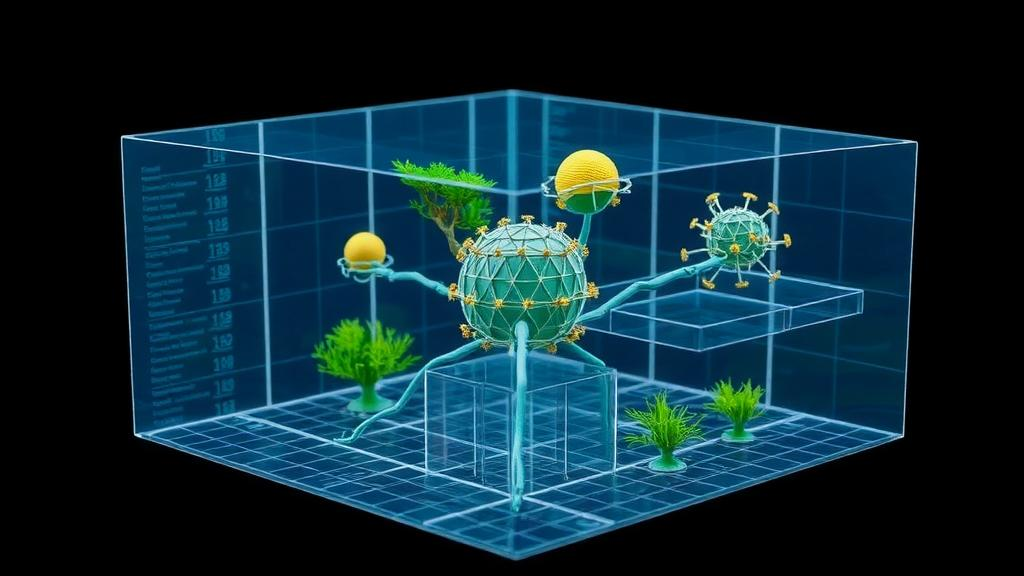
The mathematical foundation comes from bigraphs, a structure that generalizes ordinary graphs by allowing nodes to sit inside other nodes. Where a standard graph can express relationships, such as a molecule binding to another molecule, a bigraph can also express containment and hierarchy, such as a protein embedded in a membrane that surrounds a cell that lives within a colony. That nesting ability is exactly what biology demands. Cells contain compartments, compartments contain molecular species, tissues contain cells, and ecosystems contain populations of organisms. By representing both the relationships among entities and their physical or organizational containment in one structure, bigraphs provide a common language for describing biological systems at any scale.
On top of that structure, Process Bigraph adds the concept of a process: a modular unit with a declared interface that specifies what it reads from the shared state, what it writes back, and how its updates are orchestrated in time. A process might be a set of kinetic reaction equations, a dynamic flux balance analysis solver, or a spatial diffusion routine. Crucially, the framework does not care what numerical method a process uses internally; it only cares about the boundary, the contract between the process and the rest of the simulation. This separation of interface from implementation is what makes composition possible. Two processes written by different teams, using different languages or solvers, can be combined as long as their interfaces are compatible and the necessary variable translations are specified.
The new work generalizes architectural ideas that the authors previously developed in the Vivarium software, an open-source platform for building multiscale biological simulations. Rather than leaving those ideas embedded in one codebase, Process Bigraph distills them into a shared specification covering process interfaces, hierarchical data structures, composition patterns, and orchestration patterns. The paper lays out how the framework is organized and why it makes biological models easier to understand, reuse, and extend, while a supplementary text provides the full formal specification for those who want the mathematical details. The practical payoff arrives as Vivarium 2.0, an open-source implementation of the framework released as a suite of three libraries.
The first library, bigraph-schema, handles the data side. It lets researchers define and operate on data types within a hierarchical, JSON-based format, so that the nested structure of a biological system, molecules inside compartments inside cells inside populations, can be declared once and manipulated consistently. The second, process-bigraph, handles the dynamics: it provides the machinery for defining process interfaces, assembling them into composite simulations, and executing those simulations with proper coordination of reads, writes, and timing. The third, viva-superpowers, points toward the future, offering AI-assisted construction and composition of process bigraphs, so that assembling a large model becomes less an act of bespoke engineering and more a guided, semi-automated process. All of the software is openly available through the Vivarium Collective on GitHub.
To demonstrate that the framework is more than an elegant abstraction, the authors built Spatio-Flux, a standalone library of microbial ecosystem simulations that serves as a reference application. Spatio-Flux combines three very different kinds of modeling under one roof: classical kinetic equations describing chemical reactions, dynamic flux balance analysis capturing the metabolic strategies of microbial cells, and spatial processes governing how molecules and organisms move and distribute themselves in space. In conventional practice, integrating even two of these approaches would demand substantial custom glue code. Within Process Bigraph, each becomes a process with a declared interface, and the framework handles the coordination.
The results of those combined simulations are the most vivid evidence for the framework’s value. When kinetic chemistry, metabolism, and spatial dynamics run together in a shared hierarchical state, the simulations produce emergent spatially organized population dynamics: patterns of microbial growth and arrangement that arise from the interactions of the component processes rather than from any single model. Emergence of this kind is the holy grail of multiscale biology, because it means the whole simulation exhibits behavior that none of its parts was designed to produce. It is also precisely the kind of behavior that real microbial ecosystems display, from biofilm architecture to cross-feeding consortia, and it is the kind of behavior that isolated single-scale models systematically miss.
Beyond the immediate technical contribution, the authors argue that the framework carries implications for emerging multiscale modeling standards in biology. As the field moves toward large, community-driven efforts, such as whole-cell models that aim to simulate every molecular event in an organism’s life cycle, the bottleneck is shifting from solving individual equations to integrating hundreds of submodels contributed by many groups. A standard way to declare what a submodel reads and writes, how its data map onto a shared representation, and how its execution is scheduled, would let contributions interoperate the way software packages do in mature engineering disciplines. Process Bigraph offers a candidate for that standard, one grounded in a formal structure rather than ad hoc conventions.
There is also a broader lesson in the approach, one that resonates well beyond computational biology. The hardest problems in science increasingly live at the interfaces between models, methods, and disciplines, and progress depends on making those interfaces explicit and composable. By treating the architecture of a simulation as a first-class object of study, with its own formal specification and its own open-source implementation, Agmon and Spangler have turned the unglamorous work of model plumbing into a science in its own right. If the vision holds, the next generation of biological models may be assembled less like cathedrals, built once by a single devoted team, and more like living ecosystems themselves: modular, hierarchical, and constantly growing from parts that were each designed to fit together.
Subject of Research: A compositional framework for building and simulating multiscale biological models
Article Title: Process bigraphs and the architecture of compositional systems biology
Article References: Agmon, E., & Spangler, R. K. (2026). Process bigraphs and the architecture of compositional systems biology. PLOS Computational Biology, 22(10), e1014819. https://doi.org/10.1371/journal.pcbi.1014819
Image Credits: AI Generated
DOI: 10.1371/journal.pcbi.1014819
Keywords: process bigraphs, systems biology, multiscale modeling, Vivarium, computational biology, flux balance analysis, microbial ecosystems, model composition, bigraphs, open-source software, spatial simulation, emergent dynamics
Cite Scienmag News
Drew Townsend. (October 10, 2026). A New Blueprint for Building Life-Size Models of Living Systems. Scienmag. https://scienmag.com/a-new-blueprint-for-building-life-size-models-of-living-systems/
Drew Townsend. "A New Blueprint for Building Life-Size Models of Living Systems." Scienmag, 10 October 2026, https://scienmag.com/a-new-blueprint-for-building-life-size-models-of-living-systems/. Accessed 10 October 2026.
Drew Townsend. "A New Blueprint for Building Life-Size Models of Living Systems." Scienmag. October 10, 2026. https://scienmag.com/a-new-blueprint-for-building-life-size-models-of-living-systems/


