


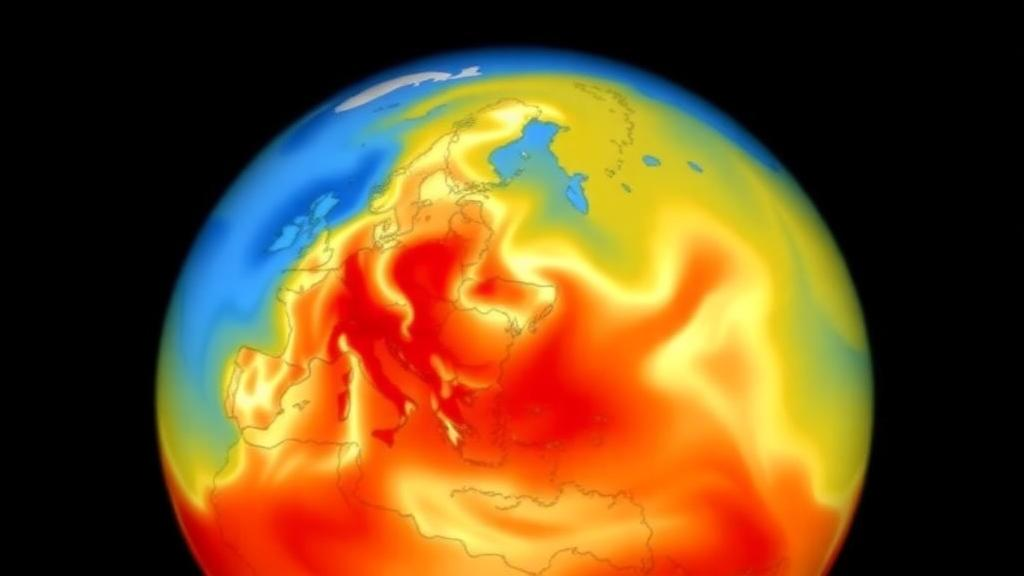
Climate change is often summarized by a single number, the global mean temperature, but the impacts that shape human lives unfold at far finer scales. Mountain villages, coastal cities, and deforested basins all warm at their own pace, shaped by topography, land use, and atmospheric circulation. Producing reliable regional projections of that local warming has long demanded enormous computational resources, because regional climate models must resolve fine physical detail over decades of simulated time. A new study published in Nonlinear Processes in Geophysics introduces a statistical tool that promises to change that calculus dramatically, generating thousands of plausible regional climate futures in a fraction of the time a single dynamical simulation requires.
The tool, called MESMER-RCM, was developed by Hao Pan of ETH Zurich and the University of Hong Kong, together with Lukas Gudmundsson, Mathias Hauser, Jonas Schwaab, Yann Quilcaille, and Sonia I. Seneviratne. It belongs to a family of techniques known as climate emulators: statistical models trained on the outputs of full physical simulations so they can reproduce those outputs cheaply. Where most existing emulators of regional climate models produce a single deterministic answer, MESMER-RCM is probabilistic. It does not merely predict how a region will warm on average; it generates whole ensembles of synthetic but physically plausible regional temperature fields, each one a different realization of the same underlying climate statistics.
The distinction matters because of a phenomenon climate scientists call internal variability. Even if greenhouse gas concentrations followed a perfectly known pathway, natural fluctuations within the climate system would cause regional temperatures to wander around the forced trend from year to year and decade to decade. Capturing that randomness with a regional climate model requires running it many times from slightly different starting conditions, an expensive proposition. Existing emulators typically sidestep the problem by producing only the deterministic forced response, effectively discarding the uncertainty that internal variability introduces. For adaptation planners deciding how high to build a flood defense or how long a heat wave to design for, that discarded uncertainty is precisely the information they need.
MESMER-RCM tackles the problem with a deliberately simple, two-part mathematical structure. The first part is a deterministic response module that maps the temperature of the driving global climate model onto the regional model’s grid. For each regional grid point, the model uses as predictors the two-meter air temperature at the nine nearest global model grid points, arranged in a three-by-three block around the location. A technique called lasso multiple linear regression then learns how strongly each of those global predictors influences the regional point, while an L1 regularization penalty automatically zeroes out irrelevant contributions. The result is a sparse, interpretable set of coefficients that describes how the regional model amplifies or dampens the global warming signal at every location.
The second part is a residual variability module that models everything the deterministic response leaves behind. The team assumes these residuals follow a multivariate Gaussian distribution, meaning the year-to-year wiggles at all 5,929 land grid points in the European domain are described by a single spatial covariance matrix. Estimating such a matrix is notoriously difficult when there are far more grid points than sample years, as is the case here with 129 years of data per simulation. The raw sample covariance matrix is rank-deficient and must be regularized, or shrunk, toward a target. Standard approaches shrink toward a diagonal matrix, which implicitly assumes grid points vary independently, an assumption that is physically wrong for climate, where neighboring regions fluctuate in tandem.
The researchers’ key innovation is a two-stage shrinkage scheme with a data-driven prior. Instead of shrinking toward an uninformative diagonal target, they first build a prior covariance matrix from the residuals of all the regional model simulations not used in a given training or testing experiment. Because this prior pools many simulations, it is nearly full rank and encodes genuine knowledge about how temperature variability is correlated across Europe. That prior is itself shrunk toward a diagonal matrix of sample variances, reflecting the statistical wisdom that variances are estimated more reliably than covariances. Two tuning parameters, alpha and beta, control the blend, and they are calibrated by maximizing the Gaussian log-likelihood with cross-validation. The scheme yields a covariance estimate with a favorable bias-variance trade-off: it adds little bias while substantially reducing estimation error.
To test the framework, the team used the EURO-CORDEX-CMIP5 experiment, which pairs regional models at 0.44-degree resolution with their driving global models regridded to 2.5 degrees. The dataset contains 42 simulations from five regional and nine global models under the RCP2.6, RCP4.5, and RCP8.5 scenario pathways, covering 1971 to 2099. The authors designed exhaustive training-testing permutations: for each model chain, they trained on one simulation pair and tested on the others, which might differ in scenario or initial conditions. This is a demanding test, because an emulator that merely memorized its training data would fail when confronted with a warming trajectory it had never seen.
The evaluation relied on two complementary metrics. The first was the rank histogram, a standard tool from ensemble forecast verification. If an ensemble is statistically indistinguishable from reality, the verifying observation should fall among the ensemble members at random, producing a flat histogram; systematic curvature reveals miscalibration in the mean or the spread. For the example chain combining the SMHI-RCA4 regional model with the CanESM2 global model, the rank histogram was flat, and a chi-squared test confirmed reliable spread at roughly 80 percent of grid points. The second metric, the multivariate Gaussian log-likelihood, assesses the full covariance structure and showed that MESMER-RCM outperformed all benchmark methods across every model chain tested.
Those benchmarks reveal why the design choices matter. A simple linear regression using only the nearest global grid point produced blocky temperature fields that retained the coarse texture of the global model, a form of underfitting. Meanwhile, the widely used Ledoit-Wolf covariance estimator, which shrinks aggressively toward the identity matrix, generated emulations with a noisy, physically implausible texture because it effectively assumed spatial independence. MESMER-RCM’s physically informed prior avoided both failure modes. The learned scaling coefficients also captured real physics: they were larger in mountainous and high-latitude regions, reflecting elevation-dependent warming and polar amplification, with Alpine grid points warming faster than their global model counterparts to the northwest and southeast, a pattern the authors link to the foehn wind effect.
Sensitivity experiments showed that much of the variation in performance across model chains stemmed not from the method itself but from the uneven distribution of training data. Training the deterministic module on multiple simulation pairs tightened the spread of pass rates dramatically, for example cutting it from plus or minus 20 percent to plus or minus 5 percent for one chain while raising the average by 10 percent. Building the prior from physically consistent residuals lifted pass rates by up to 30 percent for some chains. Looking ahead, the team plans to couple MESMER-RCM with the global-scale MESMER emulator, creating a full chain that turns arbitrary global mean temperature inputs into spatially resolved regional ensembles. Such a framework could enable comprehensive what-if analyses of regional climate responses at negligible computational cost, giving local decision-makers a statistically rigorous picture of the warming futures their communities may face.
Subject of Research: A probabilistic statistical emulator for regional climate model temperature projections over Europe
Article Title: MESMER-RCM: a probabilistic climate emulator for regional warming projections
Article References: Pan, H., Gudmundsson, L., Hauser, M., Schwaab, J., Quilcaille, Y., & Seneviratne, S. I. (2026). MESMER-RCM: a probabilistic climate emulator for regional warming projections. Nonlinear Processes in Geophysics, 33(1), 73-83. https://doi.org/10.5194/npg-33-73-2026
Image Credits: AI Generated
Keywords: climate emulator, regional climate model, MESMER-RCM, internal variability, EURO-CORDEX, downscaling, covariance shrinkage, lasso regression, climate projections, statistical modeling, temperature, uncertainty quantification
Cite Scienmag News
Reid Dalton. (October 10, 2026). New Climate Emulator Delivers Fast, Probabilistic Regional Warming Projections. Scienmag. https://scienmag.com/new-climate-emulator-delivers-fast-probabilistic-regional-warming-projections/
Reid Dalton. "New Climate Emulator Delivers Fast, Probabilistic Regional Warming Projections." Scienmag, 10 October 2026, https://scienmag.com/new-climate-emulator-delivers-fast-probabilistic-regional-warming-projections/. Accessed 10 October 2026.
Reid Dalton. "New Climate Emulator Delivers Fast, Probabilistic Regional Warming Projections." Scienmag. October 10, 2026. https://scienmag.com/new-climate-emulator-delivers-fast-probabilistic-regional-warming-projections/


