


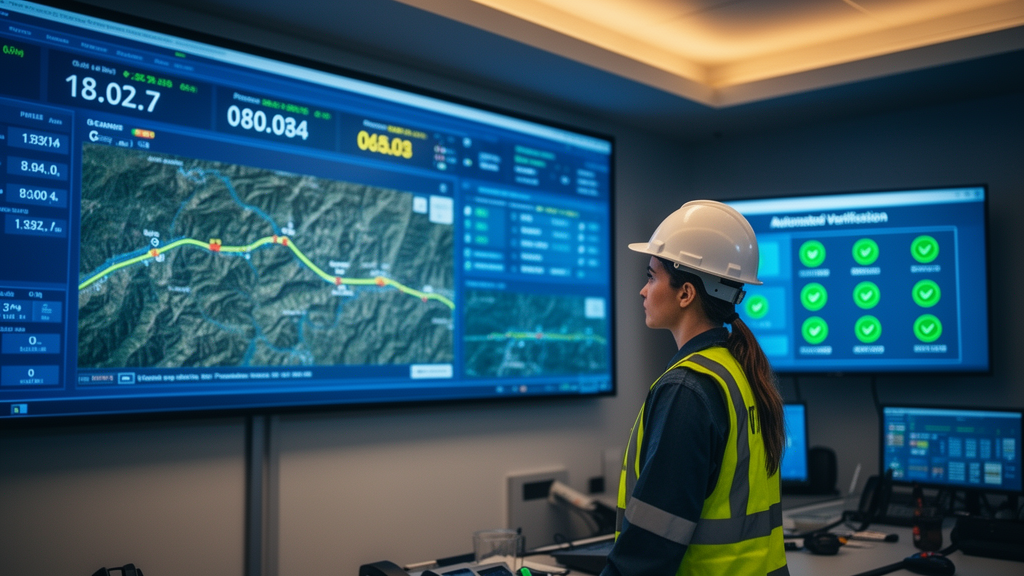
Beneath cities and across deserts, millions of kilometers of pipeline carry the liquid energy that powers modern life: crude oil, refined fuels, and other hydrocarbons flowing continuously through steel arteries that most people never think about until something goes wrong. Keeping those arteries healthy has always depended on human experts who read pressure traces, flow rates, and temperature signals to decide whether a pipeline is operating normally or sliding toward a leak, a blockage, or an equipment failure. Now a research team spanning institutions in China, Italy, and France has unveiled a framework that could fundamentally change how that vigilance is maintained, allowing artificial intelligence not only to recognize pipeline operating conditions but to audit its own judgments for reliability before any human ever looks at them.
The study, published in Communications Engineering, addresses a paradox that has slowed the adoption of AI in safety-critical infrastructure for years. Conventional manual analysis of pipeline conditions, grounded in established operating principles, is highly dependable, but it is also extraordinarily labor-intensive and slow, demanding that skilled engineers sift through streams of hydraulic data day after day. AI-driven monitoring systems promise to relieve that burden by flagging anomalies automatically, yet they carry a different liability: because deep neural networks function largely as black boxes, there has been no systematic way to verify whether their outputs are actually trustworthy. An algorithm that confidently declares a pipeline healthy when it is not could delay maintenance until a safety-critical failure occurs, which is precisely the scenario operators fear most.
The research team, led by Jian Du of the Chinese Academy of Sciences, China University of Petroleum-Beijing, and the Politecnico di Milano, together with colleagues including Enrico Zio of Mines Paris-PSL, set out to close that trust gap. Their solution is an intelligent condition recognition and reliability diagnosis framework designed to enable what they call semi-unattended pipeline monitoring, a mode of operation in which machines handle the routine watching and humans intervene only when the system itself determines that its own conclusions need review. The framework rests on two tightly coupled components: a recognition model whose internal reasoning can be visualized, and a diagnostic model trained to judge whether that reasoning is sound.
The first component tackles interpretability head-on. Rather than accepting the recognition network’s verdicts at face value, the researchers visualized the contributions of individual neurons in the model, extracting what they describe as hydraulic spatiotemporal explanations. In practical terms, the network is forced to reveal which patterns in pressure and flow data, at which moments and locations along the pipeline, drove its classification of the operating condition. This step transforms an opaque statistical judgment into something resembling the evidence trail a human engineer would construct, linking a detected anomaly to specific hydraulic behavior rather than to an unexplainable correlation buried in the weights of a neural network.
But producing explanations is only half the problem, because an explanation can itself be wrong. A neural network might highlight plausible-looking features while still reaching an incorrect conclusion, a phenomenon researchers call non-causal recognition, where the model latches onto patterns that correlate with a condition without genuinely reflecting its physical cause. To catch these failures, the team developed a hybrid diagnostic model built on a two-stage training strategy. The model first undergoes pretraining to acquire a general understanding of what valid hydraulic reasoning looks like, and is then refined through a condition-prompted contrastive fine-tuning process, which sharpens its ability to distinguish explanations that genuinely support a diagnosis from those that merely mimic one.
The result is a system capable of autonomous discrimination of explanations and reliability diagnosis of recognitions. When the recognition model classifies a pipeline condition, the diagnostic model examines the fully observable inference logic behind that classification and determines whether it is consistent with established pipeline operational knowledge. Judgments that rest on reasoning inconsistent with hydraulic principles, whether because the network misrecognized the condition or because it relied on non-causal features, are flagged and rectified automatically. In effect, the framework builds a second, independent intelligence whose sole job is to police the first, ensuring that only conclusions passing an expert-knowledge-based credibility check ever reach the operators who make maintenance decisions.
The significance of this architecture becomes clear when one considers the stakes of pipeline operations. A misrecognized operating condition that goes unchallenged can prevent timely maintenance, allowing a small defect to escalate into a leak or rupture with environmental, economic, and potentially human costs. Traditional AI monitoring offers no safeguard against this failure mode, since there is no mechanism to question the algorithm’s output. By contrast, the new framework explicitly prevents misrecognition from hindering maintenance, creating a layered defense in which errors are caught by the diagnostic layer before they can propagate into operational decisions. The approach effectively gives the AI a form of self-skepticism, an attribute that has been conspicuously absent from deployed industrial machine learning systems.
The study draws on real operational data provided by a branch of PipeChina, the national pipeline operator, grounding the framework in the messy, noisy reality of actual liquid energy transportation rather than idealized laboratory conditions. That connection to practice matters, because the gap between models that perform well on curated datasets and models that survive contact with live industrial telemetry is where many promising AI applications have foundered. The involvement of researchers from PetroChina Planning and Engineering Institute alongside academic groups further signals an intent to bridge that gap, embedding the perspective of pipeline engineers directly into the design of the diagnostic logic.
Beyond its immediate application, the authors argue that their work establishes a broader technical paradigm for deploying AI within pipeline systems. The core insight is that reliability in safety-critical AI does not come from making networks more accurate alone, but from making their reasoning inspectable and then building dedicated mechanisms to validate that reasoning against domain knowledge. This pattern, in which a generative or discriminative model is paired with an autonomous auditor trained on expert principles, could plausibly extend to other energy infrastructure, from power grids to storage facilities, wherever black-box predictions currently meet human skepticism and regulatory caution. The framework thus speaks to one of the central debates in modern engineering: how to reconcile the raw pattern-recognition power of deep learning with the accountability demands of critical infrastructure.
The path toward genuinely semi-unattended pipeline networks is still unfolding, and the researchers are careful to frame their contribution as a step in that direction rather than a finished destination. Human expertise remains embedded in the system at its foundations, in the operational principles used to rectify inconsistent inference logics and in the expert knowledge that shapes the contrastive fine-tuning. What changes is the economics of attention: instead of engineers continuously monitoring every kilometer of line, they are summoned only when the system’s self-diagnosis indicates that a judgment warrants scrutiny. As liquid energy pipeline networks continue to expand and age in parallel, that shift, from exhaustive manual vigilance to intelligent, self-auditing automation, may prove essential to keeping the world’s energy arteries safe, efficient, and quietly reliable.
Subject of Research: Deep learning-based autonomous condition monitoring and reliability diagnosis for liquid energy pipelines
Article Title: Toward semi-unattended operation condition monitoring for liquid energy pipelines: deep learning-enhanced autonomous reliability diagnosis
Article References: Du, J., Li, H., Zheng, J., Wang, B., Liao, Q., Tu, R., Liu, C., Liang, Y., & Zio, E. (2026). Toward semi-unattended operation condition monitoring for liquid energy pipelines: deep learning-enhanced autonomous reliability diagnosis. Communications Engineering. https://doi.org/10.1038/s44172-026-00796-0
Image Credits: AI Generated
DOI: 10.1038/s44172-026-00796-0
Keywords: pipeline monitoring, deep learning, reliability diagnosis, explainable AI, condition recognition, liquid energy pipelines, neural network interpretability, contrastive fine-tuning, hydraulic analysis, predictive maintenance, energy infrastructure, autonomous diagnostics
Cite Scienmag News
Blake Davidson. (October 10, 2026). AI Learns to Check Its Own Work on Pipeline Safety Monitoring. Scienmag. https://scienmag.com/ai-learns-to-check-its-own-work-on-pipeline-safety-monitoring/
Blake Davidson. "AI Learns to Check Its Own Work on Pipeline Safety Monitoring." Scienmag, 10 October 2026, https://scienmag.com/ai-learns-to-check-its-own-work-on-pipeline-safety-monitoring/. Accessed 10 October 2026.
Blake Davidson. "AI Learns to Check Its Own Work on Pipeline Safety Monitoring." Scienmag. October 10, 2026. https://scienmag.com/ai-learns-to-check-its-own-work-on-pipeline-safety-monitoring/


